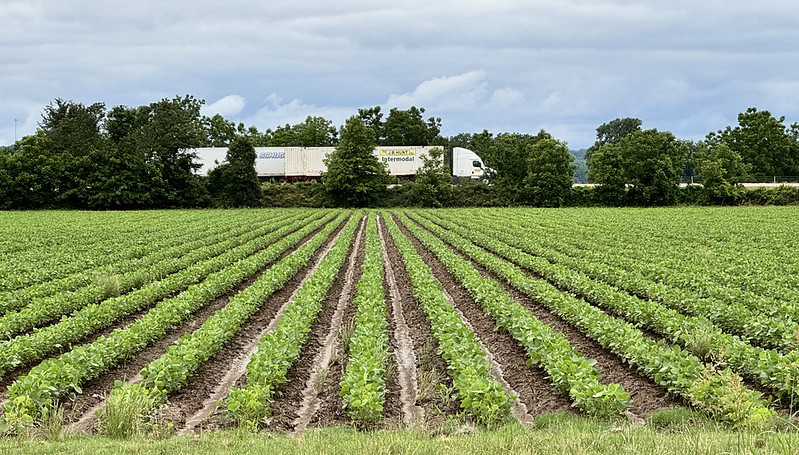
ROOTED AND READY — With nearly 100% of Arkansas soybean acres now planted, growers brace for whatever weather the summer may bring. | Division of Agriculture photo
By RYAN McGEENEY | University of Arkansas Division of Agriculture
Fast Facts
- Arkansas soybean acreage rebounds to 3.1 million acres
- Spring planting went well for most Arkansas soybean farmers
- July, August may present weather challenges
Compared to the tumultuous planting season of 2025, this year’s soybean planting efforts have been relatively smooth sailing. But farmers are bracing for July and August, the months that can make or break a crop with unpredictable weather changes.
Jeremy Ross, extension soybean agronomist for the University of Arkansas Division of Agriculture, said that as the midpoint of June passes, the state’s soybean crop is looking strong.
“Some of the late fields probably need an herbicide application just to get them through the canopy closure,” Ross said. “But overall, the crop looks really good. I’ve talked to farmers, county agents and consultants who are pretty pleased.”
Ross said recurring rain events and generally wet conditions across much of the state have opened a window of opportunity for foliar diseases and fungi, although farmers have been able to stay on top of those threats so far.
“The next biggest thing is irrigation,” Ross said. While rain events have reduced the amount of irrigation necessary thus far, particularly in the northeastern portion of the state, some growers have begun to irrigate their earlier-planted soybean acres.
Ross said that Arkansas soybean farmers are in as good a position as they can be to enter the summer months, when excessive heat, rain or other damaging events can wreak havoc on a crop midway through its growth cycle.
“I don’t know what the rain forecast for July and August will be, and that’s really the time for setting yields,” Ross said. “We haven’t had much insect pressure yet, but it’s probably coming. So, it’s just a matter of scouting fields, and if we do have a problem, making sure we’re there in a timely manner with pesticides to control those issues.”
As large numbers of producers shifted away from corn, cotton, peanuts and rice this year, Arkansas soybean acreage has rebounded to 3.1 million acres, up from a near-historic low 2.59 million acres planted in 2025. Ross said this resurgence is unlikely to lead to storage issues for soybeans, as most on-farm storage is dedicated to rice and corn.
“Very little of the Arkansas soybean crop is stored on farms,” Ross said. “The majority of it gets harvested and sent to an elevator or shipped down the Mississippi River. Where we’ve had issues over the last few years is when the Mississippi River has been so low that they haven’t been able to ship beans from Memphis down to the Gulf.
“As long as the Mississippi River stays high enough to have good transportation, we shouldn’t have any problems,” he said.
To learn about extension programs in Arkansas, contact your local Cooperative Extension Service agent or visit uaex.uada.edu. Follow us on Facebook and Instagram. To learn more about the Division of Agriculture, visit uada.edu. To learn more about ag and food research in Arkansas, visit the Arkansas Agricultural Experiment Station at aaes.uada.edu.
Discover more from
Subscribe to get the latest posts sent to your email.