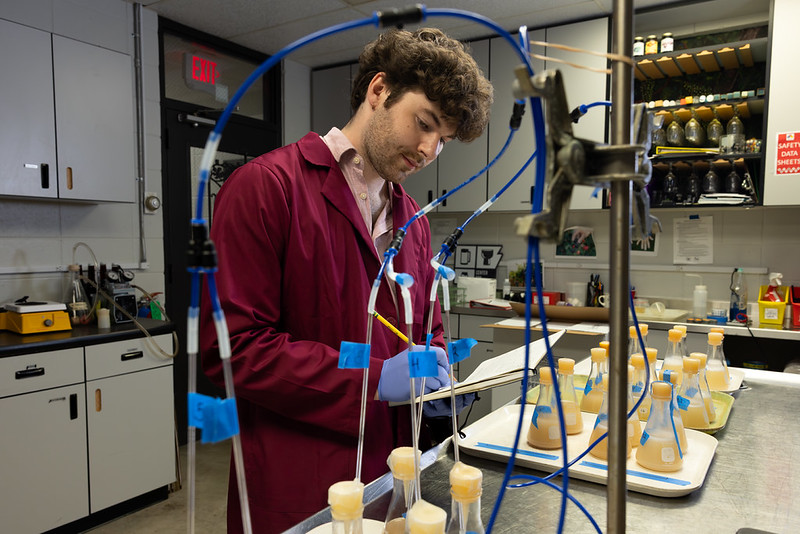
LOWER ABV — Zachary Bean, a master’s student in the department of food science, conducts research on reducing alcohol in wines. He will carry on his research next year at Graz University of Technology with an Austrian Marshall Plan Foundation scholarship. | UADA photo
Fast Facts
- Zachary Bean earns Austrian Marshall Plan Foundation scholarship
- Wine consumers increasingly seek reduced-alcohol wine for health reasons
- Research explores novel yeasts and fermentation-based winemaking methods
By JOHN LOVETT | University of Arkansas Division of Agriculture
As health-conscious consumers continue to seek lower alcohol content in their wine, scientists like Zachary Bean are working on ways to both meet this demand and make it better.
In addition to finding ways to ferment grape juice without producing as much alcohol, Bean’s work also explores novel yeasts and methods to overproduce aromas to compensate for their eventual loss when reducing alcohol through grape juice dilution.
“Most low‑ or non‑alcohol wines are made by removing alcohol after fermentation,” said Bean, a master’s student in the department of food science for the Dale Bumpers College of Agricultural, Food and Life Sciences at the University of Arkansas. “Since many of the aroma and flavor compounds in wine are very delicate, when you use heat or mechanical separation to create low or no alcohol wine, you can lose those volatiles or create cooked or burnt aromas.”
According to research, many wine consumers — particularly among younger generations — are drinking less due to a greater awareness of the risks associated with alcohol consumption and a focus on less calorie consumption. No- and low- alcohol wines have gained popularity, with global consumption of no-alcohol wines increasing by 13 percent per year and low-alcohol wines by 21 percent per year between 2018 and 2023, according to a 2025 Wine Australia market update using International Wine and Spirits statistics.
In January, Bean will attend Graz University of Technology in Austria for four months on an Austrian Marshall Plan Foundation scholarship to continue his research on fermentation-based strategies that reduce alcohol in wines.
As part of his master’s studies over the past year, Bean has worked with Renee Threlfall, an associate professor in enology and viticulture in the department of food science for the Arkansas Agricultural Experiment Station, the University of Arkansas Division of Agriculture, and Bumpers College. Threlfall is co-director of the Center for Beverage Innovation.
“This research on using fermentation strategies to reduce ethanol is novel, especially in the impact of quality of our Vitis hybrid wines,” Threlfall said. “The Marshall Plan Foundation scholarship allows us to expand our research to the impact of volatile compounds and for Bean to work with a world-renowned scientist in Austria.”
Yeast selection and dilution
Bean’s goal is not alcohol-free wine, but meaningful reductions that drop alcohol in wine from 11 or 12 percent to 9 or 10 percent, or lower.
“That kind of reduction in alcohol can make a big difference,” Bean said. “It affects balance, consumer appeal and even tax classifications for wineries.”
Yeast selection and fermentation conditions can redirect sugar metabolism from ethanol production, he said. Because of this, his research includes screening non-traditional yeast species, using controlled aeration to influence yeast behavior, and evaluating a novel strain of Saccharomyces cerevisiae that overproduces aroma compounds to help maintain flavor in reduced-alcohol wines.
Reducing alcohol removal costs
Traditional alcohol removal technologies, such as spinning cone columns, can require costly investments or force wineries to ship wine offsite for processing. Bean said fermentation-based approaches could offer a far more accessible option, particularly for small and regional producers.
As part of the Marshall Plan Scholarship, Bean will analyze wine aroma compounds using gas chromatography‑mass spectrometry and gas chromatography‑olfactometry, linking volatile compound data with human aroma perception under the advisement of Erich Leitner, University Professor of food chemistry and head of the Institute of Analytical Chemistry and Food Chemistry.
After completing his master’s degree in December 2027, Bean hopes to continue working in fermentation and enology research.
Originally from Fort Smith, Bean earned his bachelor’s degree in biochemistry from the University of Tulsa in 2024.
To learn more about ag and food research in Arkansas, visit aaes.uada.edu. Follow the Arkansas Agricultural Experiment Station on LinkedIn and sign up for our monthly newsletter, the Arkansas Agricultural Research Report. To learn more about the Division of Agriculture, visit uada.edu. To learn about extension programs in Arkansas, contact your local Cooperative Extension Service agent or visit uaex.uada.edu.
Discover more from
Subscribe to get the latest posts sent to your email.