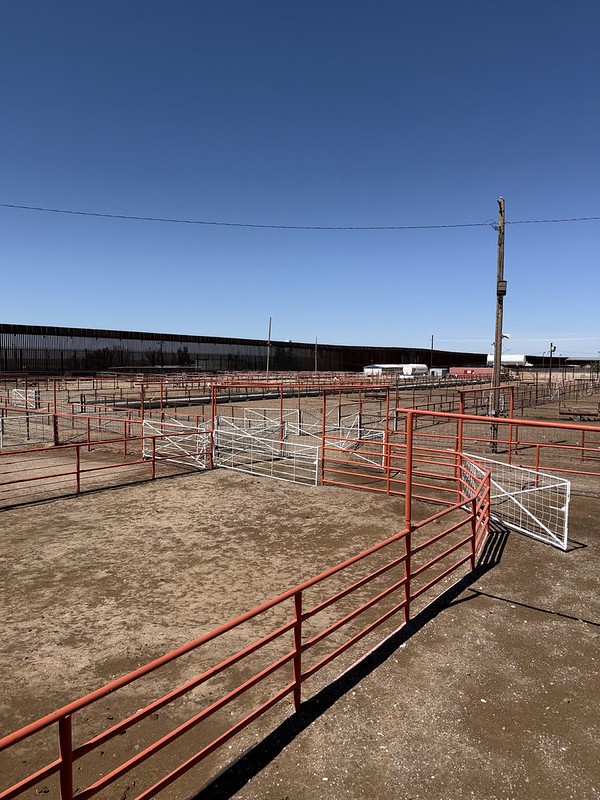
Image of the empty lots at Santa Teresa, New Mexico. The location is one of five border ports for livestock to come in to the US from Mexico. Its closure due to the threat of New World Screwworm has affected jobs there. Photo taken May 2026. | UADA photo by James Mitchell
Fast Facts
- Finding of screwworm in Texas unlikely to rattle grocery beef prices
- Southern livestock port closings affecting jobs
By MARY HIGHTOWER | University of Arkansas Division of Agriculture
Feeder cattle contract prices remained highly volatile on the Chicago Mercantile Exchange on Thursday following the confirmation of screwworm in a calf in Texas, however, consumers shouldn’t expect to see beef prices at the store change much, a livestock economist said.
The prices for cattle closer to where the new world screwworm was confirmed in Texas were likely to see immediate effects, said James Mitchell, an extension livestock economist for the University of Arkansas Division of Agriculture.
Worries about the northward movement of the screwworm has likely hindered prices for August feeder cattle futures.
“So far today, the trading range has been $335 to $353. It was a bearish reaction to the news, but the market has already recovered finishing the day limit up,” Mitchell said. The contract has been trading lower since the start of the week, presumably on screwworms suspicions.”
He said the exchange generally puts limits on price movements to dampen volatility and wouldn’t be surprised if that occurs through Friday.
The effect would be to “cool off going into the weekend as the markets respond with more reason and logic,” Mitchell said.
However, uncertainty loomed on Thursday.
“We need to get clarity on this situation; to know where we stand,” Mitchell said. “News is pretty scarce at the moment, but traders will trade and sometimes markets move in ways you might not expect.”
The cattle markets nearer to where the pest was found would see the biggest impacts, he said.
In a preprint of an article, “Screwworm Border Closure and Cattle Prices Heterogeneous Spatio-Temporal Effects of the Screwworm-Induced Border Closure on U.S. Cattle Basis Prices 1” that Mitchell authored with Mackenzie Gill of the University of Tennessee-Knoxville and his on-campus colleague, poultry economist Jada M. Thompson, anticipated the effects.
Mitchell said that based on the findings, “you would expect an increase in price, because that border closes, you have lost a significant supply of cattle at the border. And so, you see a strong price response to those markets that are closer to the border, where those cattle would be fed and enter into our supply chain.
“Farther away, as you move farther away, that price impact dampens,” he said.
What about my beef?
The finding of New World screwworm won’t have any immediate effect on beef prices at the grocery, which have already hit record highs due to tight cattle supplies.
“The relationship between cattle prices and beef prices is not immediate, because that calf is not going to become beef for a few years,” Mitchell said. “So, beef prices are going to continue to stay high and consumers are still consuming it.”
With widespread drought in the U.S., beef prices aren’t expected fall anytime soon.
“We’ll test the upper limit on consumer willingness to buy beef over the next couple years, because prices are going to go up more the next two years,” Mitchell said.
Localized Impacts
The United States is the world’s largest beef producer and a large volume of the cattle meant for beef production comes from Mexico, making the U.S. a net importer. Following reports of the New World screwworm in northern Mexico in spring of 2025, the U.S. closed its southern border to cattle, bison and horses. The border reopened briefly in July 2025 but was closed down within two days. The closure affects five ports: Douglas, Arizona; Columbus, N.M.; Santa Teresa, N.M., Del Rio, Texas; and Laredo, Texas.
“However, what’s going on with New World screwworm will have more of a local impact on Texas and New Mexico markets specifically,” he said.
Mitchell toured the port at Santa Teresa two weeks ago, with other members of the Livestock Marketing Information Center, which he chairs.
“This is a big deal for those producers,” he said.
The livestock entry port at Santa Teresa, New Mexico, “normally is the largest port of entry for cattle entering the U.S. beef supply chain but has been closed since November 2024 with two brief openings in 2025,” he said.
“This disease also affects sheep and goats and it will also affect deer populations,” Mitchell said, adding that screwworm will be a worry for “game ranches in Texas.”
“All of this has an impact on the Texas and New Mexico economies, but it is localized at this point,” he said.
To learn about extension programs in Arkansas, contact your local Cooperative Extension Service agent or visit uaex.uada.edu. Follow us on Facebook and Instagram. To learn more about the Division of Agriculture, visit uada.edu. To learn more about ag and food research in Arkansas, visit the Arkansas Agricultural Experiment Station at aaes.uada.edu.
Discover more from
Subscribe to get the latest posts sent to your email.