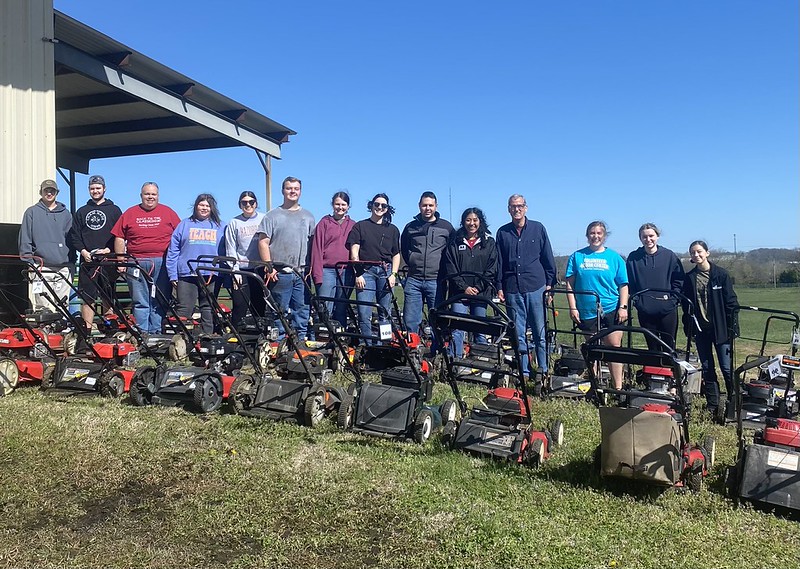
SMALL ENGINES, BIG THOUGHTS — Professor Christopher Estepp, third from left, and University Professor Donald Johnson, fourth from right, stand with members of the FFA Alumni and Supporters Club and the Agricultural Systems and Technology Club during the department of agricultural education, communications and technology’s spring 2026 lawnmower tune-up program. | Courtesy photo
By JOHN LOVETT | University of Arkansas Division of Agriculture
The 1974 novel “Zen and the Art of Motorcycle Maintenance” offered a simple but enduring idea: working on machines should not be about just fixing them, but slowing down, paying attention and reflecting on both the work and oneself in the pursuit of quality.
The concept parallels a study by researchers with the Dale Bumpers College of Agricultural, Food and Life Sciences and the University of Arkansas Division of Agriculture on teaching small-engine maintenance. But there’s a modern twist involving short-form videos.
Small engine maintenance and repair is a topic many agricultural educators are expected to teach. Yet, it remains one of the least emphasized subjects at the post-secondary level, said Christopher Estepp, a professor of agricultural education in the department of agricultural education, communications and technology and co-author of the study “Determining Instructional Design Effects on Self-Efficacy, Interest and Knowledge in a Small Engines Course.”
Previous studies have found that the knowledge gap leaves many teachers lacking technical skills and confidence, particularly in instructional planning and evaluation. In response, Estepp and his collaborators set out to examine instructional strategies to enhance learning quality in small-engine coursework.
For Donald Johnson, University Professor of agricultural education in the department and co-author of the study, better understanding how novices learn technical subjects is a longstanding research interest. Managing cognitive load and building self-efficacy, or confidence, are key components of this equation.
“Students need opportunities for hands-on experience and for critical reflection to assimilate new learning and build self-efficacy,” Johnson said. “The videos were simply a way to put a new twist on the critical reflection piece.”
Johnson and Estepp are both part of the Dale Bumpers College of Agricultural, Food and Life Sciences at the University of Arkansas. Johnson also conducts research through the Arkansas Agricultural Experiment Station, the research arm of the Division of Agriculture.
Reflecting on the process — on video
At the center of the study was a teaching method that paired lectures and laboratory activities with the creation of self-reflection videos. After completing hands-on tasks related to precision measurement and carburetor components, students recorded short videos explaining what they did, how they approached the task and what they learned.
The approach was designed to make reflection more natural and expansive than traditional written assignments, Estepp said.
“When you create a video explaining what you did, that’s a reflective exercise, and they’re doing something that they enjoy,” Estepp said.
While reflection is already a cornerstone of experiential learning, Estepp noted that written reflections are often brief and incomplete. Video reflections, however, allow students to speak more freely and capture ideas as they emerge.
“On video, they can elaborate,” he said. “Things come to mind, and they talk about it. They get the opportunity to say more than they do in writing.”
All students in the study received the same instructional experience: a lecture, a lab activity and a reflective assignment. What differed between groups was whether students completed a pretest, allowing researchers to compare learning outcomes using a quasi-experimental design.
Whether it was just the video component that did the trick remains a question.
“We would hope they would learn regardless, but what we were really interested in seeing, using that reflection method, is if that is going to help them have a learning gain. And it did. Which is a good thing,” Estepp said.
To see if it was just the video self-reflection that boosted learning, Estepp said another study would be needed where one group did the tasks without doing a video. Future research may also examine how reflective videos influence confidence and interest over time, and how instructors might better support all three simultaneously, he added.
Knowledge increases, confidence adjusts
Regardless, the results showed that students in both groups achieved significant gains in knowledge of precision measurement. Knowledge also increased for carburetor instruction, though the change was not statistically significant.
The study suggests that the knowledge gains were supported by the hands-on laboratory experience and the integration of key elements of Situated Learning Theory, which emphasizes learning through authentic tasks, reflection and application in context.
At the same time, students reported slight decreases in perceived self-efficacy and interest across both topics, with some significant declines observed in one design group. While this might seem counterintuitive, the researchers noted that such shifts are well documented in the learning sciences.
“Learning technical skills often involves realizing the work is more complex than expected,” Estepp said. “That doesn’t mean students aren’t learning. In many cases, it means they’re developing a more realistic understanding of what mastery actually requires.”
Implications for agricultural education
Despite limitations related to the sample size of 16 students in the Small Power Units/Turf Equipment course, the study found consistent patterns across instructional designs and topics. The researchers concluded that instructors at both the post-secondary and secondary levels could use similar instructional methods to increase students’ knowledge of small-engine concepts.
They also recommend that instructional designers continue to consider the role of reflection, particularly video-based reflection, as a tool for helping students process complex, technical learning experiences.
The quality matrix
In his book “Zen and the Art of Motorcycle Maintenance,” Robert Pirsig posits that quality emerges not from rushing through tasks, but from thoughtfully engaging with both the process and the outcome. The findings of the study on teaching small-engine maintenance suggests a similar lesson. As Estepp puts it, the goal is not simply to teach students how to work on engines but to help them learn how to think about the work they do.
The study was published in 2025 in the Journal of Southern Agricultural Education Research. Co-authors of the study included Will Doss, an associate professor in the department of agricultural education and communications at Texas Tech University, and Kobina Fanyinkah, Ph.D., now assistant director of the Small Farms Research Center at Alabama A&M University.
To learn more about ag and food research in Arkansas, visit aaes.uada.edu. Follow the Arkansas Agricultural Experiment Station on LinkedIn and sign up for our monthly newsletter, the Arkansas Agricultural Research Report. To learn more about the Division of Agriculture, visit uada.edu. To learn about extension programs in Arkansas, contact your local Cooperative Extension Service agent or visit uaex.uada.edu.
Discover more from
Subscribe to get the latest posts sent to your email.