
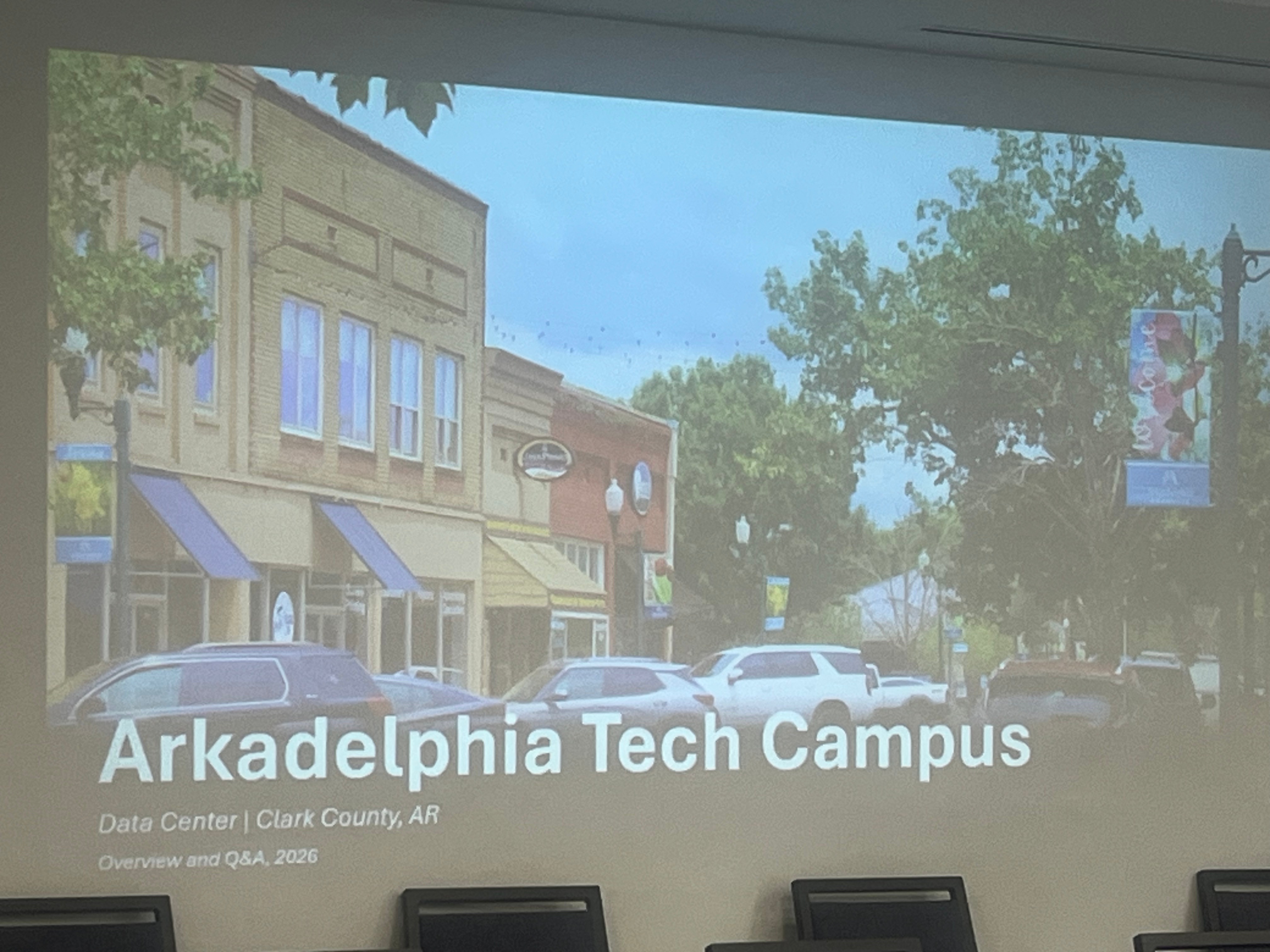
DATA CENTER ON THE HORIZON? — The first slide of a presentation hints of a proposed data center that would be located about 5 miles south of Arkadelphia at the Southwest Arkansas Mega Site in Gum Springs. | arkadelphian.com photo by Joel Phelps
This post was updated 4/22/26 to include an audio recording and transcript of the meeting in its entirety. Both can be found below the original article under the heading titled “A transcript of the meeting”.
By JOEL PHELPS | arkadelphian.com
A data center could very well be coming to Clark County, Arkansas, following a vote Thursday, April 16, to sell the entire Southwest Arkansas Mega Site to an unnamed buyer.
In a 90-minute special-called meeting of the Economic Development Corp. of Clark County, board members gave their unanimous approval to sell the 991-acre site in Gum Springs — initially to DC Devco LLC — in an estimated $11.4 million deal.
Called “Project Pulse” for now, the end buyer will make itself known prior to closing on the property. The purpose for buying the site is to develop a data center campus that would create 150 primary jobs and make a minimum investment of $1 billion.
The buyer identified the Southwest Arkansas Mega Site as a viable property, which is already equipped with the water, power and gas utilities necessary to get started. A trio of Atlanta-area businessmen representing the buyer fielded numerous questions from board members, from expected power usage to what types of jobs the company plans to offer.
It was said at the meeting that a data center would not overburden the local power grid, nor would it increase residents’ power bills. The center would produce new power using on-site natural gas transmission lines and grid power in coordination with utility companies. Working from a slideshow, the representatives quoted excerpts from Entergy’s website that says the power company ensures the grid can supply additional demand while maintaining reliable service to existing customers. The slides also claimed that power bills would not increase because, according to Entergy, new industrial customers pick up a larger share of grid maintenance improvement costs.
Ten years ago the site was expected to be home to the Chinese-owned Sun Paper, a project that ultimately fell through. In comparison with the paper mill, the representatives said, a data center would have far less of an environmental footprint, with no air pollution and “negligible” noise pollution.
If everything goes as planned for the data center and county officials, the campus could be operating by 2032, said Shelley Short, CEO of the Arkadelphia Regional Economic Development Alliance. “I’m incredibly excited, but we’ll have to be patient,” Short said.
Asked what types of jobs a data center would create, it was said that it would mostly be technical careers, but there would be engineers and tradesmen needed to keep the 24/7 facility operational.
Clark County Judge Troy Tucker asked for clarity on what data centers do. They’re essentially large computer warehouses — the backbone of the Internet, where anything data-related is generated. It was noted that the servers do get “very hot” and therefore water is needed for cooling. This particular buyer, it was said, uses a closed-loop cooling system that uses about 50,000 gallons of water per day — about 8% of the estimated 600,000-gallon capacity, and would not affect the Arkadelphia water system, the representatives said. Any water used also re-enters the water/sewer system, and no chemicals are added during the cooling process. Arkadelphia City Manager Gary Brinkley welcomed the project, saying at the meeting that the city is “all in”.
It was said that the end buyer would be responsible for costs associated with power upgrades for the data center.
The company interested in the land is likely to publicly identify itself in its own announcement prior to closing on the property.
Asked whether the company is a good community partner, the representatives said it invested $175 million to upgrade infrastructure in one community where they’re operating in Wisconsin. It was also said that the campus could generate an estimated $60-$70 million in annual tax revenue.
The company interested in the property is not seeking incentive money from the EDCCC.
Short said a tax abatement would likely be provided on the property as customary part of economic development.
Board member Brian Kirksey, who sits on the South Central Arkansas Electric Cooperative board of directors, said he welcomed the idea of a data center. Opponents, he said, are likely to invoke NIMBY (Not In My Back Yard) arguments, but “if we say ‘no’ now, we nix our future chances. Technology is where it is. This is an opportunity for our community to excel.”
Kirksey motioned to authorize the sale agreement. Kevin Jester seconded the motion, which was approved unanimously in a voice vote.
A transcript of the meeting
The Arkadelphian transcribed what was said at Thursday’s meeting from the recorded conversation. For brevity’s sake, what follows has been edited to omit most filler words and phrases such as “um” “uh” “like” and “you know”. Some portions of the meeting that were inaudible are also omitted and denoted by either an ellipsis or “[sic]”. EDCCC board members and DC Devco representatives are mostly identified as “board members” and “representative” in the transcription.
Our audio recording of the meeting is also available in the file link below.
EDCCC Special Meeting
April 16, 2026
10 a.m.
Fairfield Inn and Suites
Lori Ross, chairman of the EDCCC and Alliance:
Go ahead and just we’ve called the meeting to order. I’m gonna turn it over to Shelley to discuss Project Pulse.
Shelley Short, President/CEO of the Alliance:
Okay, good morning, everybody. How’s everybody doing today? Thank y’all for making time out of your schedule to be here. I know it wasn’t called until earlier this week. So thank you for making this a priority of being here today. For the purposes of establishing a quorum, I did show that we have a minimum of eight voting directors here, and to note in the minutes that Dr. Lewis Shepherd has provided his proxy to Dr. Celia Taylor. And Derek Franklin is in the car outside. He’s only going to be out there for about 30 minutes, but in case we should get to any business before then, he’s provided his proxy to Kevin Jester. So, I don’t think that we’re gonna get to a voting moment in 30 minutes. We can hope, but, you know, I don’t think that that’s gonna happen. So, before I get into the project parameters today, I wanted to take just a minute and allow the members of the project team that I’ve been working with on Project Pulse to introduce themselves. And then after they do that, I’d like for us to go around the room and just briefly introduce who you are, your role on the board. If you’re an officer. And what you do with the community. So they have an idea of who is at this table and who they’re speaking with. I think that would be helpful. And then to all of our guests in the audience, thank you for being here today and for being interested in economic development in Clark County. And we’re going to go ahead and proceed. So Cameron, I’m going to let you introduce yourself and you’re in the project team.
Cameron Grogan:
Yeah, thank you. My name is Cameron Grogan. I’m originally from Atlanta. I live in Florida, and have been involved in development and land development for about 10 years now. I went to Sanford University, which is sort of similar to Ouachita Baptist, Walden, for grad school in construction management, and been doing construction development ever since.
Chris Hoag:
Yeah, Chris Hoag, also from the Atlanta area in Georgia, now I’ve been in Gainesville, Georgia, been in real estate and development for about 8 years. And, yeah, went to Georgia Tech, which is sort of uh, Pariahed in my part of the world, you know, it was the Bulldog, so I have to look at that, but so glad to be here. Shelley and her team have been great in the process. So, I’m glad to be here.
David Aldridge:
David Aldridge, from Atlanta, same thing. I now live in Gainesville, Chris’s neighbor. He’s been in real estate development for about 15 years. Unfortunately, and fortunately, I went to the University of Georgia, but really excited to be here. Appreciate everybody’s time and looking forward to kind of getting some feedback on this project.
Arkadelphia City Manager Gary Brinkley:
Gary Brinkley, I’m city manager here, Arkadelphia. Appreciate y’all being here.
BOARD MEMBER – Lloydine Seale:
Lloydine Seale, just a small construction company that does big things.
Laughter
Shelley Short:
All right, J.L., let’s see what you do now.
BOARD MEMBER – J.L. Griffin:
I’m J.L. Griffin and I’m from Gurdon, and I’m just a board member.
BOARD MEMBER – Brian Kirksey:
Brian Kirksey, I’m from the Amity area. My mom worked at electrical cooperatives, my old man managed the water system, and just, ole cowboys trying to struggle to make a living.
Laughter
BOARD MEMBER – DR. CELIA TAYLOR:
Good morning. I’m Celia Taylor from Arkadelphia, and I represent Henderson State University in the Education Industries in this area.
BOARD MEMBER – STEVEN ORSBURN:
Steven Orsburn and I work for Southern Bancorp.
BOARD MEMBER – AUSTIN KING:
Austin King, I’m from Arkadelphia, I’m an attorney at Taylor King Law.
BOARD MEMBER – KEVIN JESTER:
Kevin Jester, 34 years in the logging business in the community, and we were struggling a lot more than the cowboys over here.
BOARD MEMBER – TERRY BIRD:
I’m Terry Bird. I’ve been here on the EDCCC Board, and the Alliance board, and also work for the Bank of Delight.
BOARD MEMBER – Bill Conine
Bill Conine, retired from the public utilities co-ops in Arkansas. And I’m on this board as well as the Alliance.
Lori Ross:
Hi, I’m Lori Ross, and I’m the chairman of this board, and I’m also on the Alliance board as well. And I’m the mortgage president for Citizens Bank, which is an Arkansas Community Bank here.
Shelley Short:
And they already met my team, Jon [Merryman], and E’Lyse [Thaxton], thank y’all for being here today. And so I wanted just to give a little bit of background on how we got here and what we’re what we’re going to be looking at today. So back in July of last year, Cameron reached out to me about the mega site, as far as being interested in the site for the development of a data center project. And at that time, there were multiple tire kickers, all in the office, calling the utilities. And I basically told Cameron how you’re going to need to get with the power providers because that’s really going to draw a lot of this discussion going forward. So time passed between July and the first of this year, and Cameron reached out again. He did communicate with some of the power utilities in that July time frame. Kind of got the lay of the land on what the power situation looked like in Arkansas. What could be somewhat feasible for what time frame would look like for power at the back of the site? And then I think took some months to kind of wrap their head around that and figure out if this was something they wanted to do, how they wanted to move forward. Recontacted me in January, started looking more in depth at the property and would it be a conducive site to the development they were working with with an end user. And we have started that process then of reviewing the site from a new diligence perspective that they’ve been conducting some on their own. We’ve connected now with the power companies with the natural gas utility and have just started those conversations about this particular project, about Project Pulse. Probably about a month and a half ago these gentlemen came down, viewed the site, spent some time with me, and had some different specialty software that was showing them some things that gave them the indication that this would be a viable property to locate a data center campus. And at that time they determined that they would like to go ahead and provide a purchase and sale agreement that we could get started on the review process. So, that was probably around late February, early March. That started a long, long series of negotiations on behalf of the EDCCC and with TJ Lawhon reviewing every step of the way. As many of you know, TJ is the EDCCC’s attorney, and they have a law firm that was representing their interest. So, there was a lot of communication between those, all of the parties. This is probably the version that you received, is probably the fifth or sixth iteration of the purchase and sale agreement that, after different aspects of it, were renewed and changes suggested and things put in there to protect interest, but also meet the needs of the prospect. You know, one of the reasons that we’re here today is because as a public entity, this is required of us to do. If this were a private landowner, they would be doing this just with the prospect themselves and they would be entering into a contract that fit their business needs. As representatives on the EDCCC board, it is your job to help represent the business needs of the county and to review items like this for approval. So, the reason we’re doing this today is not necessarily to announce a data center project. What we are doing here today is gaining approval for DC Devco to begin certain due diligence that needs to happen in order to verify the preliminary due diligence they’ve been doing on the site. That comes with a lot of cost that their end user is willing to pay for, but in order for them, to make those expenditures, they have to have some reasonable assurance that the property is, at least temporarily, within the care control. I can imagine as if you all were entertaining, purchasing something that was $12 million, you would like the opportunity to review it, to do some additional due diligence. And if that required hundreds of thousands of dollars in expenses to power companies and other entities, you would want something in place that gave you the assurance that we weren’t going to turn around in two months and say, ‘Oh, well, we’ve decided to sell this to some other entity. Sorry, you spent all this money, you have a nice day.’ We don’t want to have that type of relationship. We want the prospect to have the assurance that we are excited about this, and that we are on board with this, and that we give them the legal authority to go out and conduct the studies that they need to conduct, to verify and prove that this is a site that can be developed as a medicine. So that’s in a nutshell, kind of why we’re here today. Does anybody have questions over that aspect of the project? Okay.
So in your packet that I provided to you, I know I sent out the contract a little late last night, and I apologize that that was a little bit later than I had anticipated, but there was a change yesterday in a portion of the contract, and I wanted to make sure that you had the most current version that we have both reviewed, that our attorneys have both reviewed before I sent it out. So, I know it’s very lengthy and I wanted to take a moment and review the contract and the basics of that. But before we get to that point and you do have a one-pager … that summarizes some key points in the contract that’s included in the package. But before we get to that point, I would like to allow the project team to visit with you just a little bit about the project itself and what they are envisioning and answer any questions that you may have before we get into the conference specifics. So at this time, I want to turn it over to Cameron. And they have a presentation that he and Chris and David will give and they may each speak at different times just so that everybody can hear them later on if this is ever accessed, we’re going to pass the recording device down to them so that they can be heard.
Cameron:
Yeah, thank you, everybody, and thank you, Shelley and team, y’all been awesome to work with. Great, great introduction. Like Shelley said, we’ve been at this for coming up on a year now, and especially in the last three months, kind of starting in January, really digging into this site. So we’ve done a lot of, they’ve done a lot of due diligence. You guys have done a great job on the site since you’ve had it. And we feel, like Shelly said, we’ve gotten to the point where we’ve done all the due diligence we can do, kind of pre-contract, right? And excited for this next step to where we can go ahead and start paying for some of these studies and really, really making this project come to life. So just give a quick overview here. So, of course, what brought us to this site. You know it’s been marketed, Entergy, SCAECD and Summit Utilities, everybody’s done a great job kind of coming together and providing information about where’s the power, how much power is available now, where’s the gas coming from, easements in place. So there’s already been a bunch of due diligence that’s already taken place on this site.
That’s one thing that brought us here: The access to the complementary workforce. You know, the size of Arkadelphia, about 20,000 people, the workforce, you know, about 9 to 10,000. We feel like there’s a very complementary size project. We’re not coming in and need a thousand jobs where you have to increase your infrastructure and your schools and more kids in the school system, attacks on emergency services, but just a really good project for the size. The Henderson State and Ouachita Baptist universities being close by, the partnerships and talent recruitment that we could get from those schools. I listed just a few programs that exist today that are very complementary with our use, and it’s computer science, information systems, cybersecurity, engineering, security. Those are current courses at those schools that are complementary.
And then the comprehensive due diligence, it’s already been completed. Like I mentioned earlier, this meeting certifies as a site a few months ago or a month ago, just kind of lets you know that lets us know as an operator, as a user, that this site is, that the use is allowed, the utilities are there, and everything’s ready for a good developable site. I want to show our concept plan here shortly, or quickly, and this is just a concept. This isn’t, exactly what’s gonna go out there tomorrow, but I just want to kind of get everybody some context. We are looking to purchase the entire site. You’ll see the creeks, you know, that exist, so all the area’s not buildable. So, it gives us some leeway of what our goal is on every site, especially this one, is to work around any wetlands, any creeks, anything like that.
So there are roads within that site plan. It’s hard to see here [on the slideshow], but we are not looking to cross those creeks. get any special permits, any wetland credits to purchase, to affect any wetlands. This site plan and our goal, having the whole site, would be to stay away from any creeks and having, circulation around the site without having to affect any kind of state waters. It’s hard to see here, but there’s two entrances called out. One would be kind of your main entrance, would be a guard gate. The site would be 24-hour security. And then we always want a secondary entrance just in case, you know, there’s any reason, it’s really an emergency egress entrance, but all the entrances will be gated and secured. These are a 24-hour operation facility. So, you know, the jobs that we’ll talk about a little bit, those are over three shifts. There is a full-time night shift here as well.
So if you look closely, you can see the blue outline is the property boundary. There’s a red dash line inside that blue dash line. And just to give everybody a little context, the difference between that land between the blue and the red is 100 feet. So that shows a 100-foot buffer. And you can see, well beyond that. So, I just want to kind of show everybody that… Kind of like what we talked about earlier, what David said is, you won’t even know those buildings are back there. I mean, we are gonna have a lot of buffer, and just leave a lot of the natural vegetation, any natural vegetation we can, leave it alone. More than 50% of the site is probably going to be undisturbed. And that just alleviates how to add more planting or more parapet walls or anything like that because we’d rather keep a natural buffer as far as sight, noise, that’s concerned. I’m certain you guys might have for yourself or you’ve seen here recently. So, at full buildout, we’re only approximating that we’ll use 50,000 gallons a day. Just at the site alone, they kind of earmarked what’s available is 600,000 gallons a day. So again, I know you’ve heard data centers take all the water, because of the second note there, we will utilize the closed cooling system. So the system will be charged day one, and that closed cooling system is similar to your car, similar to your AC unit. There’s water in your coolant that cools it, and it doesn’t waste, it saves it. We don’t dump it all out annually or monthly, it’s what’s truly called a closed loop cooling system. We’re committed to doing that. So your water and sewer that you’re using is just like any other manufacturer, any other neighborhood. It’s for employees. It’s for sinks, break rooms, restrooms. So we’re using, you know, 8% of the water that would be allowed at this site.
Board member:
Will it impact our municipal water quality, again, due to the closed loop system?
Cameron:
No, because that water is staying in the system and cooling the chips. The water that’s going in the sewer system is just like the water from your neighborhood or restaurant or any other office building.
Board member:
Will the project overburden our local power grid and will our power bill increase?
Cameron:
Both of those points are valid questions. We have our own answer, but Entergy has done a better job than I can do to explain both of those situations. They are actively seeking more data centers, I believe, for the state. They have a great website, a great section in their website called Mythbusting for Data Centers. It gives just some real good reasoning of why from the local utility themselves, that what we call legacy customers, all of us sitting in this room, all the businesses in this room are not affected. And in reality, benefit from a large load customer like a data center. And so I would just let you guys read that. You don’t need to hear me read it, but I’ll say one other thing that’s kind of mentioned here, but what we like to say is the power that will operate the data center is not power that exists today. So it’s power that we will generate, then we will pay to be generated within conjunction with EDCCC, South Central Arkansas Electric Co-op, and Entergy, and its new power. So we’re not taking 500 megawatts from the grid today [to] divert 300 over here. And that’s what they mean by appropriate transmission upgrades will be added to the system to reliably supply additional demand on the grid. So there’s not a site in the country, in the state, anywhere that says, ‘Hey, you can have a gigabyte tomorrow. Doesn’t exist. You come in, and you work for local utilities to generate that power and any upgrades that are necessary for the system, to operate a data center while upgrading the system, that everybody benefits from. Well, I went ahead. That’s basically what that slide said. So, again, this one too, including Summit Utilities, because a big part of this deal is the gas generated, the gas lines that are close by. There’s already been a plan. I think you went out for a grant that I don’t think we got, no big deal. The grant was one part of that was going to be to bring some of the gas lines to the site. They’re over, they kind of run through the existing industrial park at this point.
Shelley Short:
And just so they’re aware, the grant from the economic development commission, the second [sic] of side development grant that you funded some of the excavation and the due diligence for this cultural resources study. They did not fund the extension of natural gas or extending the road out to Highway 67. So I just wanted y’all to be aware that that’s what he’s talking about that I’ve had a review with ADEC about what’s covered and what isn’t. And so I just said you all understand that.
Cameron:
Yeah. I say that to say kind of the plan has been, it’s been discussed. It’s been not so much engineered, but thought out of how to get gas over. We can pay for that extension. But that’s what makes this site very attractive too, is the bridging opportunity to use natural gas for power, which not everybody does. Our end user is very much doing that process throughout the country. So that’s another thing that makes this site attractive to us and not to every single data center out there in the country.
Board member:
Are data centers hazardous or polluting?
Cameron:
No, they’re clean, non-polluting facilities, just kind of one note on that, for instance, for references. I know everybody’s familiar with Sun Paper, which was, I think, actually this month is the 10-year anniversary they first announced about this site. They had actually received a Title 5 air pollution permit, which is the most you can get. So, you know, a use like that would have been a polluting facility. These are not, the data centers do not. There’s no smokestacks, there’s no chemicals being generated. There’s no chemicals in the wastewater, anything like that.
Board member:
Noise?
Cameron:
We understand and we’ve reviewed extensively the emergency ordinance listed there. So we know that you guys have done a great job putting a noise ordinance on this property. We can absolutely adhere to that. Probably with all the additional buffer we have, not having to do any fair bits or acoustic roles, but those are always options if we need to get those noise limits down and we’ll do the proper noise studies to make sure preconstruction, post-construction, pre-CEO, all those ordinances [are adhered to]. But we’re super excited about plenty of other stuff. I can get very long winded. So happy to answer any questions and I’m just excited to be here and talk with everybody.
Shelley Short:
Does anybody have initial questions for Cameron or anyone on the team as relates to what we just looked at?
Board member:
I do. Okay. Cameron, will that concept plan we just reviewed, will the end user … that builds the data center, will they have to adhere to what we just saw. I mean, they’ll adhere to any codes, right?
Cameron:
Yes, sir.
Representative:
[Codes] that you have? This isn’t a site plan specific, so I want to caution it may not be 12 buildings, right?
Board member:
No, I’m not talking about, not the building. I guess what I’m talking about is, generally, I understand what you said, but some of the things are very important, the end user, about the noise, about the water, about the electricity, all of that. The end user, or the buyer that winds up building this data center, will they have to adhere to the concept plan we just went over?
Representative:
Yes. Oh, the whole concept plan, I see. Yes, yes, they do understand that may change, architecturally. Yes, sure. … And I think [Shelley] always told you guys, our user has been identified. We have that end user, Shelley knows who that end user is. The contract limits us to six. So if it didn’t end up being that one, but that end user has seen what I’ve told you today, has seen this concept plan, has seen that it’s what we think, and now we’re going to go out and see who wants it. So, yes, sir, they are when I say we, it’s us, the three of us standing here, and them.
Board member:
Okay. But there’s the assignment you’re talking about. It could be assigned to these five on I this first page here in this contract and one of them.
Shelley Short:
And, J.L., just for reference, and the contract, there is a provision that the Assignee has to abide by all of the particulars that are contained in this document. The end user would be bound, just like any, to the noise ordinance. They are going to utilize the system that he spoke about today. And so there is some provision in the contract that says the Assignee, whoever of those six it is, has to abide by [sic] and measure in this contract fully like they decide that, but for whatever reason, natural gas isn’t the way they need to go. I mean, maybe they pull on power and they wait to get the power to it. That may be a piece that changes. But as far as what we have represented to them, there’s the water that’s available, they know that’s the parameters they have to work within or they have to pay for whatever upgrades are needed. Thank you.
Board member:
What will be your source of backup power at the facility?
Representative:
Most likely the standard in the industry is Tier-4 generators. By and large, they’re diesel powered, and Tier-4 means it’s the strictest level of EPA regulation around those generators. How often they can run, what criteria can run them under, which is strictly grid outages, power outages, it’s one of those you put on and test, and the testing is limited and monitored on when those can stay on, but part of that Tier-4 classification essentially just minimizes the amount of emissions.
Board member:
Will those generators still be subject to the noise ordinance?
Representative:
Correct. Yeah, the whole campus will be subject to the noise ordinance.
Board member:
I know this is a complete conceptual plan, but how do you think this will evolve? I mean, as far as the building process, is this in different stages? Does it go through several years, or what kind of proposed building plans would you say would be on this conceptual plan?
Representative:
So it’s definitely phased for a couple different reasons. One, the power, right? We want this to be a gigawatt power facility. We’re not going to get all that gigawatt at one time. We understand that. So to be phased in that way, right? For power. To do a whole site, all 12 of those buildings, if it were 12, would be a gigawatt. So there could be three, you know, we might get 300 megawatts, and we will. Also just construction. You’re not going to go build all of those things at one time. I always do like to say, too, that we don’t come, mobilize, build, demobilize, come back two years later. It’s just an evolution of construction phases as it comes on.
Representative:
Maybe we turn in our application, and with our application we’ll need a load map, and that’ll show [what is] really going to be based on how quickly you guys can provide power to the site with how the buildings are going to be constructed. But I can tell you that the site plan right there, you’re probably looking at half those buildings, so just given the fact that this is gonna be a 2 gig plus campus. It could be about half the size of what shuts there, for a big one. So you’re looking at a multi-year, yeah, obviously.
Representative:
Absolutely, yeah.
Lori Ross:
So what does that look like? Is that two years, is it four years? I mean, I know you can’t say specifically, but what’s that main package for something that size we’re talking about?
Representative:
I would say four to six.
Shelley Short:
In discussions that we’ve had, operational, you know, full-wheeled out by about 2032. And that’s if everything goes swimmingly and as planned. These are not small undertaking type projects. If you kind of look at the document that I provided, I mean, it’s a $1-billion-dollar-plus investment that would be incurring over a period of time, resulting in 150 jobs. That is fairly similar to what was proposed, you know, when Sun was looking at the property as far as jobs and the amount of investment. So, I understand, and the power companies understand that this isn’t something that even if this contract is approved today, and the power companies get started tomorrow, that this is gonna be up and running for probably at least five or six years. And that’s just the reality of any of them that are of this scale that are going in anywhere in the country. It’s not a matter of, can you get the builders or can you get all the things? It’s these types of operations take a considerable amount of time primarily because the power that’s needed to run these facilities, they’re gonna they’re gonna pay for all that, but it’s not being generated right this minute. The power companies are going to have to figure out how they are going to be able to serve this entity and within what type of what time frame. And in order for them to do that, which you’ll see in some of the language, there has to be certain studies ordered through the power companies, and I’m sure the gas has the same, that require the end user to spend dollars in time to get those results. In a conversation we had with Entergy and the Co-op, like some of those the studies, like the final, as you would call it, power supply study and presentation to the service commission and saying, ‘Okay, I can take up to a year just to get that piece completed.’ And so while they’re spending time, resources, and money, you know, to get all of that done, they’re asking for some time to do that, which is very limited. I mean, it’s 120 days, I think, if y’all remember, there was another project that came around and wanted a very long option time period, almost three years. And we decided that wasn’t the way we wanted to go unless it was a very, very significant deposit, but even that company wasn’t willing to do anything. So I just want everybody to understand that I am incredibly excited about this. I think it’s a fantastic opportunity, but I’m also realistic that this is not something that we’re gonna see in just a couple of years. We’re gonna have to be patient and allow the utilities and the end user to do the work that’s necessary to have the end result that we would want. And some of that may be people saying, ‘Oh, goodness,’ or whatever, whatever the case may be, but I’m here to tell you that even a large manufacturer that I’ve had several, I’ve had site visits with a few over the course of the last year. They’re also looking at 2031, 2032 as an open date because of the power constraints that are in existence everywhere in our world and in this country. We had one, and I don’t want to speak too specifically, but one that needed about 10 megawatts. Well, that solution, at least in that first meeting, it’s not immediately available. And it would take some time even then. They had government approvals they needed to go through that would add to their timeline. So I think the days of, Unless you have an existing building or some existing space of just taking raw land and putting a billion-dollar project on it, that’s gonna take a considerable amount of time. So I just want everybody to be aware of that as we try to move forward.
Representative:
Very well said. The great thing about this site and our user is the [sic] right? And I’ll say that is the one thing that could accelerate this. And I know we had a call just the other night at Summit. One thing, they studied this site in January, and that’s when I talked to them and they told me what was asked. … So we know we can get it there. It was approved for so many million cubic feet an hour of gas. And that was okay with us, right? We’ll do another study as we get going. And he said, when would you just, you know, best case scenario, when would you want it? And I answered as far as we’ll say when I close it, permit it, do the site work, get a building up. I said, late ‘27, early ‘28, you said, ‘Oh, yeah, yeah, that’s fine.’ So the gas is what could get this moving forward, which not every user does and not every site has. The other thing I want to mention is Shelley mentioned the minimum investment of a billion dollars and the minimum employees of 150. Those are minimums, especially that billion dollars. And David, correct me if I’m wrong, that is our minimum. We’ve agreed in the contract to put some money in escrow and closing so that, if within five years we don’t spend a billion dollars or we hire 125 people, you guys get more money. And that’s more just so that if we end up building one building and it’s just not what we promised here today, you get a little bit more, right? I think we will blow both of those numbers out of the water, especially the budget I think we’ve talked about. This probably will be somewhere around a $20 billion dollar investment in your community when it’s all said and done.
EDCCC board member:
Say that one more time.
Shelley Short:
You ready to vote?
Laughter
Board member:
You said 20 billion dollars?
Representative:
Yes, sir. Twenty billion.
Shelley Short:
Well, and that’s money I can’t even comprehend, but that’s on par with campuses of this size and other places. It’s just crazy.
Representative:
Now, one thing to share what they were saying about the time, the on ramp for a project like this, that while it does take time, it also really kind of unpacks the answer behind some of those questions around the What-does-this-do-to-the-grid and What-does-this-do-to-my-power-bill? The studies that are in front of us conduct very technical, very highly engineered studies that look at the local, the surroundings, the broader grid, because the grids are connected. And essentially models and analyzes, okay, what does a load like this? How does it impact the grid? And how do we thus have to make sure that we upgrade, improve, extend, reconduct, and we can reconduct some of these lines instead of new ones to make sure that the grid is stable and reliable, and nothing, no interruption, no cost is passed on to the existing customers. So it just takes some time to do because it’s very technical, very involved, and that’s to keep the system as robust as it is today.
Board member:
So when you’re looking at your due diligence over the next 120 days, obviously power is probably at the top of the list and trying to come up with the solution for it. What two, three, or four things beyond that would you list that are specific to this site that you would say, ‘These are the issues we got to find a solution for on this site? I know that this will work.’?
Representative:
Power. power, and power. That’s it. Yeah.
Board member:
Y’all anticipate soil issues of any kind?
Representative:
Shelley’s already, yeah, and that’s where I love that you guys have done a fantastic job of ‘We’ll do our own’, right? We’ll do a new geotech, a new phase one, but you guys have done enough to get us on second base, and that’s great. And the study that was done, no issues. We don’t need any special or air permit. We don’t need to extend roads, you know what I mean?
Board member:
No legislation. We’re going to need to get passed, right?
Representative:
What was that? There’s no legislation, no legislation, no. The thing we talked about, and I know there’s no zoning in the county or anything, but, you know, a letter that clearly states your use is allowed, you know, because these are so, you know, they’re, they’re coming up against some headwind, right? So even though you have a zone site or outside city limits that doesn’t need zoning, that’s one thing we would like to just there’s no question that we can do a data center. You know, we’ll serve on water and sewer, right? These things take a week. Also to David’s point, “power power power” we know everybody, you know, S-C-A-E-C, and Entergy has looked at, where do we get the power from, right? The power lines are just over, they’re 0.8 miles away. We don’t need 18 easements to get to. I could show you the site, and everybody knows, it does need a lot of easements to get to. We might not need anything. We might just come straight through the industrial park. So I say on the power, basically the next step on the power is a class five. That takes four to six weeks. And that gives you [an idea of] this is what we’re going to do, this is how much it’s going to cost. Plus 100%, minus 50%. So let’s say it costs $100 million. It costs $200 million, it could be $50. That’s the information we need in this 120 days to go, it’s not $10 billion, you know.
Board member:
But natural gas will be a part of your power supply beyond just start?
Representative:
He says that takes two weeks to get a study back on how much he has.
Other representative:
And we’ve already done a preliminary study, right?
Representative:
We know how much gas is in those lines, and now we just got to get your agreement.
Board member:
Can you educate me on jobs? 150 jobs? Like what type of jobs are we looking at in a data center?
Representative:
Yeah, very mostly technical jobs. You know, a lot of people, these things while they are autonomous on their actual server and data holds. And because of the large mechanical, electrical plumbing component that operates these facilities, need a lot of network engineers, mechanical engineers, electrical, praisements, you know, plumbing engineers to essentially be on standby and maintaining and operating in the facility just day to day is the majority of those positions.
Other representative:
And I gave Shelley a number earlier that was much higher, and we said, ‘Well, we want to see jobs. What’s the commitment of the jobs will be hired just from the end user? So this does not include contract, which will be probably double, right? And I’ll start the fewest will be janitorial security, landscaping even. And then moving on up, you know, maybe third party engineer, right? You might not need a full-time team of 10 electrical engineers here, but you may need a contract to stop by once a week. So the commitment is, is they’re getting their paycheck from the operator.
County Judge Troy Tucker, who is not a voting EDCCC member:
Can you explain exactly what takes place in a data center?I don’t think the general public fully understands. Is it gathering data, or generating data? What’s happening in these data centers?
Representative:
Yeah, so it is a large, we have to use another term, besides that is a large computer warehouse. And, you know, if you’re watching a movie or something on your phone and it starts to get real hot on the back, you can feel that, the heat it produces. Same thing with these. I mean, you have a ton of these data center halls that get very hot. And so like the buildings you see here, a large component of that is the infrastructure that cools down these servers. And, what’s the server doing? The servers help give us the information that we use on our phones every second of every day. Medical records, you know, banks, finance, you know, even. It’s fascinating because you look up and even though we’re on our phones a good bit throughout the day, there’s so much that happens in the background that we’re not actively querying, and each one of our phones pings a data center roughly around 500 times a day. And so they are working in the background and the foreground, where everything we do in the digital realm comes from these facilities. So they’ve been around as long as the internet, they feel newer than that, given that it’s become in the center of the public eye in conversation, but they are the backbone of the internet.
Board member:
So whatever end user we have, that’s the data that they have, that we’re pinging and getting that data from them.
Representative:
Yes, basically, exactly. Exactly. So, and a lot of the website, a lot of it that doesn’t conspicuously seem to be associated with the Googles and Amazons in the world, and the backgrounds they really are, most of the websites are actually hosted on a server in one of AWS, Amazon Web Service facilities. So it all comes back down to the internet.
Other representative:
Shelley mentioned this once, that we all think people realize, do you have to put a special suit on to go in? If you see these videos or you walk inside one, which is hard to get in, they’re very secure, your data is secure. You walk in [wearing normal clothes]. There’s no hard hat, there’s no glasses, there’s no suits … It’s folks with a polo and META or whoever it is.
Representative:
Yeah, it’s a very large version of [a computer]. Everyone in their office somewhere has an IT closet and they usually have a piece of plywood where the servers in the telco are all nailed to. That concept, but on a massive scale.
Other representative:
Once you get through the face scanning, yeah.
Laughter
Shelley Short:
One of the things that kind of encouraged me just about the opportunities for employment was just the partnerships that may be generated with our universities and with our career technical education providers. Because this isn’t a work operation that has to open in two weeks or even probably two years, there’s a good amount of time to work with this end user on developing programs that lead to employment with both K-12 and our higher education institutions and two-year colleges that are close by. The end user, identified to me, has a history of doing things like this, and there are communities where they are set up working on equipping the workforce to be able to work at their facilities. And so I think that’s also an element that excites me because we currently don’t have, except for a few one-off in a career and, I mean, I’m sorry, computer tech folks in our community. This gives us an opportunity to retain talent from Henderson and Ouachita because it’s a different type of employment setting than we currently offer. There’s not a lot of opportunities for, just being honest, for people that are graduating with computer science, cybersecurity, whatever that degree path may be, to stay right now. There might be five, ten, but that’s not enough for the amount of graduates that are coming out. And this gives another option for employment for people that have chosen to come here for college, to stay here, or if you’re in high school and you want to be a critical facilities technician, that will pay you about $55,000 to $60,000 a year. You can go receive a certificate for that and start to work. And so I think that that’s another thing that excites me because we have talked so much about workforce, about developing our workforce, and providing opportunities to keep our kids here that are kids right now, but also the students that are in our universities to provide an opportunity for them to stay in Clark County. So that’s another piece that excites me about the project there as a whole. Apart from the tremendous investment and the jobs that’ll be created, for people that are already working age now, is for the new generation, the next generation that’s coming up to have a tech type of employer in our [region].
Board member:
With your data center located in the community, what other types of businesses could be interested in being located here?
Representative:
And so, at first, initially, it’s the construction efforts, secondary suppliers, primary contractors, subcontractors, because in the four- to six-year projects, that’s, say, you know, there’s not a permanent hold that, you know, companies have to identify, but it’s semi-permanent, it’s long-term, for sure. So that’s the immediate thing. And then, of course, there’s the snowball effect just around back in public alone. After that, it’s largely the second component of what Cameron mentioned for the contractors and services that aren’t directly employed by the operator, but are essential, critical to the operations. A lot of those businesses start to proliferate around that as well. So, that’s where you get your trade services and again …
Shelley Short:
At this time, I would like to just go through some of the basic elements of the contract.
Board member:
Can I ask another question?
Shelley Short:
Oh sure, Bill [Conine]. I’m sorry.
Bill Conine:
I know we’re never gonna need less data processing or less data transmission. So what is the life expectancy of this type of facility, and maybe also, what is the next looming technology when this becomes obsolete? What’s the next thing? What does that look like in the future?
Representative:
That’s a tough question to answer. You know, eventually this facility will be fully subscribed, right? So the question then becomes, will there be another one behind it? And if so, where will that be located? Unfortunately, even the Googles and the Metas of the world, they can’t even plan that at this moment. But I can tell you that AI is going nowhere. Technology is gonna continue to improve, which means more data centers are gonna be necessary and mandatory. So…
Representative:
Yeah, and I’ll give a real world example. I graduated from grad school, went to work for a major construction company, and worked on a data center. First job right out of school. And it was for American Express, specifically American Express Travel Rewards. So there’s enough travel rewards to take up a 300,000 square foot data center in North Carolina. They’re going to expand. And that was in 2010, and they’re about to build more. So there’s questions that have come up a lot recently, right? Decommissioning, what happens when we don’t need them? The vacancy rate for data centers right now is, well, it’s either less than 1% or I think 1.5%, depending on what you read. So it’s kind of a question that hasn’t happened yet, right? They haven’t, nobody’s moved out of them. Chris alluded to earlier. They seem new. Half the data centers around today were built 10 years or older. So data centers have been around for a long time. They’re not moth-balled as even just like streaming has become, forget even AI, just streaming or anything that’s just more, I always use the example I used to say, I’ll never get my groceries delivered. I like to just go to the grocery store. Now I’m like, man I gotta go to the grocery store. This is crazy. Who’s gonna take my kids while I try to go to the grocery? You know, so things are just happening more and more on our phones and tech, tech, technology, they’re just the more need for data centers. So just to kind of give that example that these haven’t, with the increase in technology, now with AI, you’re only going to need, I think today at this point, the question really should be, where should we plan to expand? You know, then what do we do with this in 15 years?
Board member:
To what extent would this facility be adaptable? I mean, it’s a little manufacturing facility, I mean at some point, whatever their manufacturing is either going to go away or change or have to adapt. Will this facility be adaptable in some ways to the new technology that would come along? I mean, I guess that’s also hard to answer because we don’t know what that technology is, but I’m just thinking on those lines.
Representative:
That’s a good question. We are a lot like you, because we’re from Atlanta, but in downtown Atlanta, in Marietta Street, there’s an old bell tower where the actual lines for [landline] telecommunications would terminate when we used landlines, in the 90s. The proliferation of the internet and urban 2000s, that building, which just were walking by on the sidewalk and looking up, it just like looks like your standard 20-story office tower, whereas today, that is one of the, they call it a carrier hotel, which is where a lot of the network, the internet, comes kind of to an intersection at this carrier hotel is part carrier hotel and part data center. So it’s a good representation of how the main components of that building, the fiber, is actually the line conduit, in that case, before fiber came out. So the networking and the power and the infrastructure are kind of the foundation to adapt these facilities as the technology changes. So you have the infrastructure that allows maybe the servers get more power than it, the chips become better, you take those specific opponents out, put them back in, and they’re still kind of powered by the same thing.
Other representative:
And to his point, the servers have to be changed out every three years. So as technology evolves, really, it’s just the servers that are being switched out. You have the actual building, the bones, in place.
Board member:
So every three years there’s a major investment.
Representative:
Correct.
Board member:
I have one more other question and for the team is obviously you’re very much aware of the division between Entergy and Arkansas Electric in the prop job site. What, I mean, to me, that will be the deal breaker. Because you’ve already alluded to the fact there’s power, power, power. So what is the perfect scenario between South Central Electric and ADEC and Entergy to make this happen?
Representative:
It’s a really good question. Um, I’m going to say in a perfect world, it’s making you guys happy and making Entergy happy as well with our index. We really don’t have the ability to answer that. I do know there’s a world where this project works for everybody, then for sure. And that’s the goal.
Board member:
Can you see two power providers on the scene?
Representative:
Yes, sir, fine.
Board member:
Without a problem?
Laughter
Board member:
I’m just, of course, I have to get my powers back.
Representative:
That’s a great question, of course. You know, we’ll say that, in that framework, the technical and the engineering part is probably easier part of [sic] powers of deal breaker on this whole project. And what I said with the split territory is that, and I don’t even want to call it a problem, but that aspect of this site exists no matter what. It exists if you split it up like the site plan that you guys have for 19 lots, right? And somebody says, well, and even on that site plan, I looked at it and I thought, well, that building’s half in that one, half in that one. So even that wasn’t really thought with, we’ll do a cluster here and a cluster here. Let’s say Sun Paper, just or any other manufacturer. It’s going to exist for them. What do we build over here? Or do we build here? Or do we and how does that work? And my thought is it exists. It’s an aspect of this site. I think the best use or the best customer or developer for this site is a data center that’s coming to spend it upwards of $20 billion. You can figure that out. There is, there, that is your one user that’s going to say, All right, let’s figure this out. If it’s a Sun Paper or anybody else that’s coming and going, All right, well, we need land for free, we need some of this, we need some of that. They’re not going to be able to figure out and get creative about how can we make everybody happy? They’re going to have to say either somebody give up your part, your part, or we’re going to have to develop on this side of the line and you’re in a tough position. I say that will have to be worked out these next few days, but there’s no doubt in my mind and talking with everybody involved, everybody said, Yeah, there’s a solution.
Shelley Short:
That’s what I want to just let y’all know that we have had those discussions. They have been just because of the nature of where we are in the project. I wouldn’t say extremely high level, but they’ve been more of a “are you guys willing to work together” level, because that may be what it takes to get the project done. And while each of them would say selfishly, they want the full load in their territory.
Representative:
Of course.
Shelley Short:
Just like I’d want somebody, I only put projects in Arkadelphia. I’m also realistic that does not happen. And so, but the sentiment was, we’re willing to work together to find a solution. We don’t know yet today what that may be, but that’s something that will be borne out over the next several weeks and within the inspection period and beyond of how to get to that. how to get to that amount of power. And as they mentioned, it’s not a gig all at once. It’s phased in, and maybe one provider is able to come in with 150 megawatts over some time, and the other providers are able to spend that uh that time ramping up their own supply to be able to even, I don’t know how this worked, you know, how to [sic] me, but just sell to the other person to however that might end up working in the power universe. But the ultimate thing that they both reiterated is they’re willing to work together. … JD [Lowery, economic development manager], did you want to say anything? I hate to call you out, but just, you know.
JD Lowery:
Yeah, I think that’s right. I mean, as the white hat utility here … at the end of the day, we want to see projects like this succeeding, so we’ll find a solution that works for everybody. Ultimately, we want Shelley and all of you in the community to have a good project.
Shelley Short:
And I think also, just to kind of keep in mind, if for some reason, whatever that reason is, it’s not going to pan out from whatever perspective, is that we don’t, you know, turn around and say, ‘Well, Entergy and the Co-op couldn’t get their stuff together.’ Sometimes there’s just business things that happen. And if we can’t predict all of that or control all of that, I want Energy and the Co-op to be our allies in projects, to work with us as much as possible. And no one here expects for if there is an issue that can’t be overcome for your financial reason or for whatever time reason or whatever that is, to hold our utility partners, you know, to a standard that we couldn’t even probably do ourselves. So I’m just saying that because JD is a friend. My friends at Entergy are friends. And they are going to work as hard as they can to make this happen. But if there is a problem, but it might not. I don’t want that to happen, but it’s just a part of working any project, whether it’s manufacturing, data, center, whatever it is.
Gary Brinkley, Arkadelphia city manager:
Well, your water company’s 100% all in.
Laughter
Shelley Short:
You got water and we’ve got gas. I mean, and we do have to figure out a way towards a power solution. But that’s not unique to our site. That is everywhere in this whole state and the country. In any deal like this that’s going on or any deal that requires 50 megawatts or more at this point in time.
Board member:
Do we understand the infrastructure that has to be done to increase the energy? The end user is the one that provides the money for that?
Representative:
That’s correct. That’s part of these mechanics. … The class, studies, and that 100% minus 50%, that relates to the capital needed for those improvements. So they give an estimate, but at the end of the day, there’s a true clause in those agreements to where any, every dollar would be required to make those upgrades, basically, more by the units.
Board member:
Well, let’s say we need, or the end user needs — y’all quote a need — then you enlarge, improve, then there has to be more, then who pays for that as the increase comes?
Representative:
End user. Yes.
Board member:
Where does just water go after the 600,000?
Representative:
After the 600 …
Board member:
600,000 a day, correct?
Representative:
Back in, no, no, the 60,000, what I could use.
Shelley Short:
That’s the capacity at the site.
Representative:
What I could use. But no, no it goes into the sewer.
Other representative:
It goes back in the sewers. Bathrooms, sinks, toilets, break rooms, same as, you know, this building, it all goes back.
Representative:
Sewers is at the site. And it’ll be treated and put back into the water system.
Board member:
Yeah, that’s my question.
Representative:
Yeah. It’s toilets, toilets, break room, sinks. There’s no chemicals in this point. It’s closed.
Board member:
No chemicals that come from the usage of cooling?
Representative:
That’s the cooling.
Other representative:
Cooling is the closed loop. It never comes out.
Board member:
Does the close loop ever have to be cleaned?
Representative:
It’s maintained, but they section it off, you know, maintain that piece and then open it back up. So, I mean, there’s marginal, um, if I recall, they call them uh evaporative losses.
Board member:
Yeah, that was my next question.
Representative:
Yeah. Not the evaporation. So negligible.
Other representative:
Yeah. It’s assumed every, there’s no refill that’s close to the system that does that.
Board member:
So no chemicals, no forever chemicals of any kind?
Another board member:
The, uh, the fact of that one that you’re representing someone to data center is proposed.
Board member:
Do you see that I’ve always talked to other cooperatives that said once you have one data center, then others will locate there? Also, do you see that as something that will happen or you see that happening in other areas? That some are located [where] others don’t.
Representative:
It’s a good question of, you know, where you talk about this point a lot, because it feels like it’s in the news feed and the news cycle that they are coming everywhere, when in reality, sites like this are rare in the sense that everything’s in place to allow for a data center. So. they could, you know, attract attention to the area, but it’s like I said, this is a rare site that can actually support this type of facility. So that’s the main drive for the main concern.
Other representative:
And even, we were just even talking today, I see almost every site that’s approved. I was listening at dinner, my wife made me get all listening to one that I’m not even involved in. Listen to rezoning. And there’s a lot that you see that are not viable sites. So it seems like a lot of them coming … It’s a boom, but a lot of these sites are not even feasible. So, Chris just made a good point. You might hear about it and it might be a little, what, how many viable sites there are in the community like Arkadelphia? I haven’t continued to look, but there’s not too many more contiguous thousand-acre sites with natural gas and power and water and sewer available.
Board member:
I’ve looked and there are.
Representative:
But if you find one, it always feels right.
Board member:
So the end user would be identified publicly at closing. Is that correct?
Representative:
Generally speaking, they like to make the announcement, so we don’t know kind of when that will be.
Board member:
Soon after closing.
Representative:
Or possibly before. Contract is contingent on they would be disclosed prior to closing. Okay. I’m not sure that’s a day or three months, but you’ll know before it closes who they are. We’re going to start having calls, not only what if today goes well. I don’t know if NDAs will be needed. So far they haven’t, but it’s ‘We’re starting this and it’s not with our image,’ right?
Board member:
But y’all know who that is. So can you speak to us about what you would anticipate and what you know about this company as far as what type of community partner they would be to us and the benefits they would bring to our community outside of the things in this contract?
Representative:
I can speak on that. So right now, today, there are eight gigawatt-plus campuses in the country that are fully operational. Of those eight, our end user has two of those. They’re really only about seven total end users in this entire space. Given the fact that once that power comes back, that power letter comes back, they’re probably gonna have to put up a lot of credit of over a billion dollars. So as you can imagine, there’s not many companies out there capable of doing that. I can tell you that, I can’t tell you the location, because that’ll give away the end user, but there’s a site in Wisconsin right now that they are involved in, that they are the end user on. They have spent $175 million dollars already on infrastructure upgrades for the community. It’s not related to power. And voluntarily. This isn’t just for their project. They spend a lot of time in the universities. A lot of time they want full employees from the community. This company is very well known to be an extremely good neighbor. Most of them, honestly, most of them are good neighbors, you know? I mean, using Google as an example. I’m not saying that’s our end user, but Google has, their company is basically do-or-die by their stock, right? So, they go into a community and they, you know, make everyone mad and they don’t do what they say they’re gonna do. And all of a sudden, all this negativity is posted all over the internet and social media. What does that do to their stock? You know? So that’s one thing I want to go on to kind of keep in mind. But yeah, I mean, that’s it. I mean, this company’s very well known to be a good neighbor and they will be very involved in the community.
Shelley Short:
And I want to kind of backtrack to something that Cameron said. They’ve already had discussions with this end user. It’s not that they’re starting from scratch if we approve this. Like they’ve already talked with them, and they’re aware of what’s going on here. It’s just when if we are able to form a quorum today that, because I hope that we can, they’re able to then start committing some financial resources to watch it. The other thing is, I’ve done a little bit of research on this end user, and they do, from everything that I can see, do appear to be incredibly community-minded. They are willing to work with us on what’s known as a community benefit agreement that would be over and above what they are providing in way of investment in jobs. Just for an example, there are solar projects that have done community benefit agreements in our state, where they provided a significant cash payment to a municipality for the purposes of maybe a community center on something of that sort. It’s not unusual. They’re in play in the other data center locations that are going in, in this thing and this company, the end user has been willing to do that for in this case as well. Now, what that looks like? I don’t know that yet. And that’s something in talking to my counterpart is I ask them like how did that work? And they were like, well, that really kind of took place for me. Over the few months of the inspection period and over the course of the project because it’s not something even we could sit here and envision today what that might need to look like. So just as for frame of reference, I mean, I feel very comfortable with their end user and the relationships that their reviews have with other technology companies that are operating.
Representative:
And they want to know what you guys need as a community to help them. That’s how open they are. I mean, they will be very active and involved in the community. One more thing we haven’t touched on. I just want to kind of mention: when this campus is built out, you’re looking at a minimum of about $60-$70 million in annual tax revenue. And look, I’m using a very bottom number there. So this is a significant investment in the community.
Shelley Short:
Okay, um, it’s 11:20. I know that we have been here a long while. I’d like to move if possible to the document that highlights different elements to the purchasing sale agreement. So, if you walk through just some of the basics from the beginning of the contract. [They’re purchasing the Southwest Arkansas Mega Site] to develop a data center, campus, minimum investment of $1 billion and the 150 primary jobs. Those are the people that are employed directly by the end user. The buyer will be DC Devco as indicated, although they do have the opportunity to assign this to one of those six users that’s listed below. And that end user may actually be the entity or more than likely the entity that we will actually close with that it’s actually the purchaser of property and that will expend their financial resources of $1 billion dollars plus. Earnest money, the DC Devco will put down $200,000 in earnest money. It does count towards the purchase price. $50,000 of that is immediately non-refundable when you see on your schedule below. Based on refundability.
The total sales price is $11.4 million for all 991 acres. Just to give you an idea of how we arrived at that price. We had an appraisal done last May. That valued the property, with improvements, at $9.5 million. Since that time we spent $2 million in our money and the state’s money to make improvements on the site. And so that’s where that figure came from. I am aware that other other places have different pricing for land that they sold to different companies, but this is the price that we had put out on the public facing website and this is the price referenced in the contract. After the 120 day inspection period, the company has to put up an additional $200,000 that is non-refundable, it does count towards the purchase price, and their inspection period is 120 days. And so during that time, they will make the decision whether to proceed to closing or to terminate the arrangement should things not appear the way that they need to appear the way they need to proceed in the project. And in the contract, there’s different levels of when and if that should happen, what earnest money goes back to them, which we read about some of that. Also, just keep in mind, earnest money is a commitment from the buyer, if we decide that we will go, do not want to proceed, for whatever reason, then we’ve got to refund that back from that prior obligation to them, we don’t get to keep it if we decide we don’t want it. Regarding the farm and the house place, the purchaser is aware. The leases should be terminated by the closing date. Purchaser will provide compensation for the documented crop loss claims up to the cap in the farm lease. That’s over and above the purchase price. They’ll also pay the lease allowances that are contained in the home lease. Their signees are listed below, you can read all those. The end users have been made known prior to closing. The callback reversion clause, that is after the closing. That is, after they purchase the property, they’re doing everything, they’re getting all of the other approvals that they’re going to need and dealing with the power company and working for that association. But the contract provides for should the purchaser fail to procure governmental approvals or commence land to serve those activities within 180 calendar days, following their procurement of the final power supply the diligence also referred to as RFI Study-Class 3 Estimate, or closing, whichever is the latest to occur. We have the right after a 30-day period to purchase the property at a purchase price along with trade market value of permanent improvement on the property, less any damages or costs as a result of purchaser’s default. So that is a protection that was put in there to allow us to purchase back the property should, for whatever reason, the end users are not doing what they say they’re going to do, but they don’t already own the property. You know, we’ve kind of got provisions in there for before they own the property and thresholds that they have to meet while they own it then if they don’t, this is what would be available to us.
The other is a compliance measure. The company is willing to deposit $3 million in an interest bearing account to constitute a normal threshold security payment, that is to ensure that within five years of land disturbance activities, they will meet the minimum threshold in investment in jobs. If not met the payment is released to the seller, the EDCCC.
The closing is to be by September 30th, and the closing calls allocations are listed below, and I think you’ll see you’ve been involved in very closings, the purchaser is willing to take up a large bulk of any closing costs that should occur. Those are just the basics of the purchase and sale agreement. After your review, did you see anything else that you want to call out?
Board member:
When would the $11.4 [million] be paid?
Shelley Short:
At closing.
Representative:
Yeah, on or before September.
Board member:
An escrow agent – has it been named?
Shelley Short:
No, it has not yet.
Board member:
So are there any incentives or anything discussed in the sale contract?
Shelley Short:
Um, no, the company is not asking for an EDCCC job creation incentive. They’re paying a sales price for the property. They more than likely, if I’m just going to be, I want to be as transparent as I can, more than likely we’ll see property tax abatement. That is customary in projects of this type, manufacturing or not. It’s been in place in the other data center projects that have announced in Arkansas. And it’s a reality of doing business. And for just frame of reference, I have a very, very preliminary estimate that over 30 years, which is the max you can do in Arkansas, abatement at 65%. That would still generate in just local taxes about $90 million dollars. That was based on a billion dollar investment.
The more that investment number goes up, the more that tax liability comes up. But that doesn’t figure in sales and use taxes. They have talked to ADEC, about different programs that they could apply for, including advantage Arkansas, tax back, and those are statutory incentives, and those are dropping [sic], and it’s required to be a participant in advantage Arkansas to apply for a tax back resolution. So they aware of that. There’s also a data center [tax] … that was passed by the legislature in the last, well, two [sessions] ago, but it was amended last session. It may even be amended in the [fiscal] session for some reason. And I’m sure that they would take advantage of that incentive. But what they’re asking for from us is not a discounted price on the property. They’re not asking for cash-in-place deal. They’re not asking for us to pay the infrastructure costs, or the due diligence they have to pay …
One other thing I did want to just so everybody is aware I did reach out to [Arkadelphia Public School Superintendent Nikki] Thomas because I know that at times those are things that come up that, well, you know, property tax abatement the schools lose the money. Well, at this point in time, that property is generating 0 in property taxes because it’s a considered exempt property, Just preliminary estimates, which show on a billion dollars, show about an additional $3 million to the school every year. And to put that in a frame of reference, that’s about 21% more than what they get currently, which is about 11 to 12 million. So they will have a lot more money going towards schools and Nikki got me permission to say that, while she would love to have all of it, and she understands that property tax abatement is part of the economic development process, and she’d much rather have a a piece of that instead of, you know,
Representative:
A huge amount of that.
Shelley Short:
So, I did get her permission to share that.
Board member Brian Kirksey:
Something that struck my mind the last few meetings that I’ve gone to, the acronym has come up: NIMBY. Not in my backyard. Well, I think the discussion we have on this board today is whether we want a data center in our backyard. If we decide today that we don’t want to approve DC Devco’s proposal, then to me, we have X’ed our chances of basically ever working with anyone on a data center. That’s my thoughts on where we are on this project. And yes, we would probably have loved to have had a timber industry or a sawmill that has come in. It’ll really use the assets that we’ve had in this county, no otherwise, but technology is movement, technology is movement. Technology is where it is. AI is where it is. I don’t see that changing. I think this is a chance for our community, for our community to excel, with our tax base. I think it’s something that we all have to take real seriously. Do we want a data center? To me, I think it’s a great thing. It’s a great opportunity for us, for the tax base, for the political quantities, for water systems, for the county one. I’ll make that motion.
Lori Ross:
So Brian has a motion for us to accept the purchase and sale agreement that’s been presented to the board today.
Shelley Short:
Can I make a request? This is from TJ Lawhon, I just spoke with him, and he said that in the form of the motion, it needs to be that you’re authorizing me as the CEO to sign the purchase and sale agreement, and any other ancillary documents that are needed to arrive at the closing and participate in the closing.
Brian Kirksey:
That’s what I said.
Loris Ross:
That’s exactly what’s Brian said.
Shelley Short:
It’s so that, should I have to sign something in two weeks, I don’t have to come back and get approval. As long as it doesn’t deviate from the basics of the motion, from what’s in this contract.
Lori Ross:
That’s why we have TJ.
Shelley Short:
That’s why we should.
Board member Kevin Jester:
I second.
Lori Ross:
We have a second by Kevin. Is there any other discussion before we call for a vote? Okay. All those in favor, please signify by saying “AYE”.
Ayes heard
Lori Ross:
Any opposed?
Silence
The motion carries.
Shelley Short:
Okay. All right, yeah.
Representative:
Thank you, everybody.
Shelley Short:
I’m excited. Are y’all more excited? Excellent. I am pumped. Thank you. Thank you very much. Thank you.
Discover more from
Subscribe to get the latest posts sent to your email.



2 thoughts on “[Recording, transcript added]: Data center eyes Clark County, set to buy mega site in $11M deal”
Comments are closed.