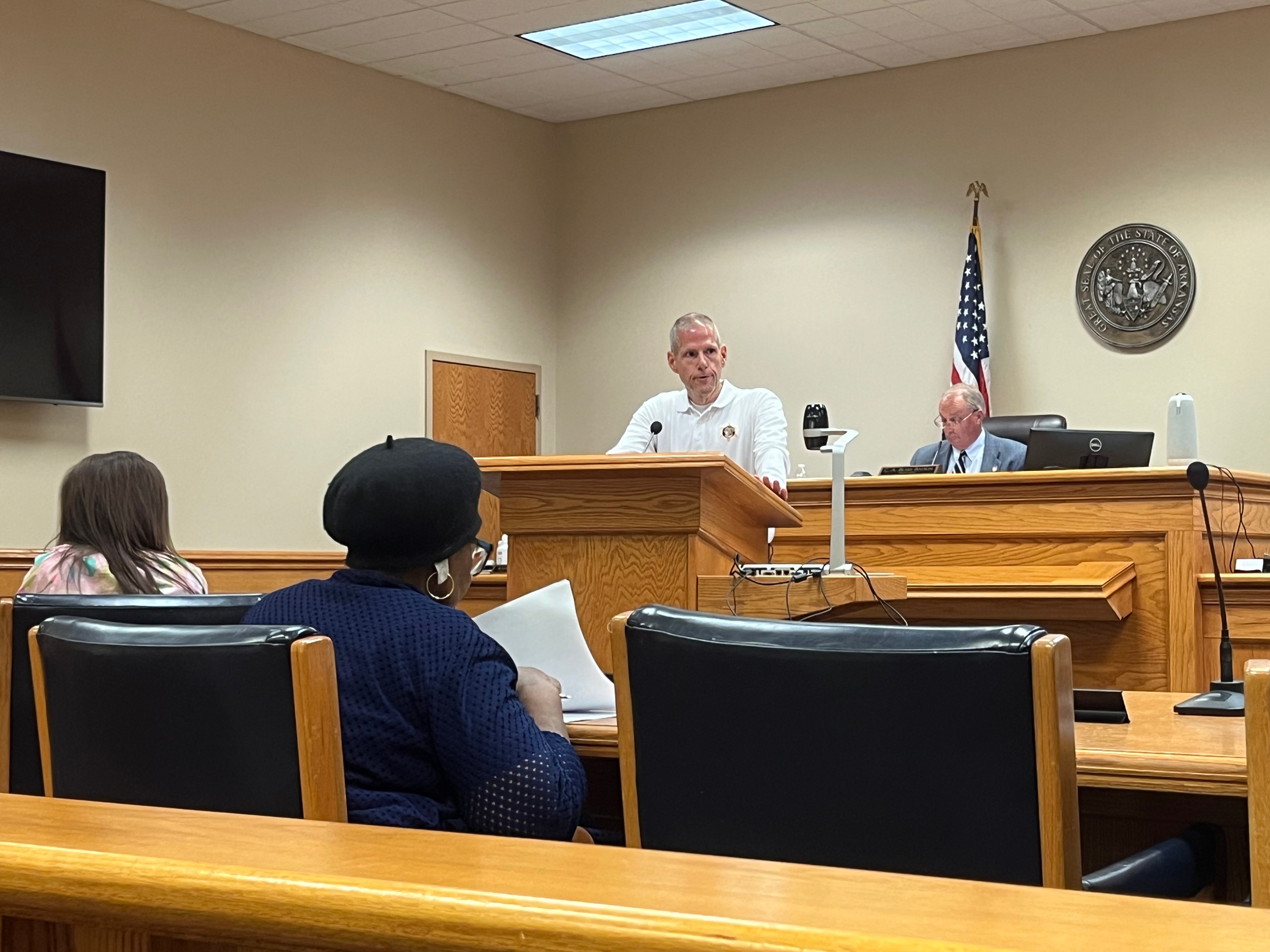
JAILHOUSE TALK — Speaking from the podium, Sheriff Jason Watson addresses members of the Clark County Quorum Court about the ongoing issue of the county’s detention center future. | arkadelphian.com photo by Joel Phelps
By JOEL PHELPS | arkadelphian.com
Clark County has the oldest and smallest jail of all its neighboring counties, including those with much smaller populations.
Sheriff Jason Watson on Monday warned justices of the peace that it’s time to seriously consider the future of housing prisoners in Clark County.
“Nothing has to be done overnight,” Watson said, “but something’s going to have to happen at some point.” In a brief address to the quorum court, the sheriff said there was a recent meeting held with the state Criminal Detention Facilities Review Committee to “address concerns and issues with the jail and to start developing a plan moving forward.” Watson said the state jail standards director was present at the April 17 meeting and explained the state recognizes the local jail issues.
Watson said the panel will begin holding monthly meetings, though he had yet to lock in the next date.
Jail overcrowding, understaffing, inadequacies and constitutional violations were all issues discovered when, in 2024, the National Institute of Corrections paid a visit to the local jailhouse and informed the quorum court of its findings.
Justice Vanilla Hannah asked the sheriff at Monday’s meeting whether he had prioritized the jail’s most pressing needs.
“There are so many issues we’re dealing with, it’s hard to put which one [is the most important],” Watson replied. “Obviously, the size, and the money we’re spending on housing inmates outside of Clark County: ankle monitors and things of that nature. But that’s our first issue we’re working on. But to prioritize one over the others, it’s hard [to do] right now.”
The quorum court had no other pressing questions or comments for the sheriff during the public meeting.
“I’m not going to ask for money we don’t have.”
Clark County Sheriff Jason Watson
Understaffing became apparent in early April, when a trusty walked away from his kitchen duty one afternoon, sparking a multi-agency manhunt that went on for nearly two and a half days before he was recaptured about 5 miles from the Arkadelphia facility he escaped.
Built in 1985, the Clark County Detention Center is rated to house 49 prisoners, though at times there are nearly a dozen more prisoners packed into the 40-year-old facility.
Compared to neighboring counties — including those of similar population and even those half its size — Clark County is behind the times when it comes to housing prisoners.
The Arkadelphian conducted an online survey of county jails throughout the region. Of the six counties surveyed on the year its jail was built, the number of prisoners it can house, and the county’s population, here are the results:
- Clark County’s jail, in Arkadelphia, was built in 1985 and can house up to 49 prisoners. Clark County had an estimated population of 20,900 residents as of 2024.
- Ouachita County’s jail, in Camden, was built in 2010 and has 139 beds for prisoners. Ouachita County had an estimated population of 21,700 residents as of 2024.
- Hot Spring County’s jail, in Malvern, was built in 2009 and can house over 50 prisoners. Hot Spring County had an estimated population of 33,608 residents as of 2026.
- Dallas County’s jail, in Fordyce, was erected in 1999 and can house up to 125 prisoners. Dallas County had an estimated population of 6,100 residents as of 2025.
- Nevada County’s jail, in Prescott, was built in 2016 and can house up to 81 prisoners. Nevada County had an estimated population of 7,942 residents as of 2025.
- Pike County’s jail, in Murfreesboro, was built in 2009 and can house up to 148 prisoners. Pike County had an estimated population of 9,964 residents as of 2025.
Asked what those figures say about Clark County’s jail, Sheriff Watson stated the obvious: “We’ve got more population but less jail space, and the other facilities are all newer. These numbers tell me we have definitely outgrown our jail.”
As for a solution, ideas point to a new facility; however, funding — and just how much might be needed — remains the top question. Bluntly put, Watson said he didn’t have the answer to how to fund a new jail.
“I’m not going to ask for money we don’t have,” Watson told The Arkadelphian in a telephone interview. “Before I approach that I want to inform the citizens on how much we’re spending on housing them elsewhere, and the soft costs to transport them, including deputy manpower and fuel to transport them to and from court appearances.” The sheriff said he is compiling a detailed list of expenditures from the past five years, and expects to have that report ready by June.
While the jail’s capacity is 49, the state recommends the local jail operate with no more than 35 prisoners to avoid understaffing, Watson said. That, however, can at times be a tall order. There were 44 prisoners on the roster Tuesday, with 9 being housed in facilities outside of Clark County. Watson said it’s nearly a daily occurrence to transport prisoners to and/or from other counties. Females and juveniles, for instance, are typically transported elsewhere, as the local jail isn’t equipped to house them. Juveniles are often taken to Yell County, in the Arkansas River Valley city of Dardanelle, and females are taken to jails in either Prescott or Murfreesboro. Another facet to the issue of overcrowding is the longer stays by convicted prisoners as they await a cell at the backlogged Arkansas Department of Corrections.
So who is guaranteed space at the Clark County jail? “Individuals charged with serious or violent crimes, or those with parole revocations,” Watson said, noting the decision to offer house arrest or ankle monitoring boils down to a number of criteria, from nonviolent crime to the offender’s medical needs. “However, if they’re a danger to our community we’ll make it work no matter what,” the sheriff said.
Until a plan is formalized, Watson pledged to provide monthly updates to the quorum court and to meet often with a jail committee comprised of local community leaders. He said citizen involvement would be part of the planning process.
Referring to the review committee’s nudge last month to create a long-term plan, Watson said it wasn’t exactly a suggestion. “It’s been brought up since my first year in office, and I’m in my 16th year,” he explained. “We are going to have to do something.” A newly built, larger jail with at least double the current capacity would be the ideal solution, he said.
The worst-case scenario? The state shuts down the local jail, forcing the sheriff’s office to farm out all its prisoners, transporting them to and from those facilities for court appearances. “We would spend way more that way than we ever would on a new facility,” Watson said.
Discover more from
Subscribe to get the latest posts sent to your email.