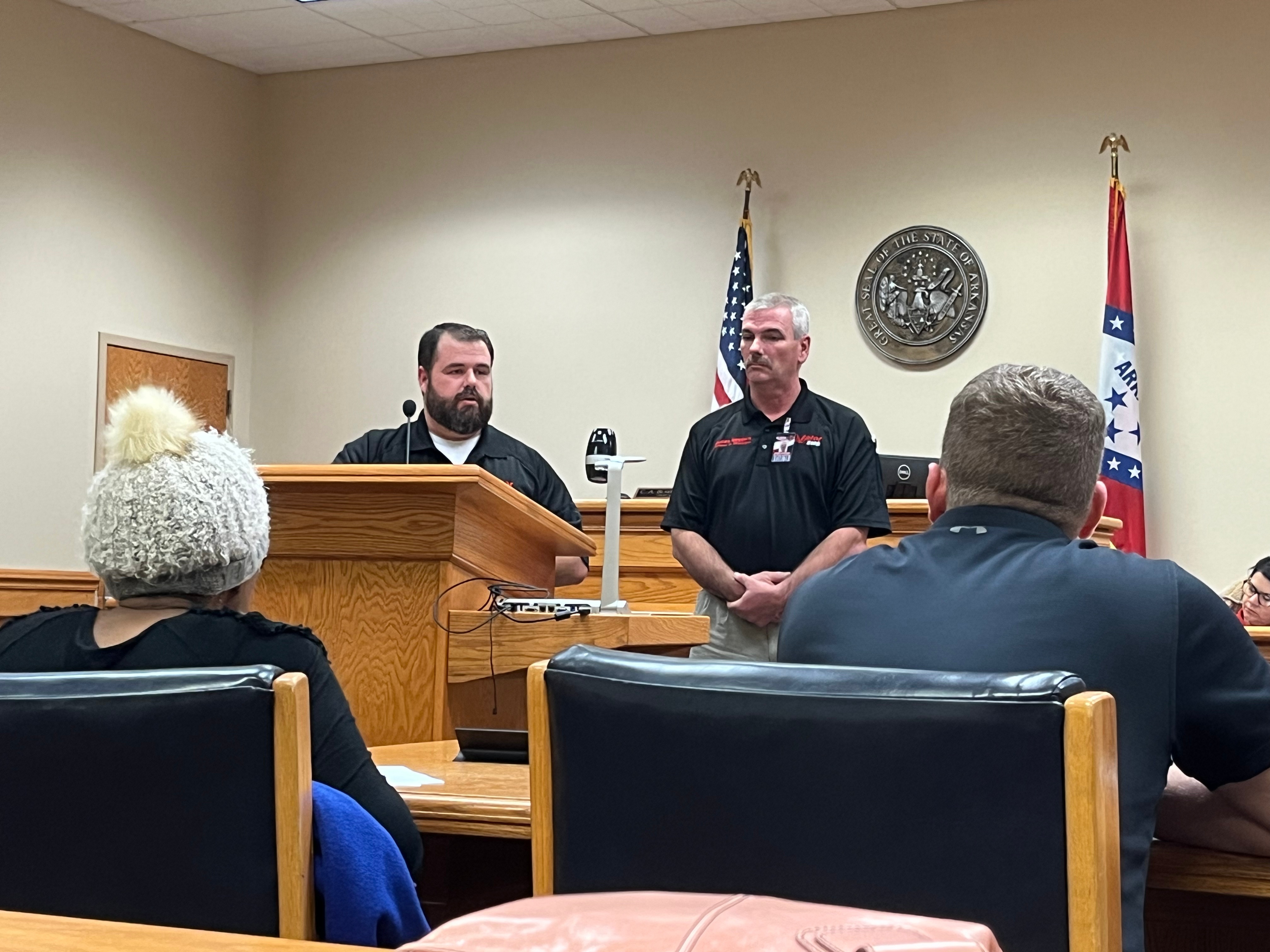
THE MAN COMES AROUND — J.D. Windham, former CEO of an ambulance company that last week yielded its operations in two South Arkansas counties to Pafford EMS, addresses members of the Clark County Quorum Court in a meeting in early 2026. Windham now works for Pafford after a year-long battle with that company for a Clark County contract. | arkadelphian.com file photo
By JOEL PHELPS | arkadelphian.com
Let bygones be bygones. That was the message that came across as J.D. Windham and Jamie Pafford Gresham addressed the Clark County Quorum Court on Monday.
Before Valor EMS ceased operations last week, Windham and Gresham’s combined presence in the same room created so much tension that you could cut it with a knife. That’s because the once-sworn–enemies spent the better part of 2025 in a heated battle to secure a contract for ambulance services in Clark County. The quorum court ultimately gave its support to Windham’s Arkadelphia-based Valor EMS. A contract that was never officially inked allowed Valor to respond to all of Clark County’s 911 medical emergencies.
Meanwhile, Pafford Emergency Services, which bought Baptist Health’s ambulance fleet this time last year, would continue hospital-to-hospital transfers. Those transfers apparently held the key to financial success, as Windham, claiming his company had lost half a million dollars in the months since Valor was awarded the contract, would later plea with the quorum court to include transfers in the contract.
In a plot twist last week, Windham made the surprise announcement that his company was folding — and yielding its operation entirely to Gresham’s Pafford EMS, a major regional provider worth millions. Furthermore, Windham accepted a job with Pafford as a regional manager, responsible for overseeing Pafford’s operations in Clark and Dallas counties, where Valor responded to 911 calls.
The news broke days before Windham was set to give the quorum court a quarterly report from his company.
At Monday’s meeting, county Judge Troy Tucker said he’d asked Windham to address justices because, he said, Windham owed an explanation about what took place between Valor and Pafford. Tucker, who as the county’s executive signs contracts, was scrutinized throughout the ambulance saga; he announced he would not be seeking re-election the day after Valor was awarded the 911 contract.
After providing a brief quarterly report, Windham apologized to the judge, to the quorum court and to the citizens of Clark County for his inability to sustain the ambulance service. “I probably blindsided a lot of people,” he said. “You guys took a chance on us.”
Windham explained that he’s learned some things about the ambulance business: some were within his control, and some were without — particularly operational costs, Medicaid, Medicare, payments from insurance companies, and getting patients to pay their bills. “Over the past three months we have been struggling,” Windham admitted. “I thought we’d be able to pull out of it, but it just started closing in too quickly.” While some operational cuts were made, Windham said he was proud to report that his company’s 16 employees never went without payroll. Thirteen of them accepted employment with Pafford; each of them are expected to continue serving their local areas.
“We didn’t make it as Valor, but we did make the decision to hand it over to somebody that could,” he said, adding that he wasn’t pressured by Pafford, whom he approached and initially met with for 3 1/2 hours. “I’ve not woken up one single day and felt like it was the wrong decision,” he said, asking the court its forgiveness for the inability to deliver on his promises.
Some justices applauded Windham for his efforts and for the services his company provided. Judge Tucker then grilled Windham with numerous questions from Facebook posts. The following is dialogue between Tucker and Windham:
Tucker: “When the Baptist ambulance service … decided to sell to Mrs. Pafford, do you think they had the right to do that, or did our hospital do anything wrong?”
Windham: “Knowing what I know now, I don’t think it was a wrong decision, because they knew things I didn’t know. They knew a lot more about revenue and [sic] management than I did. We did have smaller call volumes and smaller quantities to manage.”
The judge pointed out that Windham — like Baptist selling its ambulance service to Pafford — had conducted a private business transaction.
Tucker: “The hospital had that right, but there were comments on Facebook saying the hospital was in the wrong, and I never could understand that,” Tucker said before moving on to his next question.
Tucker: “After the hospital did sell, Mrs. Pafford came to me with a contract, and I only agreed to a temporary contract until we could put out an RFQ, which was not a requirement. We did that because you had a lot of community support, and I felt like that was a fair thing to do. The 911 board formed a citizens committee of various medical professionals. Do you think that was a fair committee?”
Windham: “I would say so.”
Tucker: “You do know the committee did not vote for Valor at that time. Do you know why that was?”
Windham: “I was told it was due to financing.”
Tucker: “It was. The reason I bring that up is it never has been a question of your level of service. No one ever doubted that. … But it was the citizen committee’s concern that financially you wouldn’t be able to fulfill your obligation.”
That committee’s vote was reinforced by a decision from the county’s 911 board in favor of Pafford.
Tucker: “Do you think the [911] committee was a fair committee?”
“I would think so. Everyone on that committee is respected. I would like to add to that we never had an issue with that committee in the last six months.”
Tucker pointed out that, prior to the quorum court’s vote in September, he would honor its decision and work out the details of the contract. Once that vote was finalized, Tucker asked Windham from across the courtroom who his attorney was: Greg Vardaman.
Tucker: “Who prepared that contract?”
Windham: “I believe Greg Vardaman did [write the contract]. He just said he wasn’t able to represent us as far as negotiating the contract.”
Tucker added that, since then, Valor attorney Clint Mathis addressed the quorum court in March, presenting a document indicating $6,000 was owed to the county and municipalities for 911 dispatch fees. He asked Windham if he had that money.
Windham: “I’ve got it right here, Judge, if you’d like it.”
Tucker directed Windham to give the check to the county treasurer.
Tucker: “Well, thank you and again, I don’t think it can be stressed enough that this was never an issue of whether or not you can provide a great level of service, because I think everybody felt like you could. You’re as probably as effective a paramedic in our community as anybody could ask for. It just simply boiled down to the financial side of it. It didn’t work. We are who we are today.”
In a lengthy address to the court, Gresham, citing a barrage of publicity and social media posts aimed at Pafford, said the past year was among the most difficult of her career, and applauded Clark County for the numerous citizens involved in the decision-making process. Gresham also vowed to be transparent in her reporting to the court and said she wants to hear about any service-related issues as they become known.
Tucker then called on the court to support a contract with Pafford. At the motion of Justice Zach Bledsoe, the court gave its unanimous approval to contract with Pafford.
Discover more from
Subscribe to get the latest posts sent to your email.