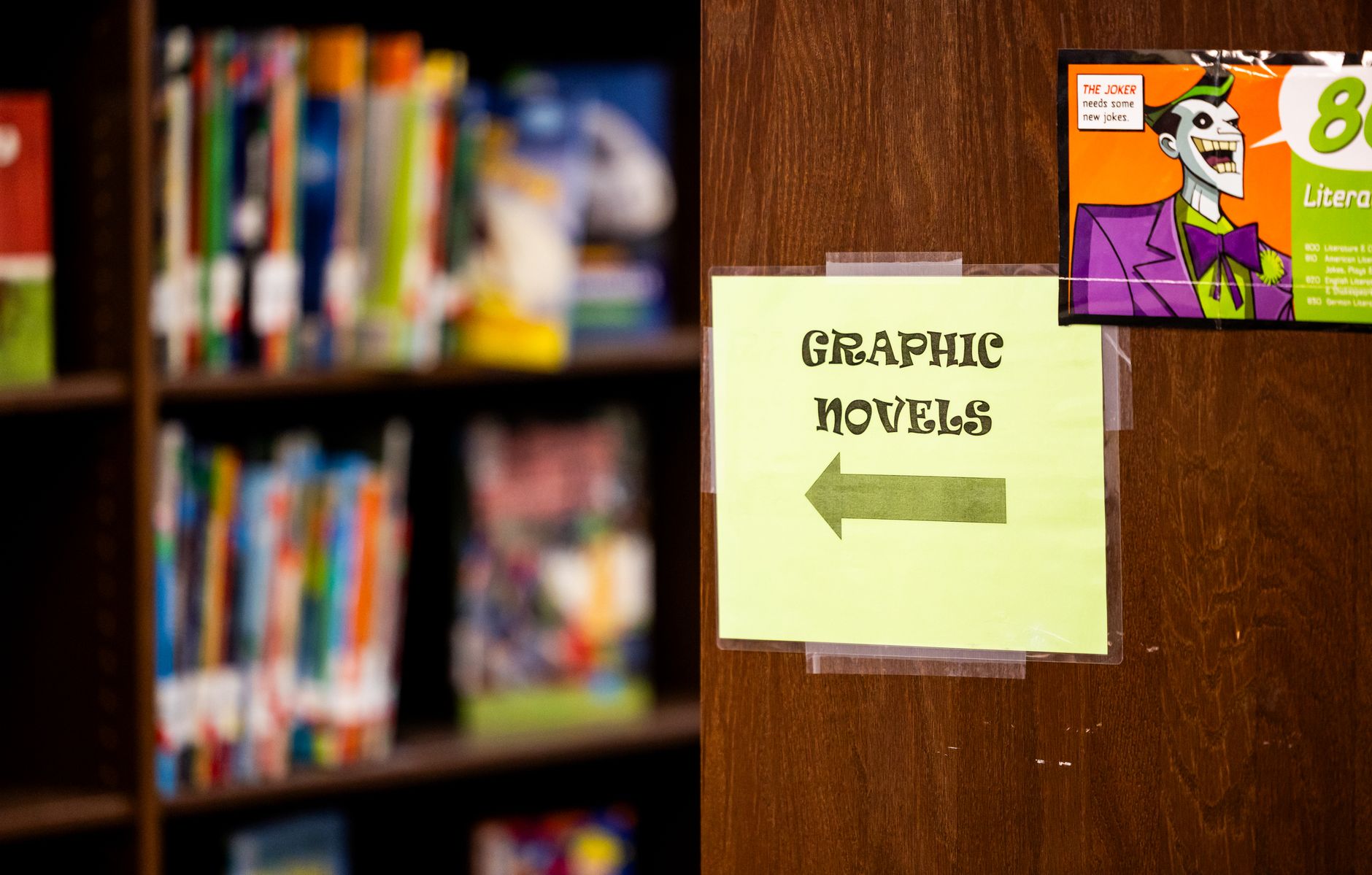
A sign points the way to the graphic novels section of a library. | Pexels image
A federal appeals court ruled Thursday that Arkansas’ 2023 law restricting access to library materials can go into effect, three years after a judge blocked two sections of the law on First Amendment grounds.
The three-judge panel from the 8th U.S. Circuit Court of Appeals in St. Louis ruled that the 18 plaintiffs had no standing to challenge one section of Act 372 and failed to prove that the other section was unconstitutionally vague.
The two sections create criminal liability for librarians who distribute content that some consider “obscene” or “harmful to minors,” and give city and county governing bodies the final say over library content.
Republican Attorney General Tim Griffin praised the ruling, saying it “allows Arkansas to move forward in enforcing a law that protects children from obscene materials while increasing accountability for public-library curation decisions.”
The plaintiffs challenging the law include libraries, bookstores, advocacy groups and individual library patrons. Their lead attorney, John Adams, said in a statement that the legal team is “evaluating all available legal options, including further review by the courts,” after Thursday’s ruling.
“Libraries and bookstores should be places where people can freely explore ideas — not where booksellers and librarians face criminal liability for selling, checking out, or even just shelving constitutionally protected books,” Adams said. “The freedom to read is fundamental to a free society and has always been protected by the First Amendment.”
Griffin said Act 372 was meant to “to address legitimate concerns about minors’ access to obscene materials and to establish a process for reviewing challenged content.”
School and public libraries already had content challenge policies before Act 372. The law stalled in the Legislature in 2023 before it was amended to say library materials would be relocated to an area inaccessible to minors, not removed from the premises, if elected officials find them to be “obscene.”
Section 5 of Act 372 allows city and county governing bodies to relocate challenged material if a challenger disagrees with a library panel’s decision to keep it in its original section.
Another section of the law that gave school boards the same authority over school library materials had not been challenged.
Adams told the appeals court in June that Crawford County, a defendant in the case, showed what the law’s restrictions would look like in practice. The county’s five library branches separated LGBTQ+ children’s books from the rest of the collection after public outcry, and county officials cited Act 372 as a reason to maintain these “social sections,” even before the legislation became law.
Crawford County lost a separate federal lawsuit in 2024 after three parents alleged that the “social sections” violated the First Amendment.
The three library patrons who sued over the state law do not have standing because Section 5’s book challenge and relocation policies do not harm the plaintiffs, the appeals court panel said Thursday.
“Plaintiffs are speculating libraries might decide to segregate certain books as part of their curation policies, which they have not yet adopted, or in response to challenges, which have not yet been filed,” the panel wrote.
The librarian and bookstore plaintiffs have standing to challenge the other section of the law because they would be at risk of prosecution for noncompliance, according to the ruling, but the three judges disagreed with Adams’ claim that Section 1 of Act 372 was too vague.
This section makes “furnishing a harmful item to a minor” a Class A misdemeanor. Conviction would lead to a maximum prison sentence of one year.
U.S. District Judge Timothy Brooks wrote that the law’s lack of a definition for terms like “furnishing” and “harmful” could lead to violations of the First Amendment right to freedom of speech.
An unchallenged provision of Act 372 removes schools and public libraries from the part of Arkansas state code that previously exempted them from prosecution for disseminating obscene content. Another unchallenged provision made school and public library employees liable for a Class D felony if they “knowingly” distribute obscene material or inform others of how to obtain it. A Class D felony conviction carries a maximum prison sentence of six years.
However, the language of Section 1 “limit[s] its application to situations when a person knowingly furnishes an item to a minor knowing of the item’s harmful character” and therefore is not too vague, the appeals court ruled.
Chief Judge Steven Colloton wrote in a concurring opinion Thursday that he understood the plaintiffs’ vagueness claim but disagreed with it “because third-party library patrons have no constitutional right to receive unfettered access to books of their choice at taxpayer expense.”
Colloton was appointed to the court in 2003 by then-President George W. Bush and has been chief judge since 2024. President Donald Trump appointed the panel’s other two judges, Ralph Erickson and L. Steven Grasz, in 2017.
Erickson was on the three-judge panel in April that allowed a 2023 Iowa law to go into effect, requiring the removal of books containing “descriptions or visual depictions of a sex act” from Iowa public school libraries.
The removal of the injunction on Act 372 comes as the Arkansas Department of Education has been considering requiring public libraries to restrict children’s access to “sexually explicit materials” in order to receive state funding.
Dozens of Arkansans told the education department in June that they oppose requiring libraries to ensure patrons age 16 or younger cannot check out materials that depict or describe sexual contact and behavior.
The Arkansas State Library Board will meet Aug. 14 to consider sending the rules to a legislative panel for further approval. Republican Gov. Sarah Huckabee Sanders appointed all six board members.
Arkansas Advocate is part of States Newsroom, the nation’s largest state-focused nonprofit news organization.
Discover more from
Subscribe to get the latest posts sent to your email.