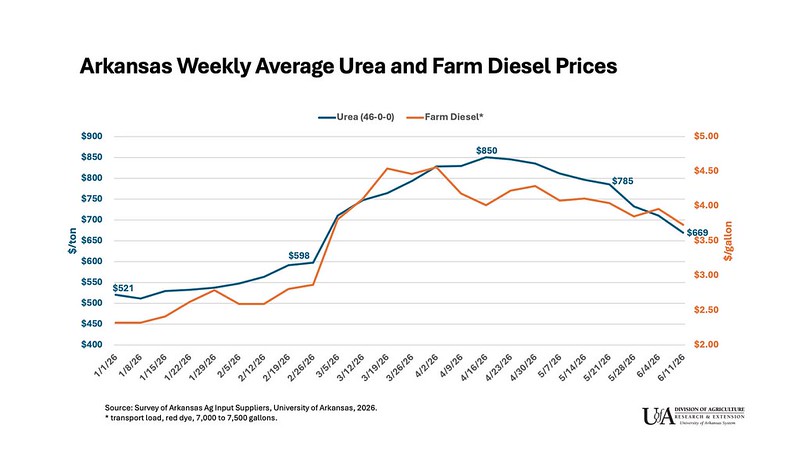
Graph tracking average weekly urea and diesel prices. | UADA image by Scott Stiles
Fast Facts
- Urea prices drop 20-25% from April peak
- About a third of global urea comes through Strait of Hormuz
- Hardke: Rice growers “felt the full brunt of the price increase at the worst possible time.”
By MARY HIGHTOWER | University of Arkansas Division of Agriculture
Urea prices, which spiked with the shuttering of the Strait of Hormuz, are on the decline, but that break comes too late for some farmers, extension experts said.
Scott Stiles, extension economics program associate for the University of Arkansas Division of Agriculture, conducts a weekly survey of fertilizer prices. He says prices have turned lower in recent weeks.
The survey includes urea, a nitrogen source for plants that’s dependent on petroleum.
Between 25 and 35% of all globally traded urea moves through the Strait of Hormuz. The United States sources roughly 17% of its total domestic urea consumption directly through the strait.
“The average price for urea in our survey this week was $669 per ton,” Stiles said. “That is the lowest weekly average price since the end of February and prior to the Iran conflict.”
Urea prices peaked in mid-April.
“At that time, we were hearing of some quotes as high as $900 per ton,” he said. “Currently, urea prices are 20-25% below the mid-April highs, depending on location.”
Stiles said that retail urea prices in Arkansas are linked to the New Orleans wholesale barge market.
“Prices there have dropped sharply in recent weeks and are now back at pre-Iran war levels,” he said. “I think some of the Iran war premium is evaporating.”
In addition to issues in the Middle East, Stiles said, “China has recently lifted urea export restrictions. From a seasonal standpoint, U.S. retailers should have enough supply on hand at this point to cover 2026 application needs.”
Oil and fertilizer
In the early weeks of the Iran conflict, not only did urea prices spike, but also fuel prices.
“By mid-April, urea had increased about 40% and diesel about 75% from where it was in the last week of February,” Stiles said. “For rice, that added roughly $120 per acre in variable costs.”
“It will be interesting to see if those combined events shifted crop acres around. The upcoming June 30 Acreage report may reveal an even larger pivot to soybeans,” Stiles said. “It may reveal an even larger pivot to soybeans.”
Too late
Based on a survey done by American Farm Bureau, the majority of growers in southern states didn’t have their fertilizer booked before the price spike.
Jason Kelley, wheat and feed grains extension agronomist for the Division of Agriculture, said that for corn growers, “we are too late for a price drop to help. At this point, about 95% of nitrogen has been applied.”
“It’s a similar story for rice,” said Jarrod Hardke, extension rice agronomist for the Division of Agriculture. “The majority of the crop has been fertilized and put to flood and far beyond.
“However, most rice only receives 70-80% of its nitrogen at the preflood timing,” Hardke said, “There is the possibility of some relief for applications on the remaining 20-30% done at mid-season and later.
“The gradual decline in urea price over the past few weeks has helped some with later rice going to flood for sure, but many felt the full brunt of the price increase at the worst possible time,” Hardke said.
In cotton, the price relief depends on when growers booked their fertilizer purchases.
“While we haven’t applied all of our nitrogen on cotton yet, I would wonder how many of our producers already booked theirs and therefore won’t benefit from any present-day price drop,” said Zachary Treadway, extension cotton agronomist for the Division of Agriculture. “But, for any producers that didn’t book early, this decrease in price could be a welcome relief.”
To learn about extension programs in Arkansas, contact your local Cooperative Extension Service agent or visit uaex.uada.edu. Follow us on Facebook and Instagram. To learn more about the Division of Agriculture, visit uada.edu. To learn more about ag and food research in Arkansas, visit the Arkansas Agricultural Experiment Station at aaes.uada.edu.
Discover more from
Subscribe to get the latest posts sent to your email.