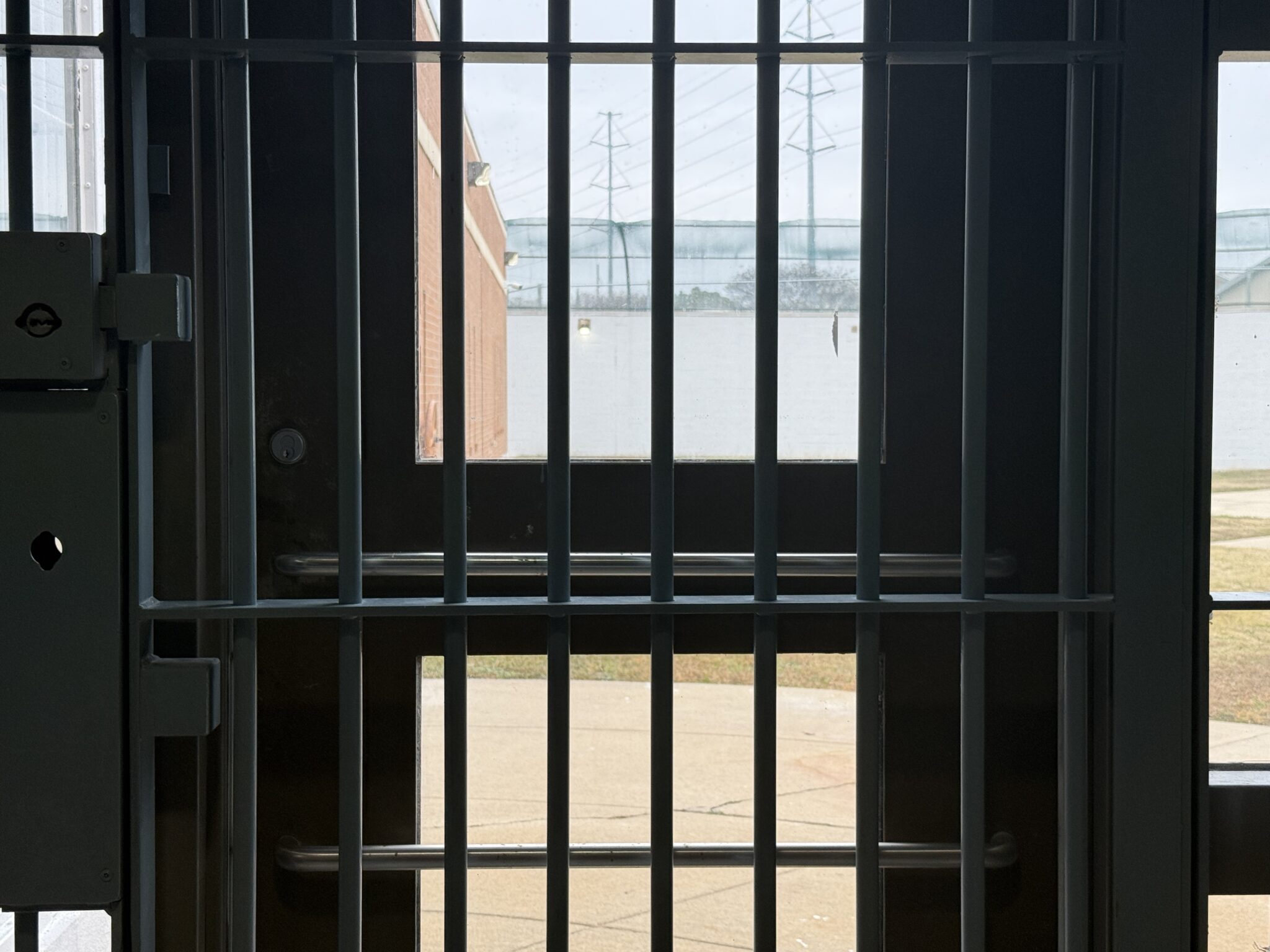
IN THE JAILHOUSE NOW — A door inside the Dr. Mary L. Parker-Reed Women’s Health Unit in Little Rock on Dec. 17, 2025. | Photo by Ainsley Platt/Arkansas Advocate
By AINSLEY PLATT, TESS VRBIN & ANTOINETTE GRAJEDA | Arkansas Advocate
A controversial plan to build a 3,000-bed prison in Arkansas is on hold after a year and a half of steadfast opposition from the local community and a group of lawmakers.
The plan to build a facility on 815 acres of Franklin County farmland, first unveiled by Republican Gov. Sarah Huckabee Sanders in 2024, had the support of several Republican lawmakers as a solution to Arkansas’ growing prison population.
But bipartisan opposition in the Senate doomed efforts to pass an appropriations bill to start construction, and legislative leaders said before the 2026 fiscal session that prison supporters and opponents remained at an impasse.
A lack of prison capacity is not a new issue in Arkansas. But with the prison population set to continue growing over the next 10 years, and the governor’s choice to address the growth on ice — at least for now — what are the alternatives?
Why not Franklin County?
Sanders hasn’t explicitly given up on the Franklin County site, but the location faces challenges in the Legislature. It’s also drawn resistance from locals, who say the location isn’t suitable for such a large facility.
When the Franklin County plans were first announced, local residents and elected officials said they were blindsided by the governor’s plans and decried a lack of transparency about its selection.
Residents opposed to the project have said they want to maintain the peacefulness of their rural community, questioned where the workforce to support the prison will come from and suggested that the state focus on providing more resources to keep people already in prison from returning instead of building a new prison.
The project was likely the cause of higher-than-typical turnout in Franklin County for a special legislative primary in January. The prison also drove a number of voters to the polls during the March primary.
In addition to local opposition, officials face challenges in delivering the needed infrastructure to the rural prison site. Testing last year indicated that water wells on the property were likely not enough to support what would be necessary for the proposed prison.
Having nearby communities provide the needed water supply was also problematic. Fort Smith officials said last summer the city lacks the water supply capacity to meet the prison’s needs without upgrades, while the Ozark City Council voted against initiating water supply talks with the state in November.
All the needed upgrades come with a cost, and state lawmakers have struggled to find enough votes to spend more on the project. A $750 million appropriation bill failed five times in the Senate last year, and legislative leaders have said they don’t believe there are enough votes to address funding during this year’s fiscal session.
Sanders has requested special language in a corrections department reappropriation bill that would prohibit certain funds from being used for the project.
The Legislature set aside $330 million for the project in 2023 that hasn’t been appropriated. State lawmakers can release that funding, but need enough votes to grant that spending authority.
Can Arkansas expand existing facilities?
The state had expansion plans before the Franklin County prison project was announced.
After Sanders took office in 2023, the corrections department paused three prison expansion projects started by her predecessor, Republican Gov. Asa Hutchinson.
In November 2022, the department sought land to build two new facilities: a 300-bed community corrections center and a 1,000-bed prison. The agency received two land donation offers of more than 400 acres each in Hempstead County for a new prison. Offers also came from Hempstead, Dallas, Nevada and Searcy counties for the community corrections center.
The Department of Corrections has not revisited any of those options, spokesperson Rand Champion said in an email. Former Arkansas Board of Corrections chairman Benny Magness, who served on the panel for more than two decades before departing in December, said expanding existing units likely isn’t feasible due to the difficulty of hiring enough workers to staff existing beds.
Magness and current chairman Jamie Barker both said a Sanders-backed effort to raise pay for correctional officers helped the department retain prison staff. Managing turnover was critical for creating consistency for both the prison staff and incarcerated people, Magness said.
Both men expressed concerns about staffing if bed space was added in communities that already have prisons. Barker didn’t completely rule out future expansions though.
“I think it would be silly to say, ‘Absolutely not,’” Barker said. “I don’t think any door would be closed to expanding an existing facility if there’s a way to do it in a way that’s cost effective for the taxpayer, that we can staff and that helps address the (capacity) problem.”
Why not build a prison elsewhere?
When the state was searching for land to build a new prison, criteria included the site being at least 60 miles from an existing corrections department facility.
If a prison isn’t built in Franklin County, Magness and corrections board member Lee Watson have said the state needs new, smaller correctional facilities somewhere in the northwestern region of the state.
“I don’t think there is any place in Arkansas that can support a 3,000–bed facility,” Watson said. “If you put it in the middle of Little Rock, I don’t think we could staff it.”
Magness, who has said drugs are a primary driver of the state’s growing prison population, said he would like to see the state build a 1,500-bed facility in northwest Arkansas. Plus, he’d like a minimum of three facilities that can provide assistance for drug and alcohol addiction scattered across the state.
This would expand treatment space, while smaller facilities make it more difficult to smuggle in contraband, he said.
“If you can keep (incarcerated people) away from their chemical dependency, they have a chance to succeed,” Magness said.
Barker said wardens at Arkansas’ existing facilities in south Arkansas told him staffing remained one of their biggest issues. For that reason, building a larger prison too close to an existing one wouldn’t be ideal, he said.
“If you don’t have the people, or you’re cannibalizing people from another facility … I just think you would be creating as many problems as you might be solving in certain scenarios,” he said.
Will Arkansas turn to private prisons?
Many states and the federal government use prisons owned by private prison companies, or outsource a state facility’s operations to a private operator.
In 2022, 8% of incarcerated people in the United States were being held in private prisons, according to The Sentencing Project. Critics of privately-owned or operated prisons say companies provide inadequate staffing and medical care to increase profits, while proponents say the private model is more cost-effective while increasing safety for incarcerated people by reducing overcrowding.
Democratic President Joe Biden signed an executive order to cut back on the federal Bureau of Prisons’ use of private prisons in 2021. That order was rescinded by President Donald Trump after he returned to office last year, and private prison companies like Core Civic and The GEO Group have profited from the administration’s immigration crackdown.
For its part, Arkansas has a relatively limited — though not unblemished — history with private facilities.
The Grimes and McPherson units were built and initially operated by Wackenhut Corrections Corporation — now known as The GEO Group — opening in 1998.
But the state took control of the two prisons in 2001, after what Magness described as “very serious” security breaches at the Grimes Unit, which held men. He said there were also issues with staffing, cleanliness and other problems at the McPherson Unit, which held women.
A U.S. Department of Justice investigation, which began less than a year after the state regained control of the units in 2001, found the prisons’ conditions violated the constitutional rights of the people imprisoned there, according to a 2003 letter to Republican Gov. Mike Huckabee. The letter cited inadequate medical care, “inadequate protection from physical harm and sexual misconduct,” and environmental conditions that were unsafe and unsanitary.
Arkansas’ Corrections Cooperative Endeavors and Private Management Act of 1987 and amendments passed in 1999 regulate the construction and operations of private prison companies in the state. No private prison can be built without consent from the Board of Corrections and Arkansas Legislative Council.
Magness said that experience made him “adamantly opposed to a private prison coming into Arkansas” while he was on the board. He is less opposed now, saying private beds could be a solution for the state’s crowding issues, but said it was crucial that a contract with an operator stipulates that Arkansas can retake control of a unit for any reason.
Another alternative would be sending people to a private facility in another state — something Magness described as preferable to allowing a private prison in-state. But there are downsides for families, he added.
“If you were to contract, let’s say in Pennsylvania, Ohio or Arizona or something … most of them would not be able to afford to visit their loved ones in prison,” Magness said. “I know that when we did talk about outsourcing some beds to private entities outside the state, my phone would ring off the wall” with calls from opposed families.
For Watson, the cost of using a private prison operator would need to be scrutinized, as well as safety and whether the company could meet Arkansas’ standards.
“We run our prison system more efficiently than about 46 of the states, as far as cost per day per inmate, and a lot of that’s the product of, just to be blunt about it, because we’ve never been given the money to do more things we’d like to do regarding programming, facilities, everything else,” Watson said.
Discover more from
Subscribe to get the latest posts sent to your email.