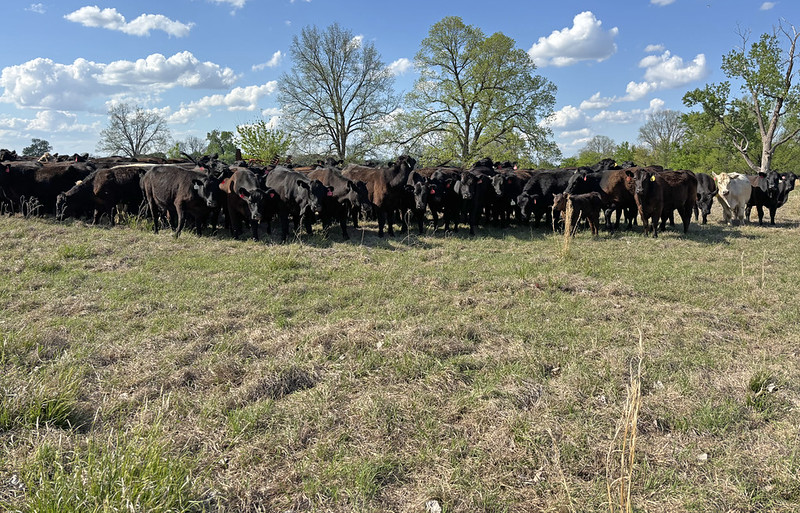
GRAZING — Cattle grazing in Faulkner County, taken April 9, 2026. | UADA photo by Kevin Lawson
By MARY HIGHTOWER | University of Arkansas System Division of Agriculture
Some Arkansas ranchers are reaching into their reserve hay as drought intensifies across the state.
The April 9 map from the U.S. Drought Monitor shows 99.96% of Arkansas has some form of drought. Areas with the highest intensity of drought — exceptional drought — increased to 8.36% of the state from 3.86% two weeks before. Most of the exceptional drought is in northeast and north-central Arkansas, with a growing area concentrated in Perry County.
In its April 12 data, the National Agricultural Statistics Service reported that 74% of Arkansas’ pastures were in fair, poor or very poor condition, while 22% were good and 4% excellent. Hay was about the same, with 50% rated in fair condition, 26% poor or very poor, 23% good and 1% excellent.
“The forage situation in White County is pretty rough,” Brian Haller, White County extension staff chair for the University of Arkansas Division of Agriculture, said on Monday. “Most have been feeding hay since October and are getting into their reserves. I have heard of several producers buying hay in fear that this year’s hay season won’t be good.”
In Arkansas, ranchers grow both winter and summer annual forages. Haller said, “our winter annuals are hurting from the drought. They are green but just not growing.
“The freeze on March 16 burned back ryegrass and oats pretty bad,” he said. “They are starting to green back up, but the lack of moisture is hampering the grow back.
“In White County, most farms averaged three-quarters of an inch of rain Saturday,” Haller said. “Some parts of the county got almost an inch. It was much needed and welcomed, but we need more.”
Kevin Lawson, Faulkner County extension agent, said the drought situation in his county was similar to White County.
Pointing to two producers who cut and baled ryegrass in his county, Lawson said, “It dried in about three days, which never happens with ryegrass cut this time of year. I know each year is always unique, but for it to just be early April, this is the oddest year I have ever seen.”
Flint Harrelson, director of the Livestock and Forestry Station for the Arkansas Agricultural Experiment Station near Batesville, said, “We have had some delay in growth of grass in the pastures, and we definitely saw some reduction in grazing days for our wheat pastures this fall and into the spring.
“We have, thankfully, gotten a few rains lately which have helped us, but we certainly need more rain for our hayfields or we will not get the amount or quality of hay we typically produce,” he said.
The experiment station is the research arm of the Division of Agriculture.
Michelle Mobley, Independence County extension staff chair, said the drought has put pressure on another resource: water.
“Ponds are low or even dry in places,” she said. “With cattle prices being strong right now, early weaning could be an option for some producers to reduce pressure on cows and forage resources.”
It’s an option Mobley is considering for her own operation, but “every situation is different, and it really depends on each operation.”
Jonathan Kubesch, extension forage specialist for the Division of Agriculture, said, “Unfortunately, that rain doesn’t correct a deficit that has carried into the early months of the growing season.
“South Arkansas fell into drought later than north central Arkansas, and so the response is going to vary,” he said.
“A lot of wetter ground has been firm enough to support early grazing, and there is some baleage being made in southwest Arkansas,” Kubesch said. “In contrast it looks like a number of pastures have been lost in north central Arkansas to drought and its complicating factors.”
Those complicating factors can include poor soil fertility, weak grazing management or overstocking.
“Drought rarely kills pastures and hayfields outright, but it’s often the final straw when the fields aren’t getting needed inputs and being asked to produce a lot of outputs,” Kubesch said. “A prolonged fall drought that has continued into spring also precludes a lot of winter annual plantings that could offset missing growth.”
Making a grazing plan
Amy Heck, Cleburne County extension staff chair, said that persistent drought means “management-intensive grazing will be critical this year.”
“Producers will be forced to manage their forage stands and not overgraze them to make sure cattle are obtaining the greatest utilization rate possible,” she said.
Kubesch said that “delaying turn out to pastures until the pastures are 8-10 inches tall and pulling animals when the pasture gets down to 3-4 inches will help to start pastures off with sufficient reserves to grow into drought.
“Plan to feed hay on the weakest pastures if pasture growth stops and have a cull list ready to reduce animal demand,” Kubesch said.
The Cooperative Extension Service has MP530, Drought Management and Recovery for Livestock Systems, available for download.
Kubesch is asking the state’s farmers and ranchers to document local conditions and submit information to the U.S. Drought Monitor.
“That will help us fine tune recommendations in the counties,” he said. “Having an inventory of pastures and hayfields — how much growth and on which species — will help to create a spring grazing plan.”
To learn about extension programs in Arkansas, contact your local Cooperative Extension Service agent or visit uaex.uada.edu. Follow us on Facebook and Instagram. To learn more about the Division of Agriculture, visit uada.edu. To learn more about ag and food research in Arkansas, visit the Arkansas Agricultural Experiment Station at aaes.uada.edu.
Discover more from
Subscribe to get the latest posts sent to your email.