
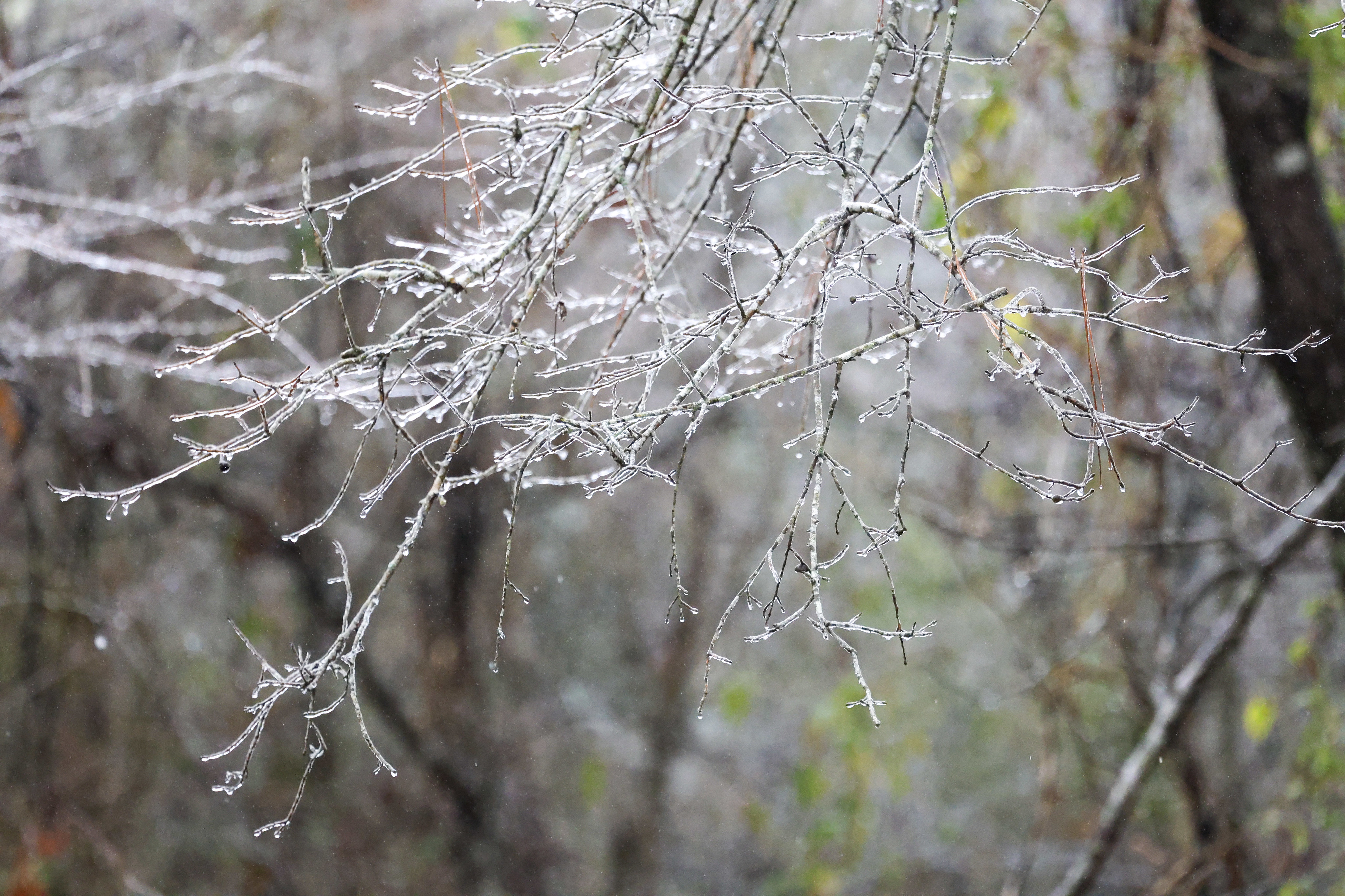
ICE BUILDUP: Even small amounts of ice buildup can cause significant and lasting damage to trees and forestlands. | UADA photo
By TRACI RUSHING | University of Arkansas System Division of Agriculture
Following recent ice storms across the southern United States, forestry experts caution landowners to watch for storm-damaged trees that threaten personal safety and the long-term health of forestlands.
Even small amounts of ice buildup can cause significant and lasting damage to trees and forestlands, said Jaret Rushing, extension forestry instructor for the University of Arkansas System Division of Agriculture.
“It only takes about one-tenth of an inch of ice accumulation for damage to occur on weaker limbs or on trees that are small or previously damaged,” Rushing said. “As ice builds up, the added weight places extreme stress on branches and trunks, often exceeding the strength capabilities of the wood itself.”
Ice damage commonly appears as broken or split treetops, stripped or torn bark and loss of large limbs that expose inner wood. These injuries reduce a tree’s structural integrity and limit its ability to transport water and nutrients, Rushing noted.
Rushing is part of the Arkansas Forest Resources Center, a Division of Agriculture research and outreach unit housed at the University of Arkansas at Monticello. The Arkansas Forest Resources Center conducts research and extension activities through the Arkansas Agricultural Experiment Station and the Cooperative Extension Service, the Division of Agriculture’s research and outreach arms.
Winter damage economics
Trees that lean under the added weight of ice or snow buildup, even for as little as 24 hours, can also start to accumulate reaction wood, a specialized type of tree growth that helps trees return to a vertical position.
“Reaction wood is nearly impossible to detect in standing trees, yet it causes shrinkage and warping of lumber to the point where it loses much of its value,” said Matthew Pelkki, Director of the Arkansas Center for Forest Business.
Beyond immediate structural damage, ice storms can present serious, long-term threats to forest health. Exposed inner wood provides ideal entry points for insects and disease organisms. Many forest pests are attracted to stressed or damaged trees, and fungal pathogens can quickly colonize freshly exposed wood.
If damaged trees are not identified and addressed, a single storm event can increase the risk of larger pest or disease outbreaks across a stand or even into neighboring forestlands.
“Damaged timber deteriorates rapidly due to exposure to fungi, insects and weather, requiring prompt and well-organized action,” said Shaun Tanger, associate director of the Arkansas Center for Forest Business. “The challenges extend beyond physical recovery, involving financial and technical decisions critical to preserving value and preparing the land for future growth.”
What to do after a winter storm
Following an ice event, landowners are encouraged to conduct an inventory of damaged trees to determine which will recover and which may need to be removed, Rushing said. Trees with minor limb breakage may survive, while those with major trunk splits, severe crown loss (with about 75% of their branches broken) or extensive bark damage are less likely to recover and may pose safety hazards and future forest health problems.
Safety should remain the top priority when considering assessment of storm-damaged timber. Downed trees, as well as some standing trees, may be under significant tension and can release suddenly when cut or disturbed, posing a serious risk to anyone nearby. Leaning trees, hung limbs and partially broken tops are especially dangerous and unpredictable, Rushing added.
Landowners should only enter storm-damaged areas when conditions are safe and should never stand under a tree that has visible damage. It is best to check for damage from roadways or at a distance. Consulting a certified arborist or registered forester is strongly recommended before attempting cleanup or harvest operations of hazardous timberlands.
In cases where many trees have been damaged, a salvage harvest may be necessary to recover economic value and reduce future forest health risks, said Pelkki, who is also a researcher with the Arkansas Forest Resources Center. Salvageability depends on several factors, including the extent of damage, the volume of timber available for harvest, acreage, species present and size distribution. Some species deteriorate more quickly than others once damaged, making timely decisions critical.
The Steps for Assessing Storm-Damaged Timber for Salvage Operations guide provided by the Arkansas Center for Forest Business can help landowners evaluate their individual situations and determine the appropriate next steps. Download the report online.
For additional assistance, landowners are encouraged to contact their local county extension agent or Arkansas Department of Agriculture forester for technical guidance and support.
Discover more from
Subscribe to get the latest posts sent to your email.


