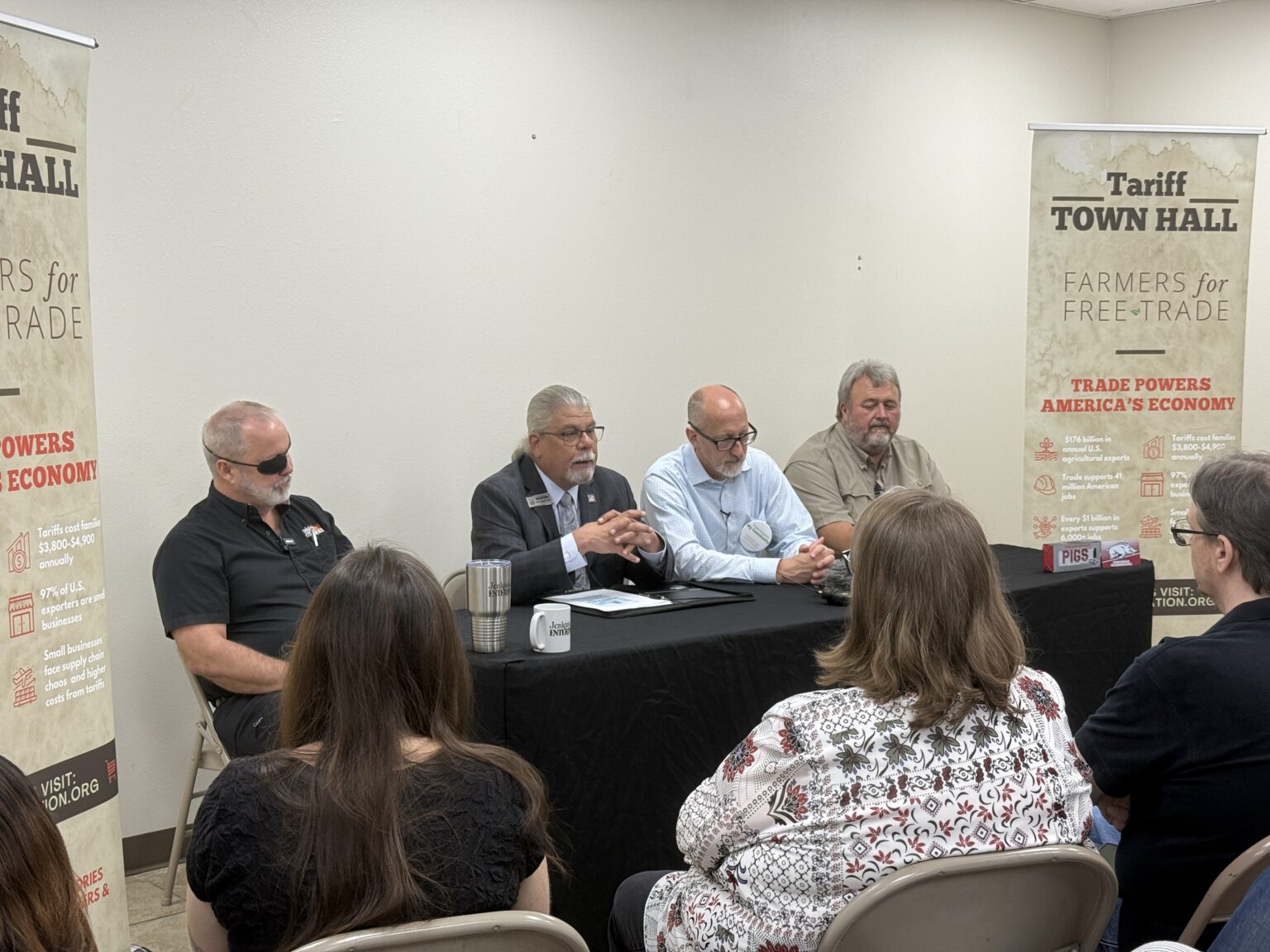
PHOTO: Panelists discuss the tariffs imposed by the Trump administration and how they affect domestic manufacturing and agriculture during a town hall in North Little Rock on July 1, 2025. Panelists included (from left) Jenkins Enterprises owner Steve Jenkins, University of Arkansas at Little Rock economics professor Michael Pakko, Farmers for Free Trade Executive Director Brian Kuehl and state Sen. Blake Johnson. | Ainsley Platt/Arkansas Advocate
By AINSLEY PLATT | Arkansas Advocate
Arkansans are paying millions more for daily necessities like car parts as a result of tariffs placed on imports by the Trump administration, according to a report from Farmers for Free Trade.
The national nonprofit discussed the report during a town hall meeting Tuesday in North Little Rock. According to the report, Arkansans paid $747,700 in import taxes for vehicle parts in April 2024, with an average tariff rate of 7.3%. In April 2025, that number more than tripled to $3.5 million, with the average tariff rate reaching 27.3%.
Vehicle parts are especially exposed to the tariffs instituted by President Donald Trump in response to what he has described as unfair trade practices by other countries. American car manufacturers have increasingly turned to Canada and Mexico for manufacturing parts for their vehicles in recent years, with more than half of American vehicles and parts coming from those two countries.
But the tariffs — and the back-and-forth they have created for businesses as the administration announced new levies and then backed away from them in order to negotiate — don’t only affect car parts. Arkansas also imports hand tools and air pumps and fans from other countries, and paid large tariff costs as a result.
“Arkansas companies have already experienced sharp tariff increases in March and April of this year. But the breadth of these proposed trade actions — if fully enacted — could result in even more severe cost burdens in the months ahead,” the report said.
The broader trade war also poses risk for agriculture, the state’s largest industry.
During a panel discussion at Tuesday’s town hall at Jenkins Enterprises, longtime farmer and Corning Republican Sen. Blake Johnson said he believed the tariffs could force 20-30% of U.S. farmers to close their doors by December if relief doesn’t come, even as he said that tariffs were necessary and needed “so we can sell and buy in a fair market.”
Farmers face a double-whammy from tariffs. They have high input costs for items like tractor parts and fertilizer that could increase more because of tariffs. Johnson said fertilizer that cost $450 a ton last year now costs close to $650.
Tariffs imposed by other nations in retaliation for U.S. import taxes are another risk. For example, about half of the state’s soybean exports were sent to China last year, according to the report. But after Trump levied tariffs on Chinese goods, the east Asian country imposed reciprocal tariffs on American-grown crops. Soybean exports from the U.S. to China were down 43.7% in April compared to the same time last year.
“That’s why we see the 50% fall off in Arkansas exports of soybeans, because our soybeans now are more expensive when we’re trying to sell into overseas markets [as a result of reciprocal tariffs],” said Brian Kuehl, the executive director of Farmers for Free Trade.
Trump has argued that businesses should absorb the tariff costs. Short-term pain is necessary for long-term gain, he and his allies have said, in order to bring back manufacturing jobs to the U.S.
However, Steve Jenkins, the owner of Jenkins Enterprises, which makes branded products such as Arkansas Razorbacks flags and coffee cups, said that while the administration’s goal was admirable, it was not necessarily possible.
“People will say to me, ‘Well, why don’t you just buy it in America?’ Because those products are no longer made in America, and one of the reasons for that is simply because we don’t have enough people to do it,” Jenkins said.
The issue, Jenkins said, was that even if manufacturing came back to the U.S., there wouldn’t be a workforce to fill those jobs. As America’s economy developed, he said, manufacturing of many goods was sent to Japan, then Taiwan. And as those countries’ economies developed and began focusing on more complex products, some of that manufacturing then made its way to China.
“We’ve got jobs in America, we don’t have workers…those jobs are not going to come back to America,” he said. “They’re not going to be available in America, and we just don’t have the workers to support it.”
The U.S. unemployment rate was 4.2% in May, according to the Bureau of Labor Statistics. Meanwhile, existing U.S. manufacturing has continued to contract, according to the Institute for Supply Management. Respondents to its June survey said broad uncertainty as a result of the tariffs has impacted their orders.
Discover more from
Subscribe to get the latest posts sent to your email.