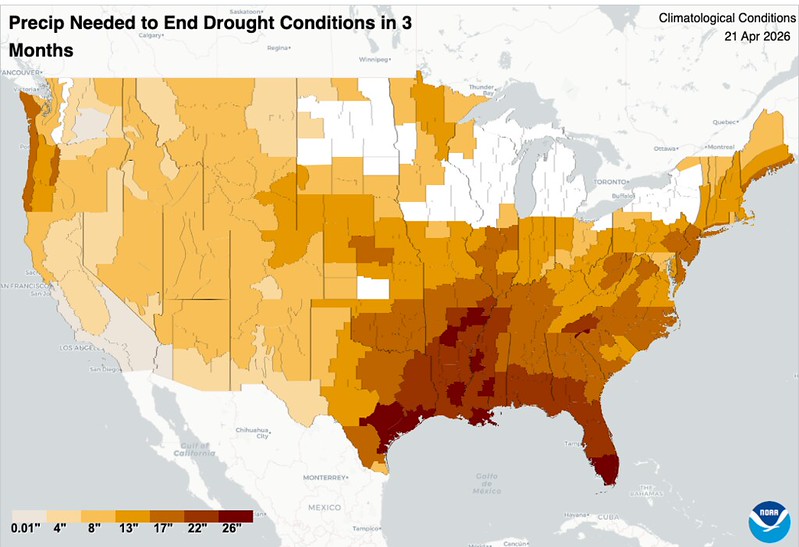
MAP — Showing the amount of rain needed to end drought. | Map courtesy National Centers for Environmental Information
By MARY HIGHTOWER | University of Arkansas Division of Agriculture
Arkansas’ weather seems to have hit fast forward in 2026, largely skipping the stormy, rainy portion of spring as farmers open irrigation taps early to get their row crops growing.
“It’s almost looking like Mother Nature is ahead by two months or so,” said Chris Buonanno, science officer for the National Weather Service at Little Rock. “Nature is already going into late spring.”
The last time Arkansas was drought-free was the week of July 22, 2025. Drought conditions returned before August and have only intensified since December.
“We could have normal rain for the rest of the year, and we would still be behind,” Buonanno said.
To eliminate drought, Arkansas would need between between19 and 27 inches of rain within a three-month period, according to the National Centers for Environmental Information, part of NOAA.
Forecast storms through early next week might lessen the moisture deficit, however.
“We’re looking at several systems coming in the next couple of days,” Joe Goudsward, senior forecaster for the National Weather Service in Little Rock, said Thursday. “Through Monday, we are definitely going to see an uptick in precipitation.”
For “storm totals until Tuesday morning, we’ve got a general 1-2 inches of rainfall for pretty much the entire state,” Goudsward said. “There are pockets that will be heavier than that.”
Gourdsward said the northwestern and eastern parts of the state, including some Delta counties, could see 2.5 to 3 inches.
“That’s pretty good for everybody,” he said.
Coping with drought from the start
Kevin Lawson, Faulkner County extension agent for the University of Arkansas Division of Agriculture, said he had several farmers running irrigation. One was irrigating corn for silage. Silage is undried forage stored in an airtight pit until it’s used for cattle. Some ranchers prefer silage because of the amount of nutrients it retains versus hay.
Lawson said the producer “had some areas where the corn hadn’t come up yet. She ran the pivot to get it all up.”
“I also have a producer who has part of his farm in Perry County, and he is running his pivot to get soybeans germinated and to activate his pre-emergence herbicide,” Lawson said.
Much of Perry County is experiencing the most intense form of drought.
Growers who plant rice into dry ground flush it with water to promote germination or allow seedlings to emerge.
Jarrod Hardke, extension rice agronomist for the Division of Agriculture, said, “drought conditions and lack of soil moisture have become issues leading some growers to back off, slow down or pause planting.”
While research is helping rice production use less water, the crop still requires significant amounts of irrigation, whether being grown as row rice or more traditional paddy growth.
“Others have already begun shifting more acres out of rice to other crops because surface irrigation water is so far behind normal.They lack confidence in water availability to irrigate all their originally planned acres,” Hardke said.
“The situation is going to start becoming more exaggerated as fields are in need of being flushed to establish stands on already planted fields,” Hardke said. “We’re using irrigation a month ahead of usual. What soil moisture is there, or was there, at planting deteriorates rapidly under current dry conditions with high winds.”
The El Niño factor
One of the most important drivers of climate in the Western Hemisphere is the El Niño — Southern Oscillation, known as ENSO. According to the National Oceanic and Atmospheric Administration, ENSO is one of the most important climate phenomena on Earth due to its ability to change the global atmospheric circulation, which in turn influences temperature and precipitation across the globe.
ENSO has three phases:
- El Niño, with its warmer ocean temperatures in the central and eastern Pacific.
- La Niña, with its cooler sea temperatures in the central and eastern Pacific.
- Neutral, where the ocean does one thing and the atmosphere does something else.
“In a nutshell, ENSO causes changes in precipitation patterns across the Pacific that will then affect jet streams and their position, which affects our weather,” Buonanno said.
The hemisphere is currently in neutral, with a 60 percent probability of El Niño emerging in May, according to the Climate Prediction Center.
“There have been quite a few instances in Arkansas weather history where droughts are affected by landfalling tropical systems,” he said. Frequently, these tropical systems will bring “too much rain, but it will ease a drought situation.”
However, “El Niño tends to diminish tropical activity in the Atlantic and the Caribbean,” Buonanno said.
The rain coin toss
Looking ahead, the probability for precipitation is more akin to a coin toss.
The Climate Prediction Center shows equal chances for above- and below- normal rainfall in its June-July-August, July-August-September and August-September-October outlooks.
To learn about extension programs in Arkansas, contact your local Cooperative Extension Service agent or visit uaex.uada.edu. Follow us on Facebook and Instagram. To learn more about the Division of Agriculture, visit uada.edu. To learn more about ag and food research in Arkansas, visit the Arkansas Agricultural Experiment Station at aaes.uada.edu.
Discover more from
Subscribe to get the latest posts sent to your email.