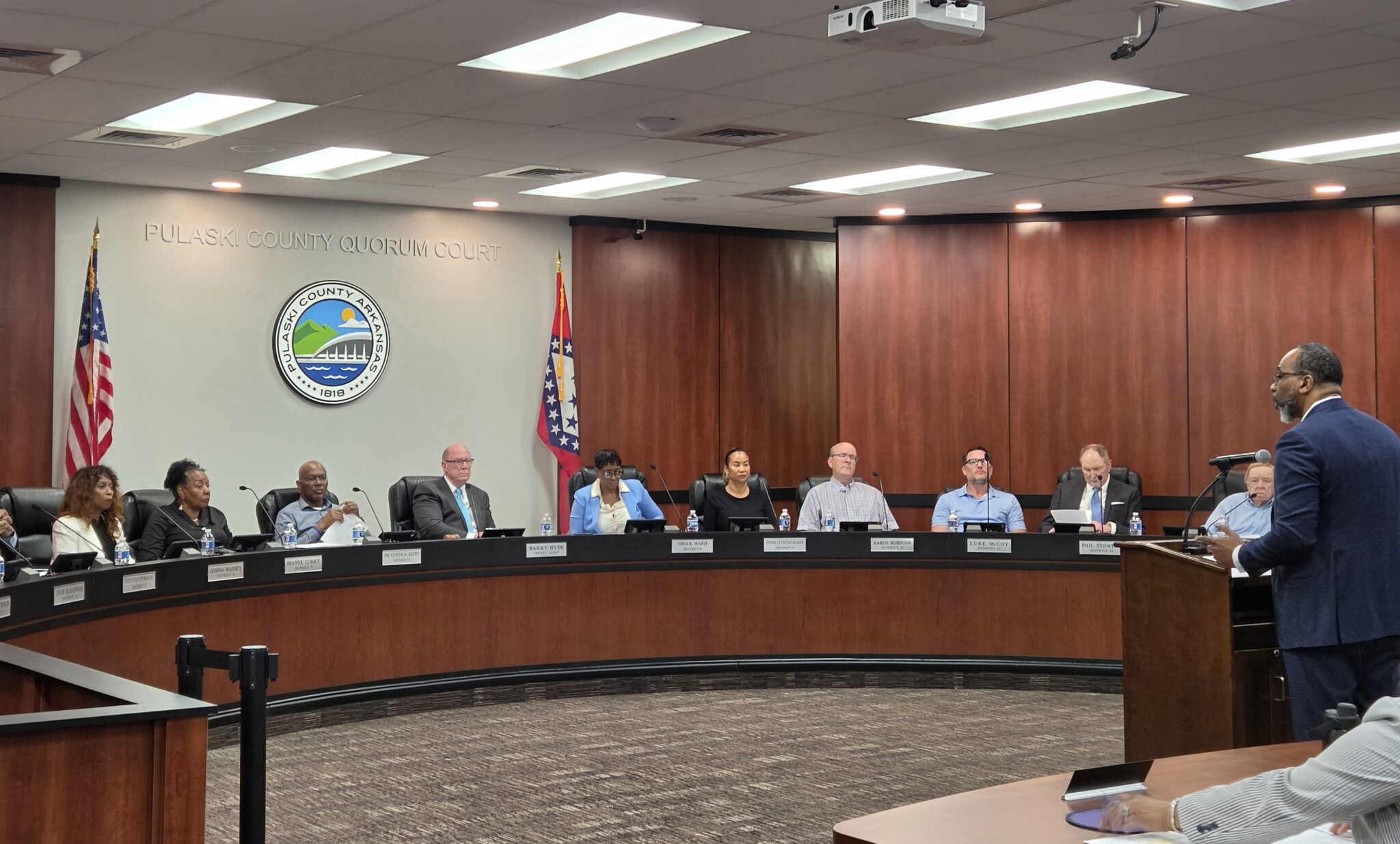
Entergy Arkansas Vice President of Customer Service Ventrell Thompson (right) gives a presentation in favor of data centers to the Pulaski County Quorum Court on May 26, 2026. | Arkansas Advocate photo by Tess Vrbin
By TESS VRBIN | Arkansas Advocate
A yearlong pause on new data centers in Arkansas’ most populous county won’t take effect after the county’s clerk said she miscounted the number of votes in favor of the moratorium.
Pulaski County Clerk Terri Hollingsworth said in a news release that the moratorium that went before the Quorum Court Tuesday night fell short of the 10 votes, or two thirds of the 15-member body, needed to pass.
Eight justices of the peace voted for the measure, six voted no and one voted present. Hollingsworth erroneously recorded the vote as 10 in favor, four against and one present. Emergency ordinances need a two-thirds vote rather than a simple majority.
“Clerk Hollingsworth sincerely apologizes for this mistake and any confusion it may have caused,” a news release states.
It was not immediately clear what the next step is and whether the proposal would go before the quorum court again. Pulaski County Judge Barry Hyde, the county’s top elected administrator, directed questions to a county spokesperson Thursday afternoon. A county spokesperson directed questions to the quorum court’s parliamentarian, who did not immediately respond to a phone call.
It was also not immediately clear whether the quorum court can call for a vote on the original ordinance without the amendment that would exempt Connecticut-based AVAIO Digital’s planned data center near Wrightsville. County residents expressed support for the moratorium Tuesday, but they took issue with the narrowly-adopted amendment.
“One wonders how AVAIO would qualify for a grandfathering provision if AVAIO has no utility connections, has not been issued a permit, and has no basis for complaining about any regulations being in place,” Wendell Griffen, the Democratic nominee for county judge and a vocal opponent of data centers, said in a Thursday interview.
Democratic Justice of the Peace Julie Blackwood said Thursday that the error in recording the vote was “shocking” and that she will reintroduce the ordinance as soon as she can.
“I’ve been in there 20 years, and we have never counted the vote wrong,” said Blackwood, the second-longest serving current member of the court.
Griffen, who defeated Hyde in the March primary, said he understood Hollingsworth’s “honest mistake” of miscounting votes three and a half hours into Tuesday’s meeting. He attributed the likely “fatigue” behind the error to the “unscheduled infomercial” presented by data center proponents, including AVAIO.
“If AVAIO is so interested in escaping regulation for its use [of county resources], does that make us more trusting or more cautious?” Griffen said. “And if we are more cautious, isn’t the purpose of a moratorium to give us time to exercise that caution?”
The AVAIO project is one of five data centers planned for Arkansas, including one at the Port of Little Rock, where the city sold land to Google last year for a planned $1 billion, 300,000-square foot facility.
Earlier this month, the quorum court voted to send proposed data center regulations to the county planning department for further study instead of placing the item on Tuesday’s agenda. The Little Rock Board of Directors plans to take up proposed regulations from Mayor Frank Scott at its June 2 meeting.
There has been a massive buildup of data centersaround the country, fueled by the growth of artificial intelligence. Supporters of the centers in Pulaski County and elsewhere say the projects will bring jobs and needed tax revenue.
But members of the public have increasingly called for more limits on where the centers can be built and how they use land, water and electricity. This pressure has led cities in other states, including Oklahoma, to pass their own data center moratoriums.
A March Gallup poll found that seven in 10 Americans, regardless of political affiliation, would oppose the nearby construction of data centers for artificial intelligence, higher than the 53% of respondents who said they would oppose living near a nuclear power plant.
Discover more from
Subscribe to get the latest posts sent to your email.