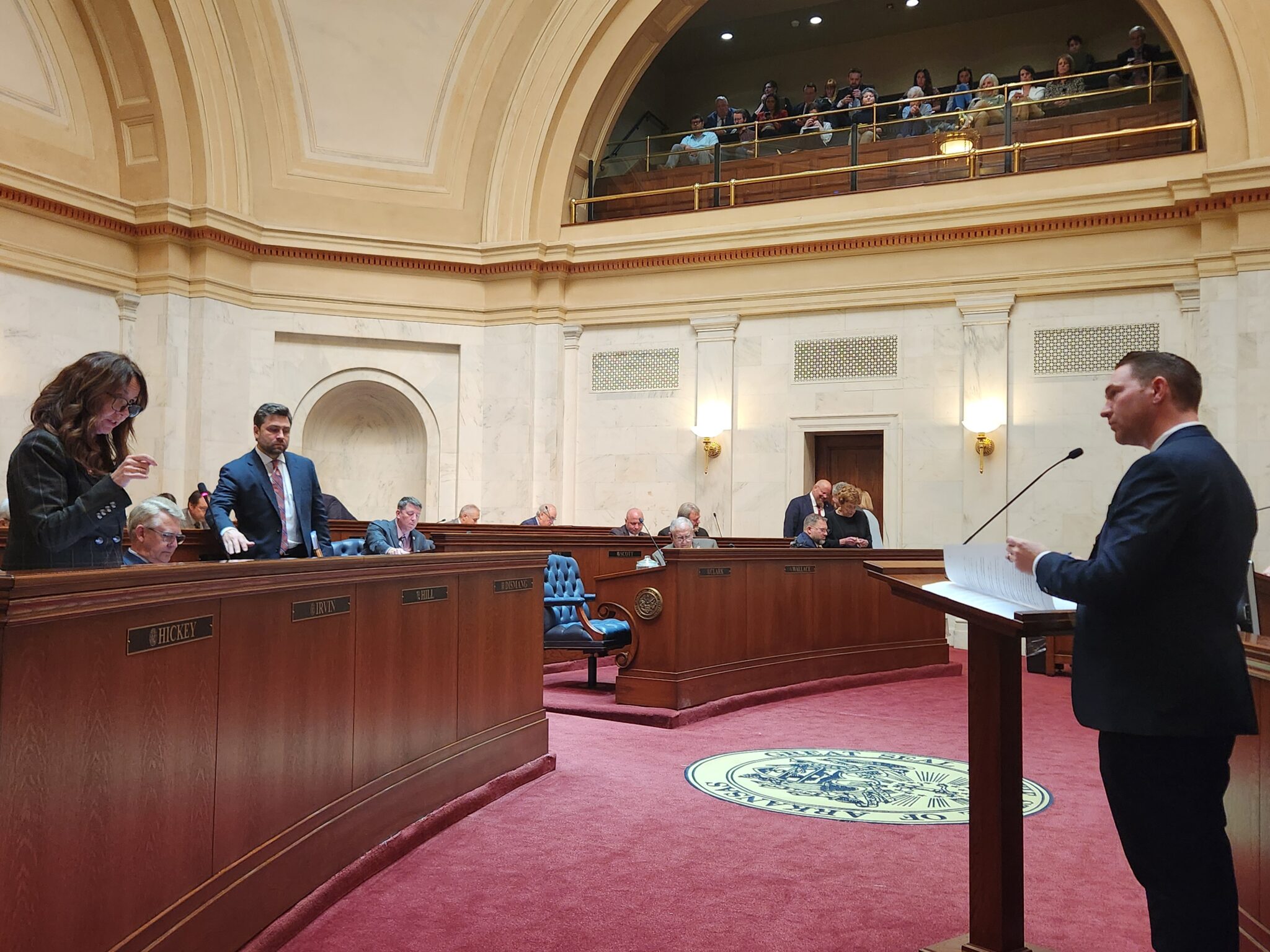
QUESTION FROM THE FLOOR — Sen. Missy Irvin, a Mountain View Republican, asks a question about Senate Bill 611, sponsored by Sen. Tyler Dees, a Republican from Siloam Springs, on the Senate floor on April 7, 2025. | Tess Vrbin/Arkansas Advocate
By ANTOINETTE GRAJEDA | Arkansas Advocate
The Arkansas Senate voted Tuesday to allow lawmakers to consider proposals to increase the state’s homestead property tax credit to $675, protect property rights against Sharia law and restrict industrial development authorities.
But eight other bills dealing with non-budget issues including cryptomines, the school voucher program and funding for local governments projects failed to win enough votes to be considered.
In even-numbered years, Arkansas lawmakers participate in fiscal sessions where they focus on the state budget. Non-fiscal bills need at least a two-thirds vote in the House and Senate to be considered during the fiscal session.
The Senate voted 34-0 to allow Magnolia Republican Sen. Steve Crowell to introduce his proposal increasing the homestead tax credit to $675. An Arkansas House committee approved an identical bill last week.
Crowell said an annual report indicated the state can afford to increase the tax credit, which has increased by $225 since 2023 to $600. The credit was created by a voter-approved constitutional amendment in 2000, and the General Assembly enacted a half-cent sales tax to pay for the credit.
The Senate also advanced by a 31-1 vote Sen. Tyler Dees’ proposal to amend the Industrial Development Authorities Expansion Act. The 2025 law defines the authorities as a public benefit corporation authorized by local governments as a political subdivision of the state “for the purpose of securing and developing industry and fostering economic development.”
The Siloam Springs Republican said he brought his proposal in response to constituents’ concerns about these development authorities in his region. Dees’ proposed legislation would require members of the authority’s board to live in the area they’re representing and eliminate the authority’s ability to take property using eminent domain.
“I believe this resolution is healthy for us to take up because it does listen to the people that have showed concerns, it takes away the risk of eminent domain powers from this board,” Dees said.
Dees’ proposal faces an uncertain future in the House, where a subcommittee rejected an identical proposal last week.
Another proposal that received a green light Tuesday, this one dealing with property rights, was also rejected by a House panel last week.
Senate Majority Leader Blake Johnson’s proposed Arkansas Property Rights Protection from Sharia Law Act would require a managing entity to disclose when an agreement is for the purchase of an interest in the entity and not residential property itself. It would also prohibit requiring a dispute over the agreement from being brought before a tribunal other than a U.S. court.
Sharia is a religious framework that guides many Muslims’ daily lives. Lawmakers in Republican-led states have been advocating measures aimed at prohibiting its application in state courts. Critics of anti-Sharia law measures have said such legislation is unconstitutional and unfairly targets a religious group.
Johnson said the resolution was “imperfect” and promised the bill would be amended immediately when he introduces it.
Seemingly responding to questions posed by the House committee last week about whether non-fiscal proposals required immediate attention or could wait until next year’s legislative session, the Corning Republican asked his colleagues if the issue was “immediate or is this pressing?”
“Is stage 2 cancer immediate or pressing? Would you want it handled earlier than stage 4?” Johnson asked. “This is pressing and imminent. This enemy that this is trying to address, since the foundation of this nation we have fought and is advancing, and it’s advancing greater than the foundations of what our country was built on.”
The Senate advanced Johnson’s resolution by a vote of 25-6.
Discover more from
Subscribe to get the latest posts sent to your email.