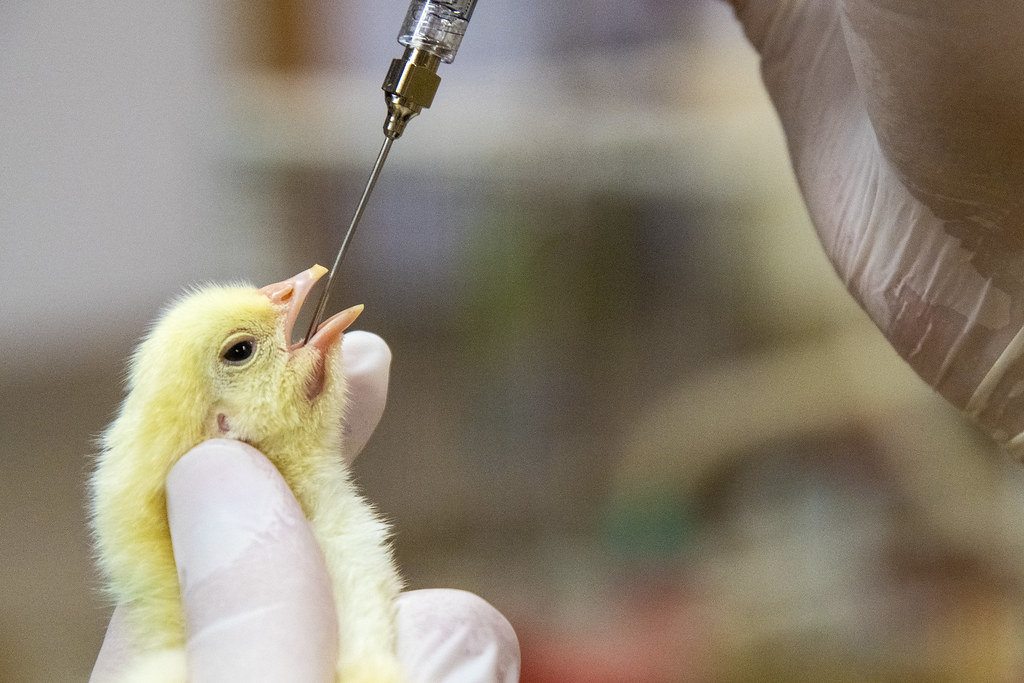
VACCINE BOOST — Using a scientific achievement shelved for decades, scientists with the Arkansas Agricultural Experiment Station developed a vaccine additive that generates a strong immune response against salmonella. UADA photo
By JOHN LOVETT | University of Arkansas Division of Agriculture
Fast Facts
- Vaccine additive boosted immune response against salmonella in poultry
- Scientific development shelved for decades revived with new ideas
- Technology applicable to any animal species, potentially humans
Poultry science researchers in Arkansas have developed a way to improve the effectiveness of animal vaccines against salmonella, a leading cause of foodborne illnesses.
The scientific breakthrough could help reduce the incidence of salmonella contamination in meat entering the food supply. According to the Centers for Disease Control and Prevention, salmonella causes about 1.35 million human infections in the United States every year.
After seven years of research, using a scientific achievement shelved for decades, scientists with the Arkansas Agricultural Experiment Station developed a vaccine additive that uses a DNA-based structural component that acts like Velcro to make microscopic connections with immune cells in chickens, generating a strong immune response against salmonella.
Young Min Kwon, a professor in the department of poultry science for the experiment station, the research arm of the University of Arkansas Division of Agriculture, said the key to the discovery was finding a way to connect multiple DNA aptamers — molecules that can seek out and bind to a specific biological target — to a vaccine antigen made with dead salmonella cells. An antigen is a substance the immune system responds to.
“They are completely different materials, but they can be customized to do similar things,” Kwon said of the antibody and DNA aptamers. “It makes the vaccine work better and makes it stronger.”
Kwon and his collaborators published the study’s results earlier this year in the journal Frontiers in Veterinary Science under the title “In vitro evaluation of CD40-targeting aptamer-based DNA vaccine adjuvants using HD11 cell culture.” More publications are on the way, said Kwon, who is also works with the Cell and Molecular Biology program at the University of Arkansas.
While the study demonstrated enhanced immune-cell activation in poultry, adoption by the poultry industry would depend on a per-dose cost of just pennies. With proper production scaling, the cost per dose could be closer to $1. While still pursuing the pathway to lower its production cost for application to poultry, Kwon is setting his sights on future studies of the technology for higher-value animals, where it would be more cost-effective.
Building on an earlier discovery
The research that led to the development began in the late 1990s when Luc Berghman, now professor emeritus of poultry science at Texas A&M University, developed an antibody called 2C5 that targets chicken CD40 for immunogen delivery. Berghman held a joint appointment in the departments of poultry science and veterinary pathobiology.
“CD40 is a molecule on the surface of the macrophage cell and is a key part of the natural immune system,” explained Kwon, who was a graduate student at A&M at the time but not affiliated with Berghman’s lab. “Activating it helps boost the immune response.”
“Antigens go into the body and elicit an immune response,” Kwon said. “They tested various types of antigens attached to the 2C5 monoclonal antibody to boost immune responses in chickens, and it worked well. It has a universal quality. It’s not limited to a particular pathogen or a disease.”
Although the antibody showed promise, Kwon said its use in the field was limited because of the time and expense required to produce it. The discovery sat on a shelf for more than a decade before it was pulled back out with some new ideas in mind.
Billy Hargis, a recently retired veterinarian and Distinguished Professor of poultry science for UADA, was a professor in the same department as Berghman at Texas A&M. Many years after he moved to Arkansas from Texas, Hargis revisited this approach with Berghman and hatched a plan to bring in Kwon for ideas on the project. Kwon earned his doctorate from Texas A&M in 2000 and worked as a research scientist for the U.S. Department of Agriculture’s Agricultural Research Service for two years before taking a faculty position with UADA.
A DNA-based solution
“About seven years ago, Billy and Luc discussed again to find a way to move on with the idea based on 2C5,” Kwon said. “Once they talked, Billy said, ‘Hey, Young Min. Can you help me? This antibody is a wonderful discovery, but we cannot use it to improve vaccines for the poultry industry. Can you do something about it?’”
Kwon said that while immunology was a little outside his wheelhouse, his experience working with DNA offered another way to approach the problem. At the time, he was working on a DNA aptamer, a short, single-stranded DNA molecule that can fold into unique 3D shapes. Those shapes allow the aptamer to bind to a specific target, much like antibodies.
“DNA has a sequence,” Kwon said. “It consists of ATGC nucleotides, so depending on the specific sequence, they can fold in different ways. It’s like a string with four different beads and in different orders. They can fold into a three-dimensional structure, and they can have a capacity to bind to a specific target.”
Like the 2C5 antibody, a DNA aptamer can be designed to bind to a specific target and has become a more common tool with expanded applications, including biosensing to detect salmonella or any other pathogen. So, Kwon developed the aptamer that binds to chicken CD40 to replace the 2C5 monoclonal antibody.
But there was a problem. A DNA aptamer is much smaller than a 2C5 antibody. Kwon needed to make the DNA aptamer bigger to encompass larger regions on CD40. To solve the problem, Kwon turned to a technique called rolling circle amplification, or RCA, which produces long strands of repeating singled-stranded DNA sequences, presenting hundreds of CD40-targeting aptamers.
“The analogy I like to use is that it is like Velcro. An aptamer is a little finger-like loop in the Velcro, but for the Velcro to work well, there should be hundreds of those fingers. RCA is like the plate on which all those fingers are attached.”
The resulting complex has multiple attachment points, allowing one part of the vaccine complex to target CD40 immune cells while another captures the dead salmonella cells.
“We did a series of experiments, and it worked well,” Kwon said. “It was very surprising. It’s a fun part of the research. We get some simple ideas from just ordinary thinking and then give it a try. A lot of times we fail, but sometimes it works!”
Testing the technology
In the lab experiment, Kwon’s team used HD11 cells, chicken macrophage cells, that can be grown in a petri dish. A dead salmonella cell was the target antigen.
“Whatever vaccine complex we put it into, we can measure if activation happened or not by measuring how much nitric oxide is released,” Kwon said.
The amount of nitric oxide released indicated how strongly the macrophage cells had been activated. With successful results from HD11 cells, they went on to test them in chickens exposed to live salmonella. The results showed that the salmonella vaccine complex provided superior protection against salmonella colonization in the gut compared with dead salmonella cells alone.
Co-authors of the study included Abigeal Omolewu and Santiago Uribe Diaz, who were graduate students at the time of publication; research scientists Seong Kang and Christine Vuong in the department of poultry science; and Adil Al-Ogaili, formerly a University of Arkansas graduate student, now in the department of medical laboratory techniques at the Kut Institute of Technology of Middle Technical University in Baghdad, Iraq.
To learn more about ag and food research in Arkansas, visit aaes.uada.edu. Follow the Arkansas Agricultural Experiment Station on LinkedIn and sign up for our monthly newsletter, the Arkansas Agricultural Research Report. To learn more about the Division of Agriculture, visit uada.edu. To learn about extension programs in Arkansas, contact your local Cooperative Extension Service agent or visit uaex.uada.edu.
Discover more from
Subscribe to get the latest posts sent to your email.