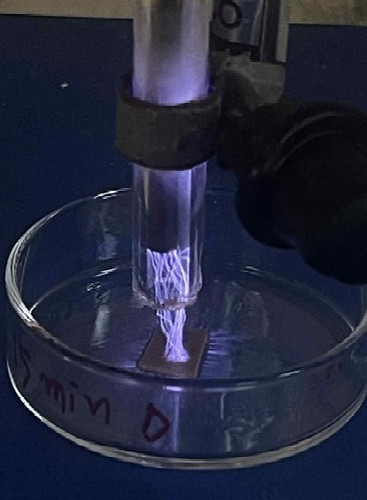
PLASMA PROTEIN — A biodegradable film made from rice bran is treated with cold plasma generated by argon gas to develop antimicrobial qualities. | UADA photo
By JOHN LOVETT | University of Arkansas Division of Agriculture
Rice bran is a plentiful agricultural byproduct that is often underused, but research out of the Arkansas Agricultural Experiment Station shows it could be a source for biodegradable food packaging with built-in antibacterial properties.
Antimicrobial resistance is a significant global health threat, according to the Centers for Disease Control and Prevention. In the United States alone, more than 2.8 million antimicrobial-resistant infections occur each year.
For the past year, with funding support from the Arkansas Biosciences Institute, a multidisciplinary team of scientists led by Mahfuzur Rahman has explored how plasma technology could contribute to new antimicrobial strategies. The team is using plasma, a state of matter visible in natural phenomena such as the Northern Lights, to improve the value-added capabilities of rice bran and rice bran protein.
Rahman is an assistant professor in the department of food science for the experiment station, the research arm of the University of Arkansas Division of Agriculture, and the Dale Bumpers College of Agricultural, Food and Life Sciences at the University of Arkansas.
The research showed that treating a clear film made from rice bran protein with argon-generated cold plasma inhibited foodborne bacterial pathogens including E. coli, Staphylococcus aureus and Pseudomonas aeruginosa, a bacterium known for its antibiotic resistance.
The plasma treatment inhibits bacterial growth in two ways: it creates microscopic spikes on the film and triggers a chemical reaction that produces and releases hydrogen peroxide, a strong oxidizing agent with antimicrobial properties.
After exposure to the plasma-treated rice bran films, bacterial populations of all pathogens declined within eight hours and were inhibited from regrowing at 24 hours after application. Conversely, untreated rice bran films showed marked bacterial growth, the study showed.
Rahman said the research demonstrates that argon cold plasma offers a green, novel approach for transforming rice-processing byproducts into sustainable, functional materials.
“This idea actually came from the microchip industry,” Rahman said. “They use the plasma for what’s called etching to assemble semiconductor layers, and we transferred that idea to the rice bran films.”
For the study, researchers compared films made solely from rice bran to films made from rice bran protein. The rice bran protein film appeared to react more favorably with higher microscopic spikes, or etches, and higher hydrogen peroxide concentrations. In the rice bran protein films, the plasma increased the surface roughness 3.3-fold, compared to 1.06-fold in the film using solely rice bran.
While cold plasma was known to improve physical and chemical properties in synthetic polymer films, Rahman said its antibacterial effects in rice bran-based biopolymer films had not been previously reported.
The team also examined how the treatment affected the films’ physical properties such as water vapor transmission rate, tensile strength and thermal stability.
The antibacterial effect, their study noted, likely resulted from the “combined influence of retained reactive species, enhanced wettability, increased surface roughness, and changes in surface chemistry.”
A manuscript of the study has been submitted for peer review at a scientific journal, with plans to submit a proposal for further studies on a potential medical application.
“I am very thankful to ABI for supporting the study to explore the untapped potential of rice bran in food packaging and the medical industries,” Rahman said.
Advancing antimicrobial films
In addition to its biodegradable and antimicrobial qualities, Rahman said the research on plasma-treated rice bran film will help further develop effective antimicrobial films, which is “one of the most important challenges in modern materials science.”
Conventional antimicrobial films, he added, often incorporate additives such as nanoparticles and antibiotics to inhibit microbial growth, raising health concerns because these additives can migrate from the packaging material into food and potentially enter the human body.
The research team included department of food science master’s student Saydul Md Safwa, postdoctoral researcher Nikitha Modupalli, Ph.D., program associate Karina Desiree, and Jennifer Acuff, an associate professor of food microbiology and safety. Collaborators also included Keisha B. Walters, a professor in the Ralph E. Martin Department of Chemical Engineering at the University of Arkansas, and Kayla Foley, a postdoctoral researcher in the department of chemical engineering.
To learn more about ag and food research in Arkansas, visit aaes.uada.edu. Follow the Arkansas Agricultural Experiment Station on LinkedIn and sign up for our monthly newsletter, the Arkansas Agricultural Research Report. To learn more about the Division of Agriculture, visit uada.edu. To learn about extension programs in Arkansas, contact your local Cooperative Extension Service agent or visit uaex.uada.edu.
Discover more from
Subscribe to get the latest posts sent to your email.