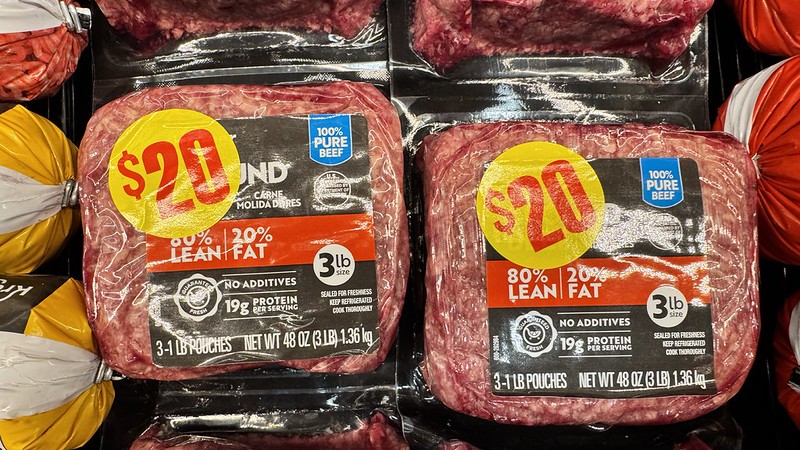
Example of 2026 meat prices. | UADA image
By MARY HIGHTOWER | University of Arkansas Division of Agriculture
Fast Facts
- Look for alternative beef cuts, cooking methods
- Consider buying locally grown, processed beef
If sticker shock has you reconsidering whether that T-bone belongs in your shopping cart, an extension meat specialist and a culinary expert have a few ideas to help keep beef on the table.
Understanding the cuts in the meat counter case can help you make less expensive choices, said Janeal Yancey, extension instructor in animal science for the University of Arkansas Division of Agriculture.
“One cut I’ve seen in the grocery store lately is sirloin cap steak,” she said. It’s basically a top sirloin steak that has a little ‘eyebrow’ on top that we would call a ‘mare’s tail’ in meat judging.
“That wedge of meat — some processors call it a ‘culotte’ or ‘picanha,’” Yancey said. “It’s a little smaller than a strip steak and it eats like a strip. Just don’t overcook it. If you like steaks well done, this isn’t for you.”
Picanha is widely used in Brazilian cuisine and is often seen in Brazilian restaurants served from a skewer.
“The thing about sirloin, whether petite or cap, they take marinade really well. They’re really lean, they’re quick to fix, and if you make it with a baked potato and green beans, you have a good family dinner pretty quickly,” Yancey said. “They’re a weeknight steak.”
“If we are going to celebrate something, it’s the ribeye for us,” she said.
The $6 difference
When it comes to cuts from a cow, the division between the fifth and sixth rib can make a significant difference.
“In front of the fifth rib are chuck eye steaks,” Yancey said. “Behind the sixth rib are the ribeye steaks.”
That small difference in anatomy could mean a significant savings.
“Chuck eye steaks are about $14 a pound, while the ribeye costs $20 a pound,” she said. “That 1-inch difference between the fifth and sixth rib is a $6 difference.”
Another tactic to save is to buy in quantity.
“You can buy beef in bigger packages,” she said. “You may have to buy 19 pounds, but you can throw the additional cuts in the freezer.”
Yancey also said “I wouldn’t be afraid to go look in the discount bin” for bargains.
Buying local
Yancey said purchasing locally grown and processed beef is another way to save, provided you have freezer space.
“The thing that people need to be ready for is you buy the beef by the whole, half or quarter carcass,” she said. “You’re going to have a big sticker price, but depending on how big your family is you might not have to buy beef again for six months or a year.”
“You might go in with another family and split it, or divide it four ways or eight ways,” Yancey said. “It’s better than buying by the piece in the grocery store. You’re keeping it local and supporting your neighbors.”
Depending on how the cow is processed, once the ground beef, steaks and roasts are gone, “you might have cuts you don’t know what to do with,” she said. “The Beef Council has a lot of great recipes and videos to show you how to cook all those cuts.”
Making the cut
With ground beef — typically a fairly cheap ingredient for burgers and meatloaf — scanning at up to $9 a pound, consumers are looking to make the most of their purchase, Yancey said.
“Something else that folks do to stretch their meat is you can add some kind of fiber, crackers or breadcrumbs to meatloaf,” she said. “Or you can add berries. I’ve used blueberries in beef. You can taste it a little bit and it still cooks like beef and it keeps the moisture in.”
“Some stores will offer a beef pork blend to help with the price point,” Yancey said. It’s a versatile mix that “you can use that for a lot of different things.”
Cooking methods
For shoppers who choose less costly cuts, there are some considerations, said Quadarius Whitson, extension program associate for culinary nutrition and food safety.
“Budget-friendly beef cuts commonly come from the chuck, flank, sirloin, and round areas of the cow,” he said. “Because these muscles are used more frequently for movement, they tend to be leaner and less tender than premium cuts, making them a more economical option for consumers.”
Whitson said, “The best cooking methods for many economical cuts of beef are slow, moist-heat techniques, such as braising and stewing.
“These cuts contain more connective tissue and collagen because they come from harder-working muscles,” he said. “During long, slow cooking, collagen gradually breaks down into gelatin, creating a rich texture and the tender, melt-in-your-mouth sensation many people enjoy.”
Whitson said that tools such as a slow cooker, Dutch oven or electric pressure cooker “can help achieve excellent results while maximizing both flavor and tenderness.”
“Some of my favorite recipes to make with these cuts of beef include pot roast, shredded beef tacos and barbecue sandwiches,” he said.
Whitson said beef can provide important nutrients such as protein, iron, zinc and vitamin B12.
“When enjoyed as part of a balanced eating pattern, beef can be a nutritious and satisfying addition to meals,” he said. “A serving size is about 3 to 4 ounces cooked, roughly the size of a deck of cards.”
“Current recommendations suggest enjoying red meat in moderation, aiming for no more than 12 to 18 ounces cooked per week, or about three servings. As with most foods, balance and moderation are key,” he said.
To learn about extension programs in Arkansas, contact your local Cooperative Extension Service agent or visit uaex.uada.edu. Follow us on Facebook and Instagram. To learn more about the Division of Agriculture, visit uada.edu. To learn more about ag and food research in Arkansas, visit the Arkansas Agricultural Experiment Station at aaes.uada.edu.
Discover more from
Subscribe to get the latest posts sent to your email.