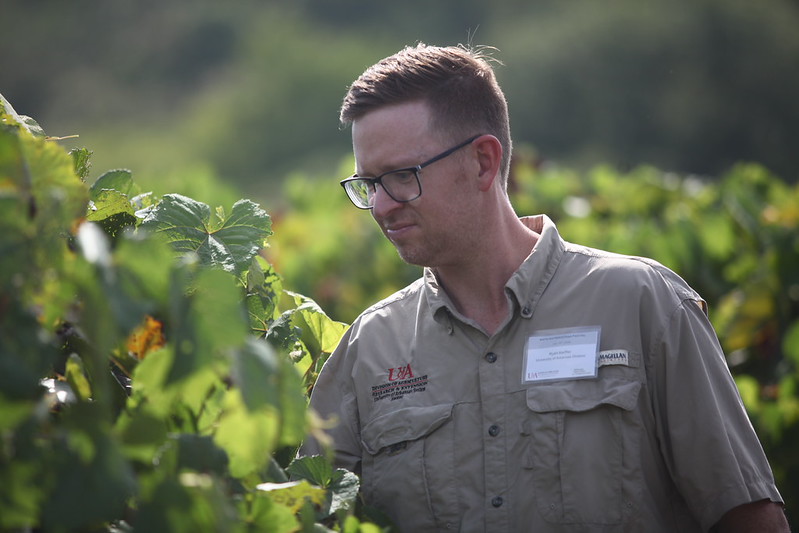
ALIVE ON THE VINE — Ryan Keiffer, extension horticulture program associate for the University of Arkansas Division of Agriculture, examines grape vines during a field tour at Rusty Tractor Vineyards in Little Rock.
By RYAN McGEENEY | University of Arkansas Division of Agriculture
Fast Facts
- Grape field day provides updates on research, findings
- Grape enterprise budgets to receive first update in more than 20 years
- Grape cultivar selection tool in development
By the time Lee Ann and Russell Matson had reached the end of their first season as vineyard keepers, they knew they needed some help.
In 2022, the couple had taken over efforts to cultivate a vineyard belonging to a friend in his early 90s and were wrestling with easily 1,000 feet of vines, Russell Matson said.
“There’s a lot to learn,” he said. “How much to trim at the end of the season, how much to leave. The first year I trimmed way too much.”
“That’s when we went to our first grape field day,” Lee Ann Matson said. “They taught us about pruning, what to look for in skin, seeds, the taste, the marketing — I had not thought about any of this.”
On July 28, the Matsons attended their fourth grape field day with the University of Arkansas Division of Agriculture.
“We’ve been to three of these, and we’ve taken something away from each of them,” Lee Ann Matson said.
The Matsons were among dozens of wine and grape enthusiasts who gathered at Rusty Tractor Vineyards in southwest Little Rock on Tuesday afternoon to learn about the latest research efforts and findings for Arkansas native and hybrid grapes.
The Native and Hybrid Grape Field Day, organized by both the Division of Agriculture’s Cooperative Extension Service and the Arkansas Association of Grape Growers, featured presentations from several Division of Agriculture researchers, as well as Justin Scheiner, an associate professor with Texas A&M University.
Renee Threlfall, associate professor for the Division of Agriculture, discussed ongoing breeding efforts to combine aspects of the Vitis vinifera grape with muscadine grapes, seeking improved muscadine hybrid cultivars.
“The work we’re doing right now on breeding Vitis by Muscadinia is one of the only projects of its kind in the world,” Threlfall said. “It’s interesting that we’re doing this project in Arkansas, and that our growers have an opportunity to see how that could impact the state of Arkansas with changes in what we can grow here.”
Threlfall said researchers are about two years into a four-year federally funded project, but that it will be at least 10 years before any resulting cultivars from this project are available to grape growers.
Amanda McWhirt, extension fruit and vegetable specialist for the Division of Agriculture, spoke about the work of UADA graduate student Joie Bogart to develop grape cultivar recommendations for Arkansas farmers.
“Research she’s doing there is going to be really pivotal in helping growers make selections about what varieties they plant going forward,” McWhirt said. “She’s assessing vine vigor, disease susceptibility, fruit quality and insect pressure. In the end, we’ll be able to recommend to growers the varieties that work really well in Arkansas, with low disease pressure that produce high-quality fruit for a fresh market.”
Evan Ware, extension agricultural economics program associate for the Division of Agriculture, delivered updates about new enterprise budgets she is developing for specialty crop growers in Arkansas.
“We’re working to provide a resource for grape growers to analyze the numbers on their farm and see what’s profitable for them,” Ware said. ““Especially now, with rising input costs, it can be challenging for a grower to establish a vineyard. If they have a better handle on what they’re paying for each enterprise that they’re trying to grow, it can help them have more financial success.”
Ware said the new fresh market muscadine budgets will provide a much-needed update to the existing production budgets for Arkansas grapes, which are more than 20 years old.
The event also featured discussions on marketing and pest management, as well as a vineyard field tour and wine tasting. Threlfall said grape field days are important, not just for the delivery of content, but also the networking opportunities between experienced and new grape growers.
To learn about extension programs in Arkansas, contact your local Cooperative Extension Service agent or visit uaex.uada.edu. Follow us on Facebook and Instagram. To learn more about the Division of Agriculture, visit uada.edu. To learn more about ag and food research in Arkansas, visit the Arkansas Agricultural Experiment Station at aaes.uada.edu.
Discover more from
Subscribe to get the latest posts sent to your email.