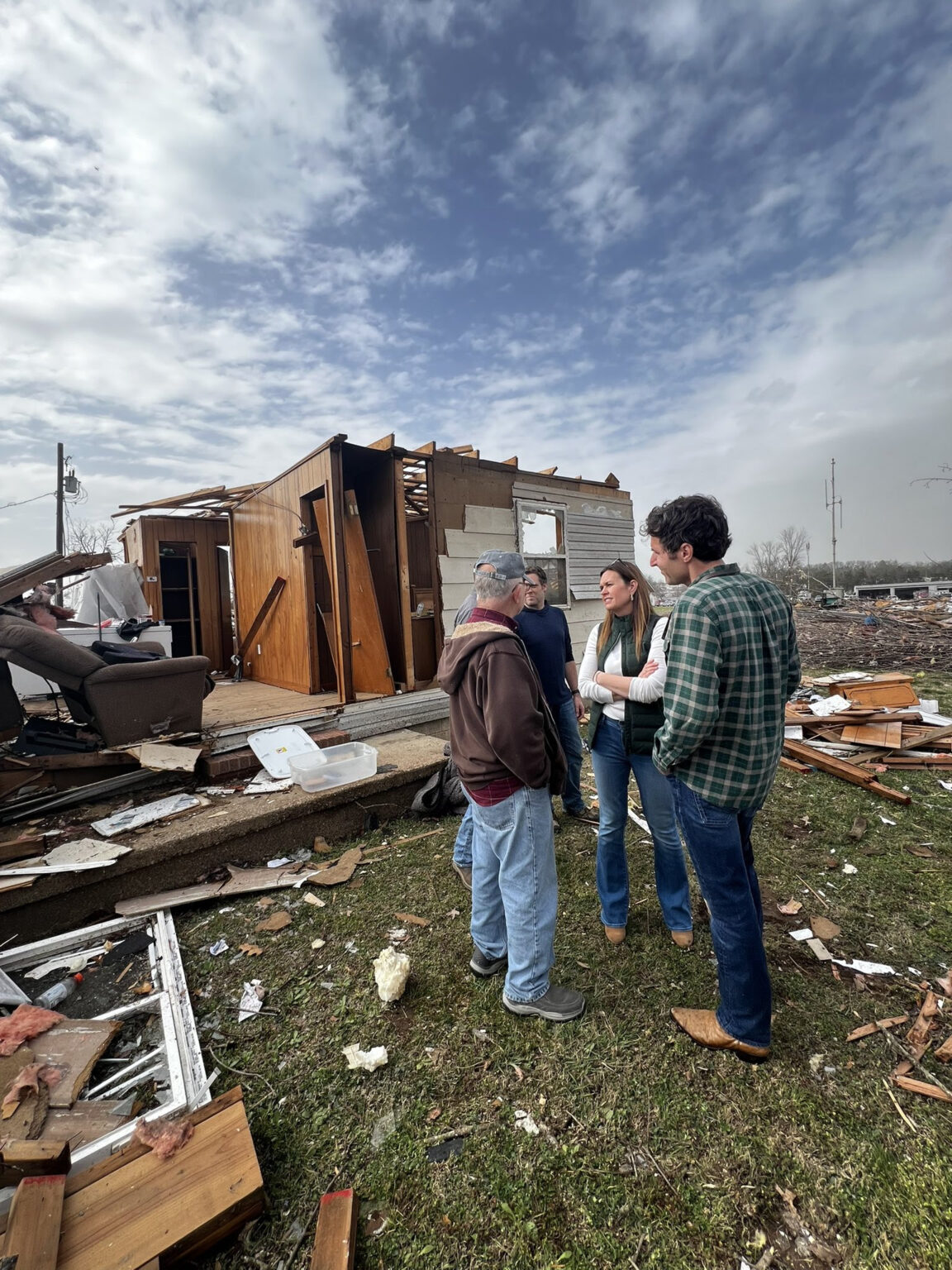
PHOTO: Signs of opposition to the Franklin County prison decorated the fence directly across the street from the prison site’s entrance on Arkansas Highway 215 on Nov. 13, 2025. | Photo by Ainsley Platt/Arkansas Advocate
By AINSLEY PLATT | Arkansas Advocate
If Gov. Sarah Huckabee Sanders needed a sign that Franklin County doesn’t want a 3,000-bed prison, it wouldn’t be hard to find.
Signs declaring opposition to the prison’s construction line fences and mailboxes along Arkansas 215 as the two-lane road cuts a sloping path through the rugged terrain of the Ouachita Mountains, just south of the Arkansas River.
But Sanders and prison supporters say the state desperately needs more prison beds. Almost all of the state’s facilities are at or above 100% capacity, according to the latest Department of Corrections population report. Some of the state’s highest-capacity units are more than 100 years old, while many others were built in the 1980s and ’90s.
Meanwhile, county jails, which house the overflow of state inmates, are “bursting at the seams,” even though counties have added a total 3,000 beds of their own since 2016, Sebastian County Sheriff Hobe Runion said in August.
Others, however, believe tax money would be better spent improving mental health and drug treatment services for inmates and for the formerly incarcerated.
“While some folks do things that warrant their incarceration for a period of time, it’s our responsibility as a state to do right by them while they’re incarcerated, and the fact is that over 90% of them are going to be getting out,” said state Sen. Clarke Tucker, a Little Rock Democrat.
Even one of the new prison’s strongest supporters, Republican Sen. Ben Gilmore of Crossett, said more needs to be done to help incarcerated people prepare for when they get out. But he noted that too many state prisoners are waiting in county jails for more bed space to open up in state facilities.
“We have people that are quite literally sitting there not getting the help that they need, not getting the programming that they need,” Gilmore said. That results in months of lost literacy lessons, anger management classes and more, he said.
But Gilmore was also lead sponsor of the Protect Arkansas Act, a 2023 law that will likely add to the need for more prison beds because it requires longer criminal sentencing and reduces parole eligibility.
That means Arkansas’ prison population, already on an upward trajectory, is set to climb even higher, according to Department of Corrections projections. The solution, according to Sanders, her special adviser Joe Profiri, Gilmore and other lawmakers is the Franklin County prison.
Truer sentences
The Protect Arkansas Act is what criminal justice experts call a “truth-in-sentencing” law, otherwise known as determined sentencing.
“Here in Arkansas, we’ve moved toward, ‘OK, if you commit a certain crime, here’s what you’re going to get, and we’re not going to let you out until you serve a certain amount of time,’” said Michael Cavanaugh, an associate professor and director of the School of Criminal Justice and Criminology at the University of Arkansas in Little Rock.
He said Texas, where someone could get anywhere from probation to 99 years in prison as punishment for robbery, is an example of the opposite.
The Protect Arkansas Act removes parole eligibility for certain felony offenses, particularly violent ones, and provides for harsher sentencing for repeat felony offenders, among other changes. The offenses for which parole is off the table include: human trafficking, Class B felony fleeing and internet stalking of a child. Previously, those convicted of some of these crimes had to serve 70% of their sentence.
Crimes such as exposing someone to HIV without informing them, arson, boating while intoxicated six or more times, or performing an abortion in violation of state law now require people to serve 85% of their sentence before they become parole-eligible.
As a result, over the next decade, the Protect Arkansas Act will increase the demand for prison beds, likely adding 2,902 offenders by 2040, according to prison population projections created by Wendy Ware, a consultant who estimated the Department of Corrections’ prison population for several decades.
The prison population was already growing before the measure passed. After three years of population decreases between 2010 and 2012, the prison population has grown 32.8% since 2012 as of 2024, with much of the increases coming between 2013 to 2015, and 2022 to 2024.
She told the Board of Corrections in November that the new law’s full effects wouldn’t be seen until after 2036, as inmates who would have been handed a shorter sentence remain in prison longer as a result of the Protect Act changes.
Longtime Arkansas defense attorney Jeff Rosenzweig used a hypothetical example to explain why the effects of the law will be delayed.
Before it was passed, he said, someone could get a 15-year sentence and only serve 10. But under the Protect Act, for certain offenses, “now they end up having to do 15. The first 10 is baked in already. It’s that extra five that is going to hit and cause huge overcrowding.”
Rosenzweig said the legislation could worsen behavior inside the prisons by “taking away the carrot we have for good behavior.”
“You’re telling people, no matter how well you behave, no matter what you do, no matter what accomplishments you have, or aging out of the judgment problems that got you there in the first place, there’s nothing you can do to get out.”
Severe sentencing in Arkansas has already forced more people to accept plea deals before the Protect Act passed, even if they have had a valid defense, Rosenzweig said.
“The severity of sentences is so substantial that you have a number of people who will take a lesser prison sentence rather than run the risk of having a sentence that locks them up for the rest of their lives,” he said.
‘If you build it’
Cavanaugh said the Protect Act, combined with the new prison, would almost certainly reduce repeat offenders, which accounts for a large percentage of those admitted to Arkansas prisons annually — if only because of the much stricter requirements to be paroled.
“It’s one of things that, if you build it, they will come. That’s always the idea. So they’re going to fill the prison now. You almost have to build it, because of the mandatory sentences and truth-in-sentencing,” he said. “You’re going to have an increased population.”
Many, including some members of the Board of Corrections, don’t think a 3,000-bed prison is the answer to Arkansas’ persistent crime and prison capacity issues, even as sheriffs, counties and some state legislators push for additional prison space to alleviate the county jail backup. As of Dec. 9, 1,852 people were sitting in county jails waiting for a state prison bed, according to data provided by the Department of Corrections.
BOC Chairman Benny Magness was ambivalent about the Protect Act at times in an interview with the Advocate, though overall mostly supportive. He supported much of the bill when it was moving through the Legislature, he said, including the longer sentences, in order to tamp down on the repeat offenders he said were driving much of the population growth. But Magness also said he wished some offenses requiring 100% of a sentence be served were still eligible for parole.
“With Protect Arkansas, there’s no question there’s going to be a growth curve we’re going to have when it takes full effect,” he said. “But I actually believe the back side of Protect Arkansas will be helpful.”
A 26-year veteran of the board, Magness said he supports Sanders’ push to increase the prison system’s bed capacity. But not necessarily how large the planned prison will be. While recidivism and parole violations fuel about half of prison population growth each year, Magness said drugs play an outsized role in why people come and are later returned to prison, and that more needs to be done to address the problem.
He’s backed up by the department’s data. A 2023 report examining the three-year recidivism rate for people released from the Division of Correction in 2018 said 56% of those who returned to prison on new charges did so on a drug charge.
“My preference would be to decrease the size of what we’re going to build in Franklin County and build more treatment centers,” Magness said. He wishes more had been invested into drug treatment on the front end.
The dedicated drug treatment facilities the department has are already more successful than in regular prison units, Magness said. What hurts the prison population the most, he said, are short sentences for reoffenders, something he said was addressed in the Protect Act, and keeping them for longer will help slow the growth.
But Sarah Moore, executive director of the Arkansas Justice Reform Coalition, said in an August interview that the Protect Act was “shooting from the hip” due to limited evidence that longer sentences deter crime. She said it’s part of a longer-term cycle.
“What we’ve seen historically is this swing that keeps happening,” she said, “where we recognize maybe there is a backlog, or we’re seeing overcrowding in a prison, and then it starts to swing one way. Then you get this tough-on-crime rhetoric that occurs. We get this tightening, like zero-tolerance, that happens.”
Moore said young people, who are more likely to commit crime, are already growing up in a world with “a lot of uncertainty and instability,” and that there needs to be greater investment in communities, not prisons.
“When we destabilize our communities further, ultimately we decrease public safety,” Moore said.
Kaleem Nazeem, co-director of decARcerate, agrees that more prisons don’t improve community safety. The nonprofit he leads is dedicated to organizing formerly incarcerated people around efforts to overhaul the criminal justice system. Nazeem was imprisoned for life without parole for a crime he was convicted of as a minor, but was freed after the U.S. Supreme Court ruled the mandatory sentencing of minors to life parole in prison was unconstitutional.
“We don’t need more prisons — and I must highlight this — we need more educational programs. We need more wraparound services. We need more mental health staff. We need more mental health treatment,” Nazeem said.
Tucker said in an August interview that building the prison wouldn’t do anything to address the core issue of the growing population in the first place.
“We can’t build our way out of this problem,” Tucker said. “We don’t have high crime and high incarceration rates because Arkansans are inherently violent. We have high crime and high incarceration rates because there’s some other problems that we need to solve as a society, including our own policies on who goes to prison for how long.”
This is the last in a series of stories examining the cost of Arkansas’ carceral system on people, how state policiesand recidivism contribute to overcrowding, and how a 2023 law foretells more increases in the prison population.
Discover more from
Subscribe to get the latest posts sent to your email.