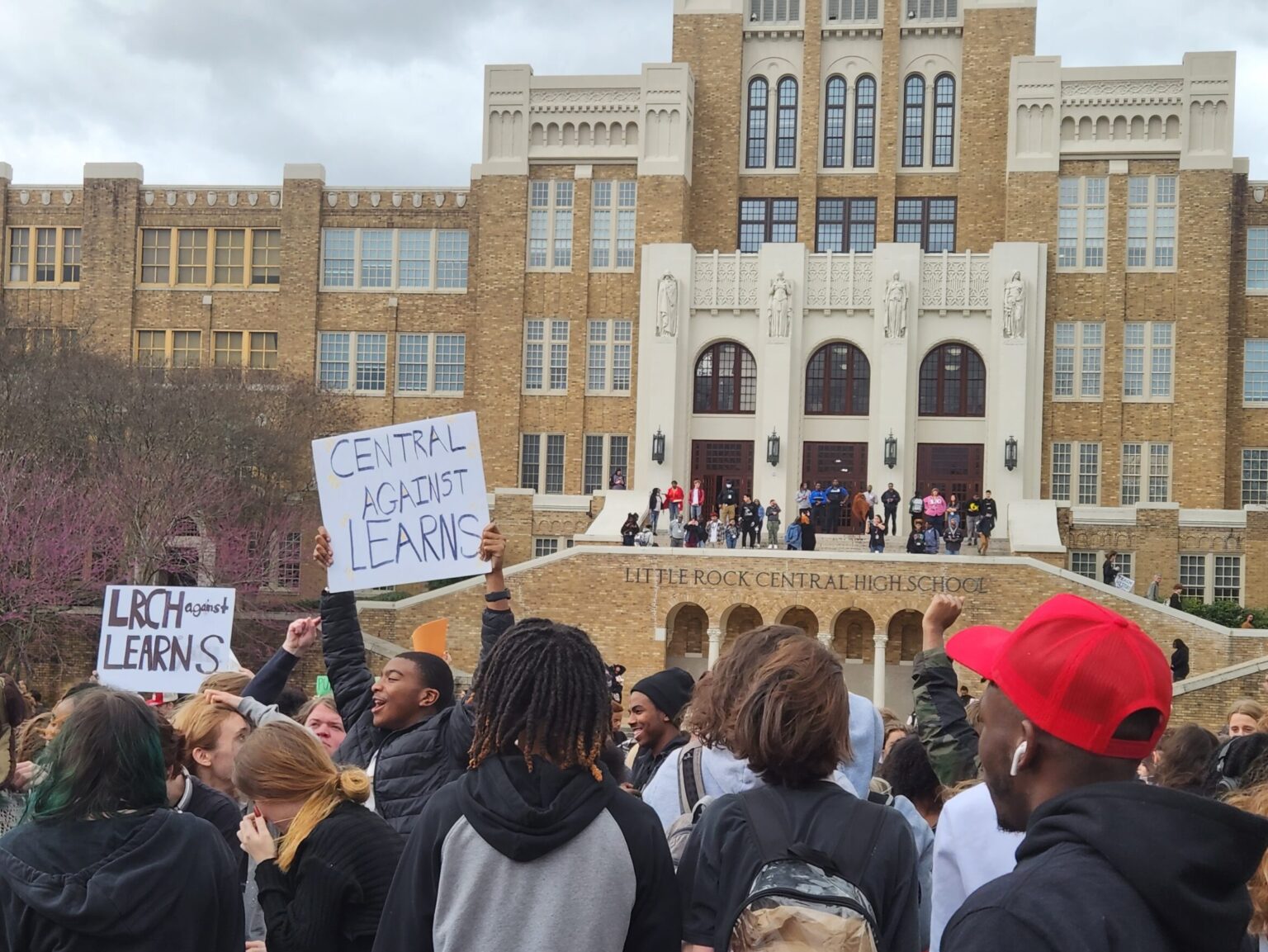
STUDENTS PROTESTING: A federal appeals court on Wednesday upheld the part of Arkansas’ LEARNS Act that bans “indoctrination” in public school classrooms. This photo shows Little Rock Central High students protesting the education overhaul law in 2023. | Tess Vrbin/Arkansas Advocate
By SONNY ALBARADO | Arkansas Advocate
Arkansas’ ban on “indoctrination” in public schools doesn’t violate students’ free speech protections because the government has a right to dictate what is taught, a federal appeals court panel ruled Wednesday.
The three-judge panel from the 8th U.S. Circuit Court of Appeals tossed out a lower court’s ruling that blocked enforcement of part of Arkansas’ 2023 education overhaul law. The panel sent the case back to the district court for further proceedings.
U.S. District Judge Lee Rudofsky in May 2024 granted a preliminary injunction against the section of the LEARNS Act that prohibits “indoctrination” in public schools. Section 16 of the law specifically bans the teaching of “Critical Race Theory.” Rudofsky’s ruling applied only to the students who had sued, not the Little Rock High School teacher who was also a plaintiff in the lawsuit.
The suit argued that the “indoctrination” section of the law violated the U.S. Constitution’s First and Fourteenth Amendments, which guarantee the rights of free speech and due process, respectively.
Arkansas officials appealed the preliminary injunction, arguing free speech protections don’t mean students can demand that public schools teach certain topics. The appellate panel agreed in its 18-page ruling, written by U.S. Circuit Judge L. Steven Grasz. Circuit Judges James B. Loken and Raymond W. Gruender were the other members of the panel.
“The students concede the classroom materials and instruction they seek to receive constitute government speech. This is fatal to their likelihood of success because the government’s own speech ‘is not restricted by the Free Speech Clause,’ so it is free to ‘choose what to say and what not to say,’” the panel said, quoting from a 2022 U.S. Supreme Court ruling in Shurtleff v. City of Boston.
“Since the Free Speech Clause does not give the students the right to compel the government to say something it does not wish to, they cannot show a likelihood of success,” the appeals court ruling said.
Attorney General Tim Griffin in a statement called the appeals court ruling “an important win for the LEARNS Act and for the rule of law. With its ruling today, the Eighth Circuit continues to ensure that the responsibility of setting curriculum is in the hands of democratically elected officials who, by nature, are responsive to voters.”
The panel also ruled the district court erred in granting the preliminary injunction based on the likelihood the students might succeed on their argument that the First Amendment protects a person’s right to receive information. While students have a free-speech right to receive information, they can’t dictate what schools include in their curriculum, the panel said.
“Though a listener’s right to receive information means the government cannot stop a willing private speaker from disseminating his message, that right cannot be used to require the government to provide a message it no longer is willing to say,” according to the appeals panel.
“We do not minimize the students’ concern … about a government that decides to exercise its discretion over the public school curriculum by prioritizing ideological interests over educational ones,” the panel wrote. “But the Constitution does not give courts the power to block government action based on mere policy disagreements.”
The First Amendment right to receive information doesn’t authorize a court to require the state to retain curriculum materials or instruction, “even if such information was removed for political reasons,” the ruling said. “Since the speech belongs to the government, it gets to control what it says.”
In spite of its ruling in favor of the state’s position, the panel noted: “Government speech is not immune from all constitutional challenges, and our holding does not suggest otherwise.”
The due process argument
The district court’s preliminary injunction excluded the teachers who sued because, Rudofsky wrote, they did not show irreparable harm arising from Section 16 of the LEARNS Act.
The teachers had argued the law forced them to self-censor in their classroom instruction, but Rudofsky ruled that the speech they were allegedly censoring was the state’s, not theirs. The teachers also argued that the law’s indoctrination section was so vague that it violated the Fourteenth Amendment’s due process clause.
The teachers filed motions in the appeal making similar arguments, but the appellate panel declined to consider the vagueness claim because the teachers didn’t file a separate appeal.
Discover more from
Subscribe to get the latest posts sent to your email.