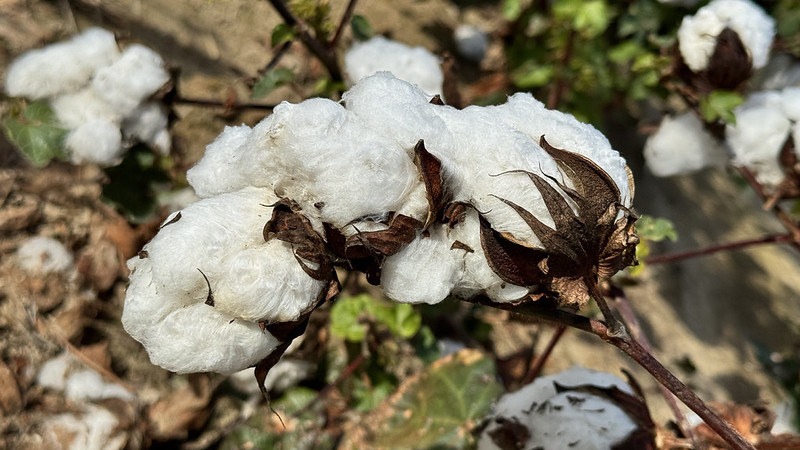
Arkansas’ cotton harvest should wind up by week’s end, said Extension Cotton Agronomist Zachary Treadway. Taken Nov. 8, 2026. UADA image
By MARY HIGHTOWER | University of Arkansas Division of Agriculture
Fast Facts
- NASS noted lower pod counts in 11 soybean states
- Treadway: Peanuts, cotton harvest should finish this week
The U.S. Department of Agriculture has revised estimated yields for Arkansas corn, soybeans and peanuts downward, but was still expecting record state yields for corn and soybeans.
Scott Stiles, extension economics program associate for the University of Arkansas Division of Agriculture, said USDA’s National Agricultural Statistics Service on Monday revised Arkansas corn down three bushels per acre from its October estimate of 193 bushels to 190 bushels.
Soybean yield was also adjusted three bushels per acre downward from 59 bushels in October to 56 bushels in its November estimate.
NASS said, “the November objective yield data for the 11 major soybean-producing states indicate a lower pod count compared with the previous year.
“Compared with final counts for 2025, pod counts are down in six of the 11 published States. Kansas showed the greatest decrease, down 358 pods per 18 square feet from the previous year,” NASS said. The 11 states are Arkansas, Illinois, Indiana, Iowa, Kansas, Minnesota, Missouri, Nebraska, North Dakota, Ohio, and South Dakota.
NASS did not have any Arkansas-specific comment for any of the crops it adjusted.
However, Jeremy Ross, extension soybean agronomist for UADA, said he’s “still not sure where NASS is finding all of these soybean bushels in Arkansas.
“Many of the soybean farmers I have talked to have ‘average at best’ soybean yields for 2026,” he said. “If you look at the ‘Soybean Pods with Beans per 18 Square Feet’ table from the NASS report, the November 2026 pod count for Arkansas — at 1,552 pods — is 323 less pods than was counted in 2025, which was 1,875 pods.
“Arkansas has 452 pods less than the average pod count from the 11 states surveyed in 2026 which was 2004 pods,” Ross said. “I still think the state average yield is too high and will be adjusted down in the final report.”
Peanuts saw a 100-pound-per-acre drop from October’s estimated yield of 4,700 pounds to 4,600 pounds.
However, NASS revised Arkansas’ rice yield upward 50 pounds per acre from 7,500 to 7,550.
Jarrod Hardke, extension rice agronomist for UADA, said the revision wasn’t a surprise.
“Rice yields were expected to climb over the previous estimate given that they were noticeably improved over 2025 crop yields,” he said. “Some growers rivaled 2024 record yields, but there was enough variability to keep many around-average yields.”
NASS left cotton at 1,384 pounds of lint per acre.
“November will be the last month USDA makes any adjustments to yields until the Crop Production Annual Summary is issued on Jan. 12, 2027,” Stiles said.
Crop progress
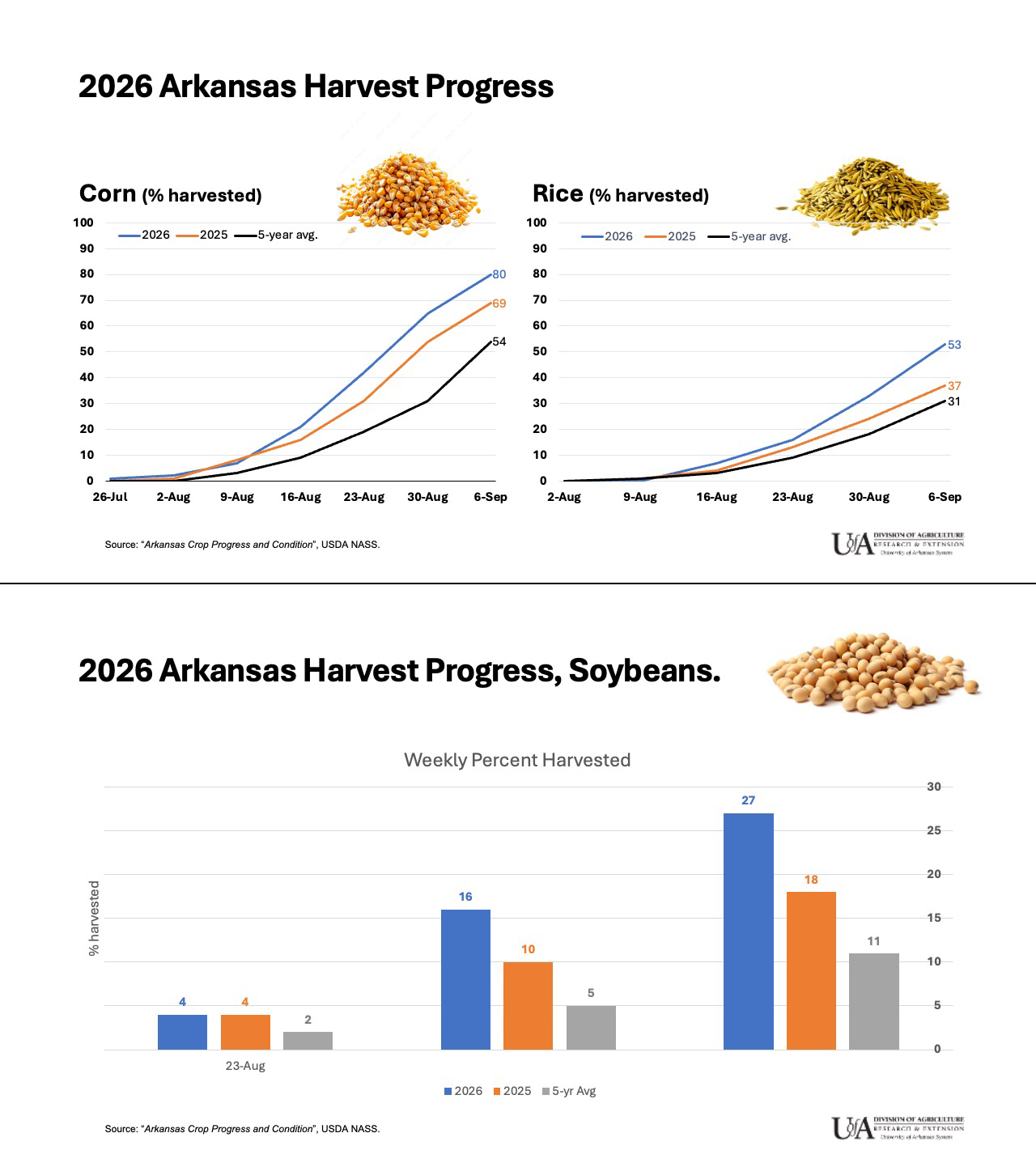
This week’s Crop Progress report from NASS saw soybeans 96 percent harvested versus the 93 percent five-year average. Cotton moved to 97 percent harvested versus the 92 percent five-year average. Peanuts were 90 percent harvested, ahead of the 83 percent average.
Stiles said winter wheat planting had advanced to 71 percent planted versus the 73 percent five-year average. Drought has stalled emergence, with only 35 percent emerged versus the 52 percent five-year average.
“One Poinsett County grower mentioned that he hasn’t planted wheat in over 30 years,” Stiles said. “He planted some this year.”
At a time when farmers are looking for crops that will cause the least depression in their bottom line, “wheat looked great back in early September. It peaked at $8.05 per bushel on Sept. 2 at a three-year high,” Stiles said. “That price level enticed some acres to wheat.”
Unfortunately, prices have dropped about $2 per bushel since then, he said. “July 2027 wheat was trading at $6.10-$6.15 a bushel on Tuesday.
“Australia and Argentina both ended up having decent wheat crops this year, and Canada as well,” Stiles said. “There’s been heavy price pressure coming from larger than expected crops around the globe.”
Zachary Treadway, extension cotton and peanut agronomist for UADA, said that “barring unforeseen issues, I expect both cotton and peanut producers to be out of the field by week’s end.
“Yields are still looking positive for cotton, while peanuts still look to be down a little from last year,” he said. “It has been a trying year, especially from a drought standpoint, but Arkansas producers can stand proud of the crop they’ve made in 2026.”
To learn about extension programs in Arkansas, contact your local Cooperative Extension Service agent or visit uaex.uada.edu. Follow us on Facebook and Instagram. To learn more about the Division of Agriculture, visit uada.edu. To learn more about ag and food research in Arkansas, visit the Arkansas Agricultural Experiment Station at aaes.uada.edu.