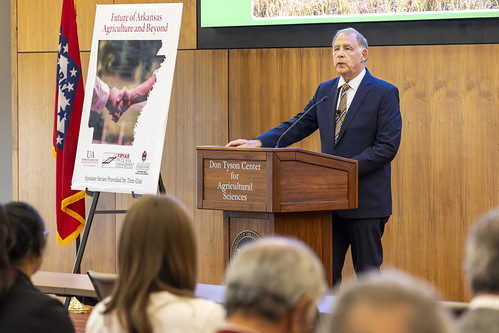
U.S. Sen. John Boozman addresses the audience as the Fryar Center’s keynote for its “The Future of Arkansas Agriculture and Beyond” series, taken Oct. 30, 2026. UADA photo
By MARY HIGHTOWER | University of Arkansas Division of Agriculture
Fast Facts
- Boozman: ‘Our goal is to advance a comprehensive, five-year farm bill by the end of the year.’
- ‘Farm Bill 2.0,’ is nearly 1,000 pages long
Based on data more than a decade old, the current Farm Bill is a relic of another time and is adding to the pressures farmers are currently experiencing, said John Boozman, chair of the U.S. Senate Committee on Agriculture, Nutrition & Forestry.
Boozman discussed the Farm Bill in the context of the severe economic challenges facing farmers in Arkansas and beyond. He was the keynote for this year’s Future of Arkansas Agriculture and Beyond speaker series event, hosted by the Fryar Price Risk Management Center of Excellence. The center’s mission focuses on food and fiber system risk management.
“Farming is certainly a risky business,” Boozman said. “Producers have experienced years of economic pressures and delays in updating policies, which has added to these challenges.
“The farm community is rightfully looking to Congress for modernized policies that can help with current conditions and give them predictability and certainty for the future,” he said.
“When producers face these financial pressures, year after year, and they see the numbers continue in the red, they have very difficult decisions,” Boozman said. “Some are selling equipment, scaling back operations, or questioning whether they have a future in the industry at all.”
“We cannot afford to lose the farms and the people who grow our food because the policies have failed to keep pace with the reality of modern agriculture and an evolving economy,” he said.
“Since the last Farm Bill was signed into law in 2018, circumstances have changed dramatically,” Boozman said. “In fact, the 2018 Farm Bill was based on 2012 data.
The world is totally different now than it was then.”
Farm Bill 2.0
The Farm Bill under development is “close to a thousand pages,” he said.
Under Boozman’s leadership, the Senate Agriculture Committee passed a bipartisan bill that includes more than 100 policies, including priorities from members of both parties, and most importantly, shaped with the input of farmers, ranchers, forest landowners and rural community leaders,” he said.
He noted that the Working Families Tax Cuts Act delivered improvements to farm safety net programs like ARC and PLC — Agriculture Risk Coverage and Price Loss Coverage — and with Arkansas farmers estimated to receive nearly $1 billion, “those resources matter to producers, and we’re continuing to build on these improved policies through Farm Bill 2.0.”
Negotiations with congressional agriculture leaders on both sides of the aisle are ongoing to get a new Farm Bill signed into law.
“Our goal is to advance a comprehensive, five-year farm bill by the end of the year, and I’m very, very hopeful that we can accomplish this,” he said.
Part of the mission
Boozman’s talk was the second in the speaker series, which was initiated by Thomas Gist, an Arkansas Agriculture Hall of Fame member and lifelong cotton and grain farmer from Marianna who focused on innovation.
“We were pleased to welcome Sen. John Boozman to campus last week for the Tom Gist Lecture Series,” said Lanier Nalley, Fryar Center director and head of the agricultural economics and agribusiness for the University of Arkansas and University of Arkansas Division of Agriculture. “We appreciate his support for Arkansas agriculture, and I’m especially grateful for his dedication to bringing both sides of the political aisle together to address the challenges facing Arkansas farmers.”
Andrew McKenzie, Fryar Center associate director and Fryar Endowed Chair, said, “Sen. Boozman showed genuine concern for row crop farmers in our state and the difficult farm economy they are facing with margins being squeezed by higher input costs not matched by higher output prices.
“He highlighted government support to farmers in the form of the $12 billion in bridge assistance and the emergency waiver to allow summer sales of E-15 to help demand for corn,” McKenzie said.
James Mitchell, the Fryar Center’s associate director for extension, noted that Sen. Boozman was complimentary of the Division of Agriculture “and the work we do for our stakeholders.”
“He also recognized the importance of agricultural research,” Mitchell said. “I left the event feeling proud to work in Arkansas. It was encouraging to know that someone in a position as prominent as Sen. Boozman recognizes and values the work we do and the contributions we make.”
“The Gist speaker series supports the Fryar Center’s mission by connecting research, education and extension to help the agricultural community better understand and manage risk,” Nalley said. “Bringing together policymakers, producers, industry leaders and researchers helps connect the challenges farmers face with the decisions that shape their businesses and livelihoods.
“Multiple perspectives are essential because agricultural risk extends beyond the farm gate. Markets, policy, weather and consumer demand all influence producers’ profitability, and no single perspective captures that full picture,” he said. ‘These conversations encourage dialogue, identify shared priorities and strengthen the Fryar Centers ability to work together for the agricultural community.”
Discover more from
Subscribe to get the latest posts sent to your email.