
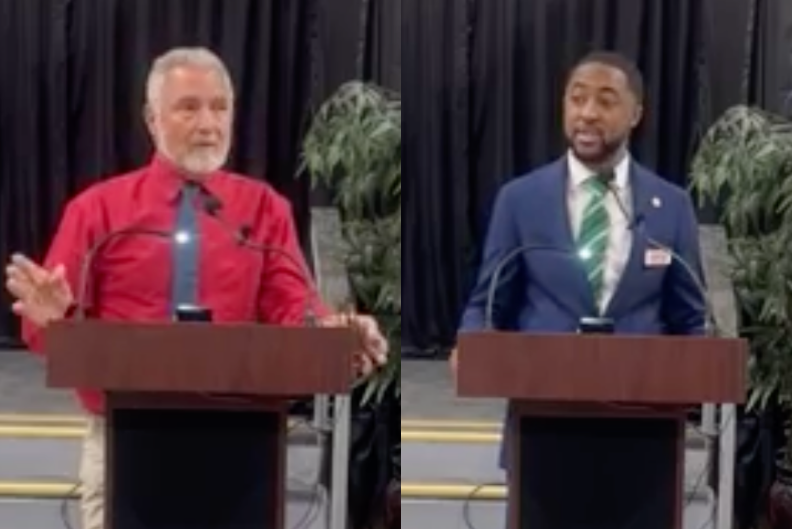
County judge candidates Bill Rogers, left, and Michael Ankton take turns answering questions during a debate in Arkadelphia. | Image from an edited livestream screen grab from The Arkadelphian’s Facebook page
Editor’s note: This post was updated Oct. 1 to reflect the latest campaign contributions and expenditures for Michael Ankton.
By JOEL PHELPS | arkadelphian.com
Candidates vying for the office of Clark County Judge in the upcoming election participated Tuesday in a debate hosted jointly by the county’s two political parties.
The candidates are longtime mechanic, business owner and volunteer firefighter Bill Rogers, who’s running on the Republican ticket, and Michael Ankton, an Arkadelphia Public Schools social studies teacher whose political experience includes a two-term stint as Democrat county lawmaker.
Others seeking public office were invited to attend, as well, and participated some in the debate, which was focused primarily on the county judge candidates. Those attending were District 2 justice of the peace candidates Amber Bailey (D) and Fred Phillips (R), and District 3 incumbent Justice Vanilla Hannah (D). Hannah’s opponent, Keith Crews (R), did not attend. Tuesday’s forum, held at the Arkadelphia Community Family Enrichment Center, drew a crowd of some 100-plus citizens.
Taking turns drawing questions, candidates spoke candidly about issues affecting Clark County, from their ideas on building a new jail to their stance on the 1/2-cent economic development sales tax.
Watch the video below:
Government programs
Asked which programs they would expand or cut to meet budgetary needs, Ankton said he would focus on continuing existing grants, and would see to it that county employees get competitive salaries. The 25-year-old said his budget goals also align with what he calls a “new season of growth” for Clark County.
Rogers admitted lacking full knowledge of all existing programs, but said county employee salary is at the top of his list to improve.
Public safety
Both candidates agreed that public safety is a job for the county’s elected sheriff, and both pledged support for the Clark County Sheriff’s Office.
Jail
Moving from discussion of building a new county jail to it becoming a reality was a question for all candidates in attendance.
Ankton said a step-by-step plan needs to be in place now. There are some “unique” scenarios regarding the funding of a jail, though he didn’t elaborate. Saying that taxes are already high in Clark County, Ankton said he remains open to all funding possibilities, and while the county judge is responsible for county property it shouldn’t be an executive decision when there is an 11-member quorum court that can be part of the process.
Rogers was blunt in that he opposes another tax. Though he didn’t specify, Rogers described the current jail as a money pit and a liability to the county. A new jail, on the other hand, could instead generate revenue. In the first year of office, Rogers said he would spend hours of number-crunching to find a way to fund a new jail without asking citizens for a tax.
Bailey said that, whether a jail is funded by taxes or with the help of grants, there needs to be a safe, clean place to house incarcerated individuals.
Hannah said the money simply isn’t available for a new jail, and that there are other county programs that need funding. Hannah acknowledged the jail’s poor conditions, and was open to suggestions on how to fund a jail.
Phillips spoke from experience as a former jail administrator. “It’s not a place I’d want to be,” he said of incarceration. He noted that the current facility does not meet all current jail standards, but it is grandfathered in. Though admitting uncertainty about how to fund a jail, Phillips agreed that one is needed.
Steward of tax dollars
A religious man, Rogers said he relies on his own good faith and character to make sound financial decisions.
Ankton relies on his record as a county lawmaker to stretch dollars where needed. Abuse of tax dollars affects everyone, including himself.
Party values
One question was directed at Ankton alone — whether he supports Republican values. Provided with a side-by-side comparison of party beliefs, Ankton reviewed the graphic between questions, ultimately responding that he didn’t believe that particular question was conducive to a county judge’s responsibilities, so he declined to answer. His response drew a roar of applause from the audience.
Community inclusion
Go where the people are and listen to their issues, Ankton said. As judge, Ankton said he would continue going to local churches, neighborhoods, restaurants and retailers to talk to people and listen to them.
Rogers said time constraints as a county judge wouldn’t allow for getting out, as his opponent suggested. Instead, Rogers would rather church and community leaders approach him. “Bring your problems to me,” he said, adding that he will have an open door policy as county judge.
Prioritizing short- and long-term needs
Priority under Rogers’s leadership will be given to issues that are “the most good for the most people.” Rogers said it’s important to solve problems at hand with a degree of foresight to prevent the same problem from cropping up later.
Naming the county’s various departments, Ankton said he would delegate to positions that exist to handle issues, and lean on department heads who are more knowledgeable about their fields.
Capitalizing on his experience in debate, Ankton was markedly eloquent in each of his responses. Responding to another question about using his experience to prioritize tasks, he said strategic planning with department heads and justices would be key to turning his vision into reality. Because money is often an obstacle, Ankton said it’s important to rank projects, but to include input from others before making decisions.
Rogers reiterated that he believes in “the most good for the most people” but would listen to everybody. He said there are county roads that need immediate attention, but noted that residents shouldn’t ask for their private driveways to be repaired.
Bad decisions
Asked what he has learned from past mistakes, at 62, Rogers quipped that there wasn’t enough time to talk about bad decisions. But he’s learned not to make any promises unless he can fulfill them. Patience is also key to solving problems.
Ankton said being the second justice called for each quorum court vote has forced him to be decisive. He said he’s not cast any wrong votes as justice of the peace. As for life mistakes, the civics teacher chuckled as he apologized to his first-year students.
Economic development tax
Neither candidate took a stance on allowing voters to decide whether to repeal a portion of the 1/2-cent economic development sales tax to build a new jail, neither candidate took a stance. Both Ankton and Rogers said they would support whatever the community wants.
Asked how the sales tax has benefitted the county since its 2007 inception, Rogers said citizens may have to wait several more years to reap the benefits. “We will be ready when some [industry] is looking,” he said. Admitting that he doesn’t agree with every decision by the tax-funded Economic Development Corp. of Clark County, Rogers said transparency and communication would educate the public on economic development.
Ankton was more forward in his response, saying Clark County is “fortunate” to have an entity (the Arkadelphia Regional Economic Development Alliance) tasked with recruiting job makers. “We should continue to use that and capitalize further,” he continued. “This is just the beginning.” Acknowledging that not much progress has been made with the tax in nearly 20 years, Ankton contended that “slow movement is better than no movement.”
Another question was pointed at transparency from the Alliance as it relates to including information about prospective industries.
Ankton said that, while he’s an advocate for transparency, economic development is where public interest and understanding collide with the business world. As county judge, he would communicate as much as he could with constituents about a prospect, but noted “some things we can’t know.”
While nondisclosure is part of the recruitment process, Rogers stressed that he would not sign any contract without knowing the end result. “We should never have a situation where we sell [land] and have no control over what’s going in there because we don’t know if it’s good or bad for us,” said Rogers, referring to the failed sale earlier this year of the Southwest Arkansas Mega Site to an unnamed data center developer.
Issue 3
On the November ballot is Issue 3, a legislature-referred constitutional amendment allowing cities and counties to create economic development districts.
The candidates have differing opinions on the issue. Rogers opposed the idea, arguing that creating a district — or an “economic town” — where an industry is immune to taxes wouldn’t be fair to other businesses in the county.
Saying he neither favored nor opposed Issue 3, Ankton viewed it as a tool to further incentivize industry.
Appointments and representation
Asked about their process in appointing members to the EDCCC, Ankton said he doesn’t always know who the county judge appoints to that panel, and believes appointments should be made more publicly. The panel, he said, should be a diverse group of business owners rather than pulling from one or two sectors. Ankton favors a nomination process for EDCCC appointments.
Rogers said there is currently too much overlap in board representation, with not enough occupational diversity on the EDCCC, which some argue consists mostly of loggers, lawyers and bankers. He said he has a list of people ready to serve, and wants to put working people on the board.
County employee health insurance
Ankton said benefits — not just pricing — should be compared when shopping for county employee health insurance. He said he wouldn’t feel comfortable slashing benefits to save $20.
Rogers said the employees should have a say and be involved in the selection process since they’re the customer.
Police equipment
Asked about upgrading communication equipment for the sheriff’s office, whose deputies’ radios sometimes do not work if outside their patrol cars, Rogers said more than just law enforcement needs better communication equipment. Referring to the eDispatches text alerts that volunteer firemen get when there is a medical or fire emergency, Rogers said he has been warning for a year that a citizen is going to die because firefighters cannot hear the directions dispatchers give to emergencies. He would continue pursuing AWIN for law enforcement and adding tower communications for volunteer fire departments.
Speaking from his brief experience as a 911 dispatcher, Ankton said there is no universal fix to the problem. “Clark County is unique, and we’re going to have to be unique in our solution,” he said.
Obeying ordinances
How important is it to follow ordinances?
“If you’re not going to obey all of them, why obey any of them?” Rogers retorted, acknowledging — but not pointing out — ordinances the county doesn’t adhere to. “We’ve got to follow all the county ordinances if we’re going to follow any of them,” he said.
As author of an ordinance requiring quorum court meetings to be live-streamed, Ankton pointed out that his ordinance has been overlooked. A county judge, he said, should be held accountable for not following the law.
Reporting violations
The final question of the evening was how each candidate would approach a known statute violation: Would you report it, or remedy it behind closed doors?
Both Ankton and Rogers said they would lean on the county attorney for legal advice in that situation.
Campaign coffers
The latest financial disclosure information filed by each candidate, accessed through the Arkansas Secretary of State website, shows that Rogers raised $8,079 for his General Election campaign. Donors include Percy Malone ($2,500), Randy Stewart ($2,000), Donna Malone ($2,000), Terry and Sharon Hearnsberger ($500), Gene and Stephanie Banks ($300), Ken Lancaster ($250), Marci and Stacey Rogers ($250), Bob Sanders ($250), Jim Burns ($200), and Gwen Smith ($150).
Rogers’s expenditures tally $8,742.42 and include payments to Batson Sign Company ($4,671), Print Mania ($3,028.82), Men’s Warehouse ($1,069.95), Arkadelphian.com ($550), The Southern Standard ($420), and Arkadelphia Printing ($72.60).
Ankton has raised $3,732.25 for his General Election campaign. Donors include Democratic Party of Clark County ($1,000), Vickie Faust ($350), Martha Dixon ($200), James T. Kauffman, DDS ($200), Loretta Moss ($200), Betty Eckhart ($100), Johnny Harris ($100), Albert Neal ($100), Lewis A. Shepherd Jr. ($100) and Romona Williams ($100).
Ankton’s expenditures tally $3,691.75 and include payments to Batson Signs ($1,787.40), Democratic Party of Clark County ($757.50), Arkadelphia High School FBLA ($250), The UPS Store (246.85), and Meta Platforms Inc. ($200).
Discover more from
Subscribe to get the latest posts sent to your email.


