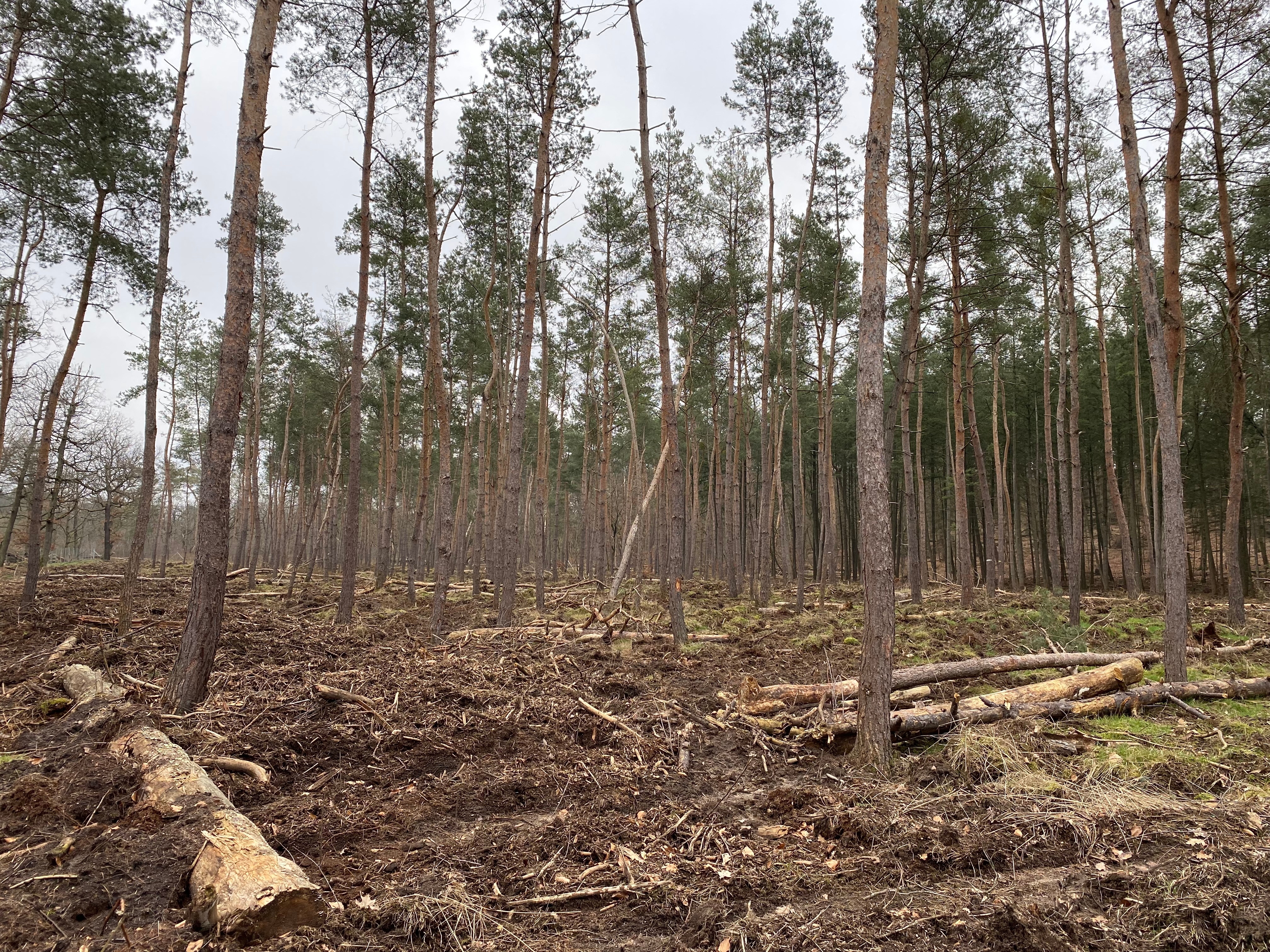
A pine forest in drought conditions. Arkansas forestry experts say that while dry conditions have allowed access to bottomlands usually out of reach to loggers, drought has adverse effects on the timber industry. | Shutterstock image
Fast Facts
- Heat, drought take compound toll on trees
- Watering in moderation best approach to healthy residential trees
- Forests cover more than 55% of Arkansas
By RYAN McGEENEY | University of Arkansas Division of Agriculture
MONTICELLO — The drought that has affected Arkansas and surrounding states for more than a year has had an impact on every sector of the region’s agriculture, including timber stands throughout the South.
According to the Arkansas Department of Agriculture, Arkansas is home to more than 18 million acres of forestland, containing more than 11 billion trees and covering about 55% of the state. Of that, about a third of the acreage is pine and about 55% is hardwood forests, featuring native species such as oak, hickory, maple and others. According to research from the University of Arkansas Division of Agriculture, Arkansas produced more than 21 million tons of commercial timber in 2024, contributing more than $365 million to the state’s economy.
Jaret Rushing, extension forestry educator for the Division of Agriculture, said the dry conditions of 2025 allowed loggers to access hardwood bottomlands typically out of reach to the logging industry.
“On the commercial side, the weather dictates how and when timber is harvested,” Rushing said. “Because we had hardly any rain at all last year, loggers had the ability to log very wet and flood-sensitive areas all year long, which brought a surplus of timber to the mills.”
Rushing said that as supply began to outstrip demand, mills placed quota limits on commercial loggers and reduced prices on offer.
“In southern Arkansas, we are in the West Gulf Coastal Plain, so we have several different perennial stream tributaries that, from October until February or even March, are so deep in water that they keep loggers out of the ‘bottoms,’ which is primarily hardwood bottomland,” he said. “This year, they have had no restrictions. They can get in just about anywhere they want.”
High heat, deep drought
According to the U.S. Drought Monitor, the vast majority of Arkansas is currently in moderate to severe drought, with areas in the northeast, central and southeastern portions of the state experiencing extreme or exceptional drought.
The monitor also features a Drought Severity and Coverage Index spanning a scale from 0-500. According to the index, the overall severity of the drought in Arkansas increased significantly over the last three months, rising from a severity score of 184 at the start of the year to a peak score of 372 occurring in April. As of June 23, Arkansas’ DSCI score is 264.
Rushing said 2026 has largely been an extension of the previous year’s commercial situation, despite recent rain events.
“We’re still in a significant drought area,” Rushing said. “The water that’s hitting the ground right now isn’t being soaked up, really. The last few rain events we’ve had, you’re talking 6-8 inches in a very short period — so the water doesn’t get absorbed, it runs off.”
The combination of heat and drought can open the door to disease and pests in timber, whether in vast forests or on private residential land, he said.
“Whenever you have periods of extreme heat plus drought, you’re adding different stress factors to trees that affect not only how they grow, but how different pests and diseases will attack the tree,” Rushing said. “One in particular that we’ve seen a lot in south Arkansas is brown spot needle blight, a fungal disease attacking pine trees. The drought conditions, as well as the extreme heat, just rapidly intensify how much it affects the tree and how far it spreads.
“In hardwoods, post oaks are extremely affected by this kind of sustained heat and drought,” he said. “Seemingly healthy trees will just randomly die overnight. You wake up one morning and all the leaves are brown and on the ground — and drought and heat are the only stress factors we can attribute that to.”
Giving trees a fighting chance
Rushing said that for commercial harvesters, not much can be done for timber acreage under these conditions other than to harvest the trees slightly ahead of schedule. For residential landowners, however, the key to combating heat stress is simply to water in moderation.
“Trees can only take up so much water, based on their size,” Rushing said. “The bigger the tree, the more water uptake. But if you’re constantly watering a tree every single day, you’re doing more harm than good. What we typically recommend is 1-3 inches of water per week. That’s perfect for the tree.
“If a landowner is planting a smaller tree in their yard, I recommend using shade cloth to avoid scalding on the bark,” he said. “Trees that have thinner bark, such as a maple, are very susceptible to sunscald. Putting up shade cloth during the exceptionally hot, dry months can protect the base of the tree from scalding, helping to avoid external and internal injuries.”
Rushing said watering and shade are also among the best ways to keep pests from gaining a foothold in residential trees.
“There’s really no way to prevent a pest from getting into a tree,” he said. “They can go high, affect the tree from the top to the bottom, and you won’t even know you have a problem until it’s eye-level, and by that point, it’s too late. But if you can keep the tree healthy, it gives them the best fighting chance with a healthy immune system.”
For more information, check out extension’s forestry resources online.
To learn about extension programs in Arkansas, contact your local Cooperative Extension Service agent or visit uaex.uada.edu. Follow us on Facebook and Instagram. To learn more about the Division of Agriculture, visit uada.edu. To learn more about ag and food research in Arkansas, visit the Arkansas Agricultural Experiment Station at aaes.uada.edu.
Discover more from
Subscribe to get the latest posts sent to your email.