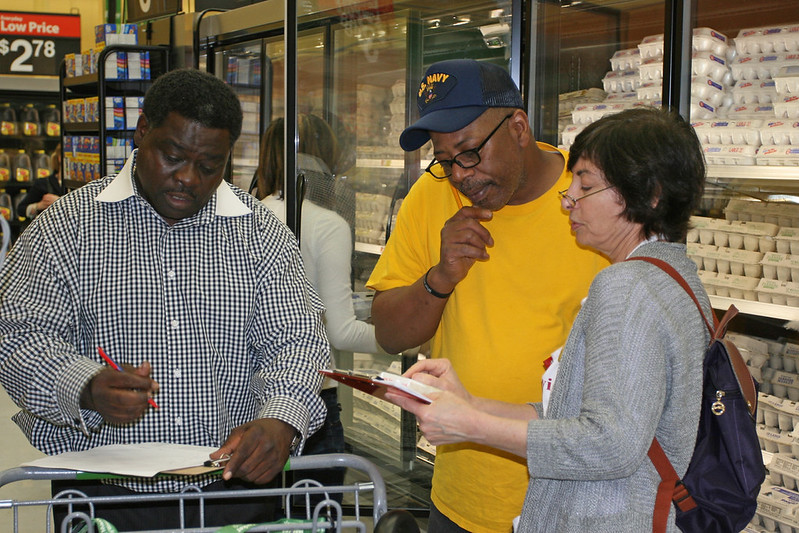
THINKING IT OVER — From left to right, Frank Smith III and Edwin Brown listen as Faith Anaya helps them make the best value decisions in the grocery store. | UADA photo by Mary Hightower
By MARY HIGHTOWER | University of Arkansas Division of Agriculture
Consumers who see parallels between crude oil and gas prices might expect the same for food, but what seems like a straightforward relationship between prices at the farm and prices at the grocery store is anything but simple, say economists with the University of Arkansas Division of Agriculture.
Making a direct connection between the two “is extremely difficult,” said Hunter Biram, extension economist for the Division of Agriculture.
Global and domestic economies are pushed and pulled by interest rates, weather, war, disease, trade conflicts and countless other factors.
“Given the complexities of the food supply chain, the best research available focuses on the share of the food dollar attributed to farming, along with a comparison of crop price volatility compared to food price volatility. Historically, food prices are about half as volatile as crop prices.”
Buck stops at the farmer
In manufacturing and other industries, if the price of a raw material increases or the cost of doing business rises, those costs are passed on to consumers.
That’s not the case in agriculture.
“The farmer is a ‘price taker’ and cannot pass his costs along to the buyer,” said Scott Stiles, extension economics program associate for the Division of Agriculture.
According to the Economic Research Service of the U.S. Department of Agriculture, a farmer’s share of every consumer dollar spent on food is about 11.8 cents. The lion’s share of consumer food costs goes to marketing.
“The greatest near-term impact on grocery prices would be related to transportation — i.e., fuel costs,” Stiles said. “And at some point, higher petroleum prices would increase manufacturing costs for plastics and packaging.
“These same cost increases are impacting farmers,” Stiles said. “Unfortunately, they are not in a position to pass these cost increases along.”
Squeezed between high input prices and low commodity prices, farmers have to make difficult financial choices.
“Farmers will shift acreage to the most profitable crop, or the crop that will produce the lowest loss,” Biram said. “Even if that crop is facing increased production expenses, the grain buyer has no incentive to offer a better price.
“Grain buyers — the elevators — are highly price elastic, which means that no matter how many bushels a farmer brings to them, the farmer is still offered the same price,” he said.
“As long as there is ample grain available to purchase, there likely won’t be any significant effects on consumer prices due to increases in production expenses,” Biram said. “Grain buyers will adjust prices accordingly in order to remain profitable.”
To learn about extension programs in Arkansas, contact your local Cooperative Extension Service agent or visit uaex.uada.edu. Follow us on Facebook and Instagram. To learn more about the Division of Agriculture, visit uada.edu. To learn more about ag and food research in Arkansas, visit the Arkansas Agricultural Experiment Station at aaes.uada.edu.
Discover more from
Subscribe to get the latest posts sent to your email.