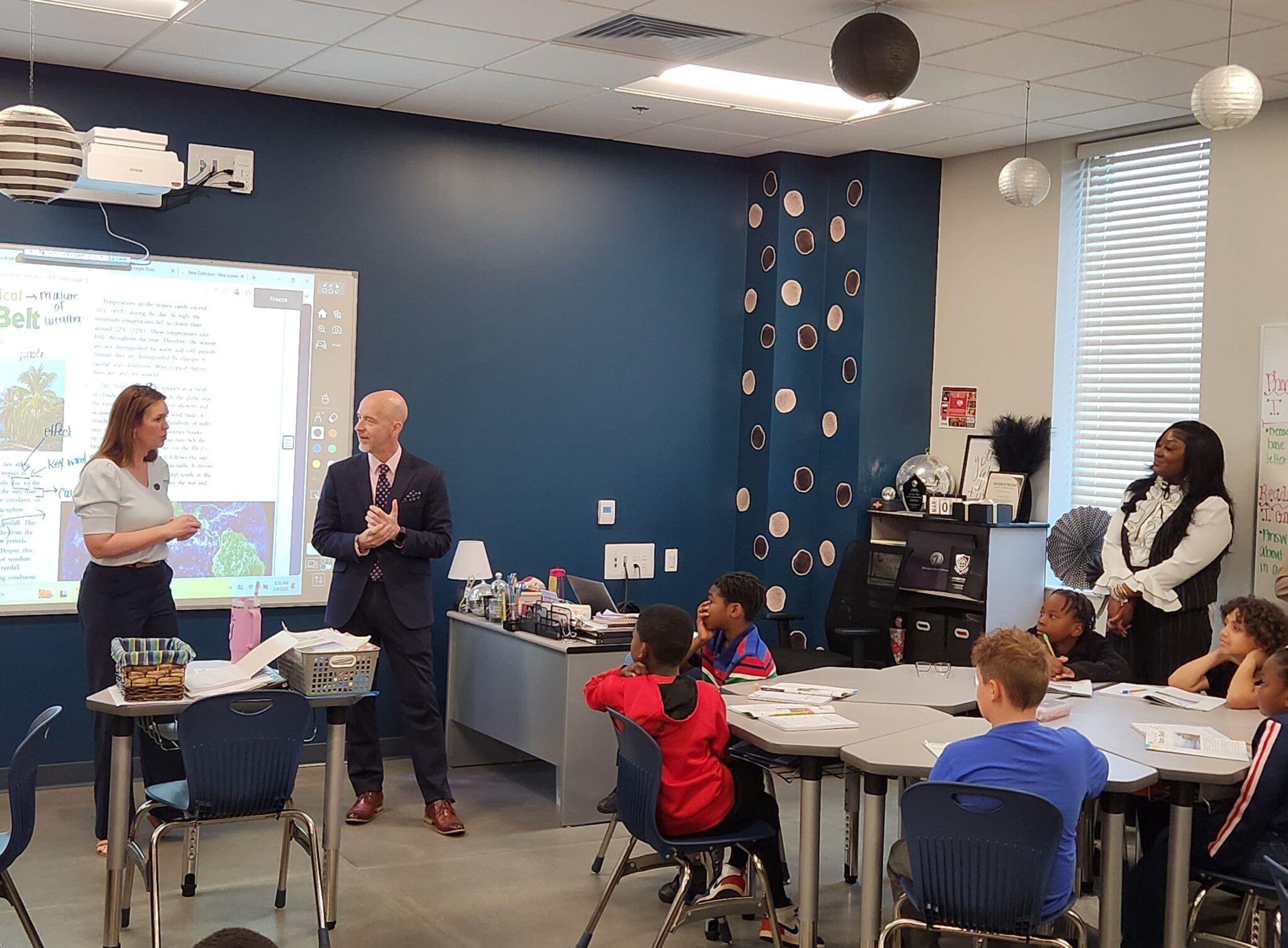
From left: Arkansas Gov. Sarah Huckabee Sanders and Education Secretary Jacob Oliva meet third graders during a reading lesson taught by Jocelyn Taylor (right) at Murrell Taylor Elementary School in Jacksonville on March 9, 2026. | Tess Vrbin/Arkansas Advocate
By TESS VRBIN | Arkansas Advocate
Arkansas leaders marked the third anniversary of a 2023 education overhaul law Monday with a visit to an elementary school that has markedly improved its student outcomes in the past few years.
Jacksonville North Pulaski School District officials and Murrell Taylor Elementary School teachers and administrators said the LEARNS Act played a role in the Jacksonville school’s improvement from an “F” rating in 2021 to a “B” rating this year.
The Arkansas Department of Education’s Division of Elementary and Secondary Education grades public schools based on how well students do on state assessment tests and how much they improve in core subjects from year to year, among other things.
School and district officials discussed Murrell Taylor Elementary’s growth in a roundtable discussion with Gov. Sarah Huckabee Sanders and Education Secretary Jacob Oliva on Monday.
The wide-ranging LEARNS Act required literacy screenings for K-3 students and provided literacy coaches for every K-3 teacher in schools graded “D” or “F.”
Literacy coaches taught not only students but also teachers and administrators at Murrell Taylor Elementary what they needed to succeed, said Principal Brandy Howell and district literacy coordinator Courtney Bilbrey.
“In the past two years, I have seen our teachers shift from thinking of ‘What am I going to teach?’ to ‘How am I going to teach this so that scholars will learn?’” Bilbrey said.
Students who don’t meet the state’s reading standards by the end of third grade and lack good-cause exemptions won’t be promoted to fourth grade at the end of this school year. The Arkansas Democrat-Gazette reported in February that thousands of third grade students were at risk of being held back.
Howell said she does not expect many Murrell Taylor Elementary students to be held back. Sanders told reporters after the roundtable discussion that “retention isn’t new for Arkansas, but the big difference is that intervention is.”
“We have always had to retain kids, but now on the front end, we’re making sure parents are aware of that earlier,” Sanders said. “…We don’t want to push kids through that aren’t ready to go to fourth grade and set them up for failure.”
Senate Minority Leader Greg Leding, a Fayetteville Democrat, said in an interview that he agreed that educators and the state shouldn’t “keep passing the problem downstream.” But Leding said it’s unclear how Arkansas is going to educate that many additional third graders who are held back.
“If that’s the decision we’re going to make, how do we handle that sudden lump in the snake’s throat?” Leding said.
Leding is among several legislative Democrats and some Republicans who have been critical of the rising cost of the voucher program created by the 2023 law.
The LEARNS Act also implemented a $50,000 minimum annual teacher salary; career readiness programs in high schools; restrictions on classroom discussions of gender, sexuality and Critical Race Theory; and a school voucher program, among other things.
Sanders’ proposed fiscal year 2027 budget includes more than $309 million for the voucher program, $122 million more than was proposed in last year’s budget. The amount matches what was ultimately spent on the program this year. The budget also calls for setting aside another $70 million from surplus funding for anticipated program growth.
The Department of Education’s budget will be expanded to account for some of the planned spending increase, Sanders told reporters.
Around 44,000 students are participating this academic year, the first time the voucher program has been open to all students. Sanders said the program aims to “fund students where they are” and the funding increase should allow for more increases in participation.
Leding noted that Arkansas spends less money per K-12 student on average compared to other states. The Education Data Initiative, a nonpartisan data collection organization, found that Arkansas spent about $14,800 per student in fiscal year 2023 while the national average was $16,526.
“If we are serious about public education and education in general, we’ve got to do better there,” Leding said.
Discover more from
Subscribe to get the latest posts sent to your email.