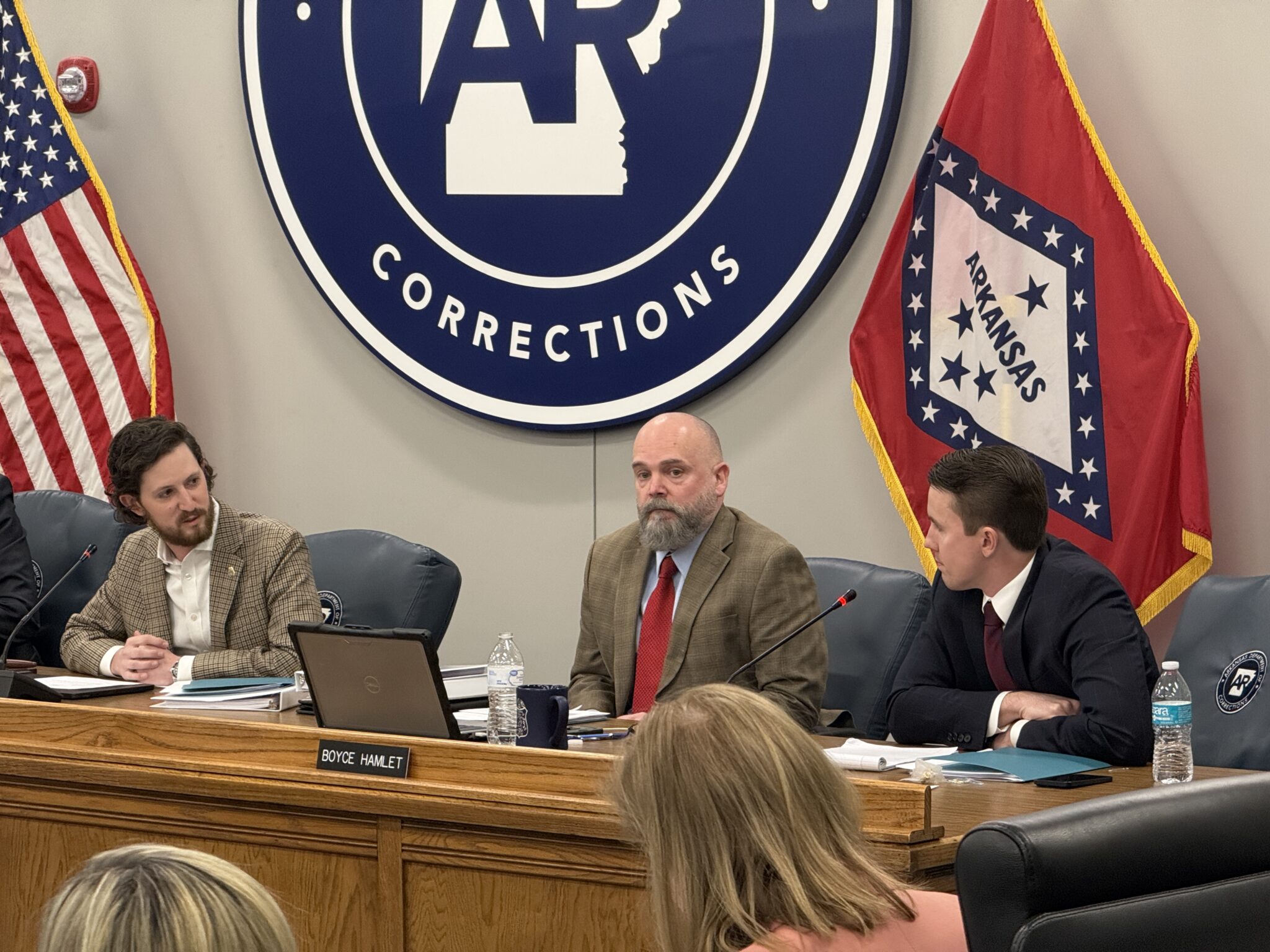
PHOTO: Newly-elected Board of Corrections Chair Jamie Barker, left, talks to newly elected board Vice-Chair Nathan Lee, right, with newly-appointed Post-Prison Transfer Board chair Boyce Hamlet in-between on Jan. 23, 2026 in North Little Rock. | Ainsley Platt/Arkansas Advocate
By AINSLEY PLATT | Arkansas Advocate
The American Civil Liberties Union of Arkansas sued top prison officials in federal court Monday, alleging that the state’s parole revocation procedures unconstitutionally deprive people of their due process rights.
The lawsuit claims that Arkansas’ parole policies — also known as post-prison transfer — unconstitutionally denies parolees access to attorneys. It also claims that Arkansas parole officers often pressure people facing revocation into waiving their rights without explaining the potential consequences of doing so.
“Arkansas is sending people back to prison through parole revocation proceedings that are fundamentally unfair and unconstitutional,” John Williams, legal director of the ACLU of Arkansas, said in a news release.
The lawsuit also said that Arkansas violates the Americans with Disabilities Act by failing to provide proper accommodations to parolees with disabilities that are placed in revocation proceedings, such as access to medication, which it says hampers a parolee’s ability to exercise their rights.
Jeff LeMaster, a spokesperson for Attorney General Tim Griffin, said in a statement that Griffin’s office was reviewing the lawsuit and would “vigorously defend the State in this case.”
The ACLU filed the lawsuit on behalf of four plaintiffs — Calvin Davis, Todd Fason, NeDraya McGowan and Robby Riedel — who were out on parole when they were arrested at various times within the last month.
All four now face having their parole revoked as a result of new criminal charges and technical parole violations, the complaint states. Lawyers for the plaintiffs wrote in the lawsuit that they were not given timely or accurate information about their due process rights, and that providing the plaintiffs with legal counsel would allow them to demonstrate to the state that revoking their parole is unnecessary.
Attorneys for plaintiffs are seeking a temporary injunction that would block the state from enforcing the policies the ACLU says are unconstitutional. The ACLU is also seeking class-action status that would allow the complaint to cover all adult parolees in Arkansas who currently face or could face revocation in the future.
Even those who explicitly ask for an attorney, including those with disabilities that would have difficulties navigating the parole process alone, are denied state-provided legal counsel, while a process for determining who would qualify for a state-funded attorney doesn’t exist, the ACLU said in its filing.
According to the state’s Post-Prison Transfer Board regulations, those facing parole revocation may provide evidence, defend themselves and have an attorney, but they “shall not have the right to have counsel appointed by the State.”
Additionally, state parole officers “frequently coerce parolees to waive their rights” to the hearings they are entitled to “without adequately informing parolees of the claimed violations of parole and the consequences of any waiver,” the lawsuit says.
As a result, the ACLU of Arkansas wrote, “The majority of these parolees end up reincarcerated due to a deeply unfair parole revocation process.”
Discover more from
Subscribe to get the latest posts sent to your email.