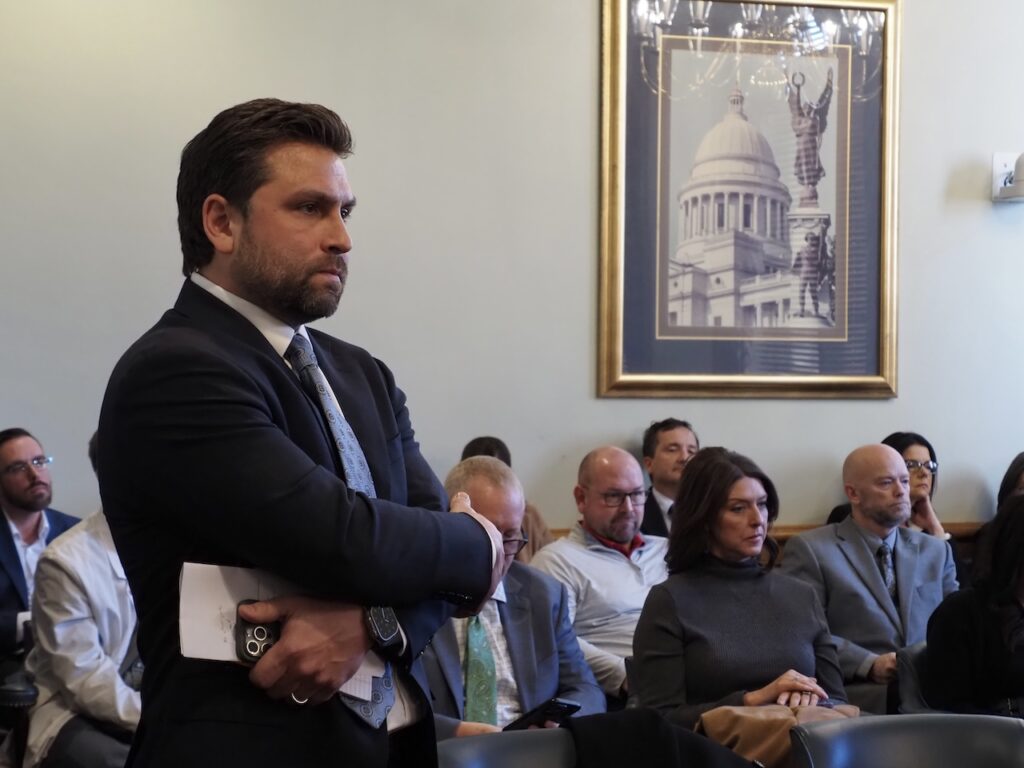

A group of government transparency advocates asked the Arkansas Supreme Court to drop its lawsuit against Attorney General Tim Griffin
By TESS VRBIN | Arkansas Advocate
The nonpartisan Arkansas Citizens for Transparency (ACT) received permission from Griffin within the past week to collect signatures in support of two proposed ballot measures — an initiated act and a constitutional amendment — aimed at making government meetings and records more accessible to the public.
ACT initially planned to pursue a case filed Jan. 23 asking the court to compel Griffin to certify an earlier version of the ballot language for the proposed amendment. David Couch, an attorney on ACT’s drafting committee, filed a motion last week asking the high court for an expedited hearing in the case.
Griffin’s response Tuesday morning asked the court to dismiss the case entirely or to at least deny the request for an expedited hearing. He argued that ACT’s complaint against him was not only factually inaccurate but also moot since the group planned to make the effort to put the certified language on the November ballot.
“Inviting this Court to issue an advisory opinion, ACT is trying to rewind the clock and revisit the Attorney General’s actions on ACT’s first five submissions,” Griffin wrote, referring to the group’s multiple attempts over several months to submit ballot language for both measures.
Couch said last week that he and the other ACT drafters believed “the attorney general’s role in the [ballot measure] process needs to be clarified” by the state’s highest court. ACT’s complaint alleged that Griffin’s refusal to certify previous versions of the proposed amendment was an attempt to prevent the group from having enough time to gather signatures in support of the measures.
However, Couch said Tuesday afternoon that he and the other six drafters decided collecting signatures should be their main focus.
“We decided that while it’s patently clear what he did was wrong and unconstitutional, our ballot question committee was organized to get a Freedom of Information amendment and act on the ballot,” he said. “While it’s not the [language] we originally wanted, we don’t want to let good be the enemy of perfect, so we’re going to go forward with what we have. We’re running out of time.”
Griffin said the groups decision to abandon the lawsuit was “a triumph for the rule of law and the taxpayer.”
“The case was fatally flawed from inception and destined to fail, as my office’s motion to dismiss made clear,” Griffin said in a statement Tuesday. “Continuing the case would have squandered taxpayer dollars, clogged up the judicial system and generally just wasted everyone’s time. The real winner is the law and our 80-year-old ballot review process. I am thankful and honored to work with brilliant, experienced staff who day after day demonstrate professionalism and grit.”
Proposed acts require 72,563 signatures by July 5 in order to appear on the November ballot, while proposed amendments require 90,704 signatures.
Griffin rejected three previous iterations of the proposed act and two previous iterations of the proposed amendment. The second submission of the amendment language had been ACT’s preferred version, Couch said last week, because it said the state Legislature “shall not make a law that diminishes public access to government” without the approval of the people of Arkansas.
The third proposal, which Griffin certified, did not include this clause or a definition of the phrase “diminishes public access to government” in response to one of Griffin’s continuing concerns.
In addition to restricting the Legislature’s ability to limit government transparency, the proposed amendment would enshrine the right to government transparency into the state Constitution.
The initiated act would serve as a companion to the amendment so the two could support each other in practice and in court, ACT’s drafters said in November.
The proposed act would alter the existing Arkansas Freedom of Information Act of 1967, codifying a range of definitions including “public meeting,” “governing body,” “government transparency” and “public notice.”
Among other things, the statutory changes would also create stiffer civil penalties for violating the FOIA and protect Arkansans’ right to appeal FOIA decisions and collect any resulting attorneys’ fees.
The popular names of the two measures are The Arkansas Government Disclosure Act of 2024 and The Arkansas Government Disclosure Amendment of 2024.
Discover more from
Subscribe to get the latest posts sent to your email.