
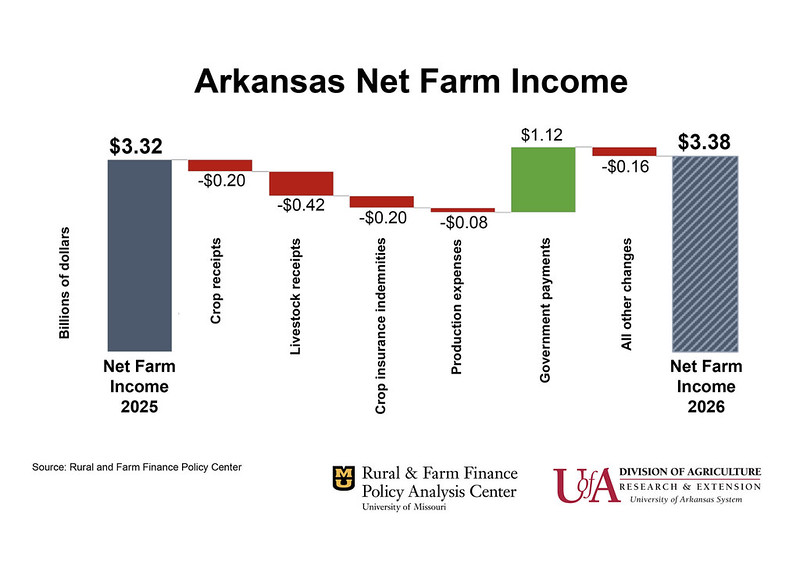
Arkansas net farm income forecast for 2026. | UADA/RAFF image
By MARY HIGHTOWER | University of Arkansas Division of Agriculture
Weighed down by low commodity prices, heavy fuel and fertilizer outlays and the costs of war, disease and weather, Arkansas’ net farm income is expected to fall for the fourth straight year, with farmers enduring on government support.
The Rural & Farm Finance Policy Analysis Center’s spring report is forecasting Arkansas’ net farm income to be $3.38 billion in 2026, relatively stable compared to 2025’s $3.32 billion.
Arkansas’ crop and livestock receipts — the value of production — were projected to fall to $11.8 billion, down $626 million or 5% from 2025 and $2.2 billion, or 16%, from 2022. Crop receipts are projected to decline for the third straight year from a high of $5.53 billion in 2023 to the current 2026 projection of $4.17 billion mostly driven by depressed commodity prices.”
“Overall, the 2026 farm income outlook reflects a shift away from broad-based market-driven gains toward increased reliance on policy support,” the report said.
“It’s very concerning,” said Hunter Biram, extension economist for the University of Arkansas Division of Agriculture, one of the authors.
Wars, disease and weak demand
“Sustained production with no real drivers in demand continues to keep prices low,” Biram said.
“From a historical perspective, crop receipts minus expenses have been negative seven of the last 10 years, with the greatest losses being in 2024 and 2025 at around $1.5 billion each year,” Biram said.
“The average negative net farm income for Arkansas over this span is $1 billion per year,” he said. “The positive crop incomes in the other three years were $120 million, $19 million, and $9 million, respectively, and were driven by elevated prices from strong demand post-COVID.
“Since 2022, crop prices have fallen 30%, while production costs have remained elevated — about 20% above pre-Russian invasion of Ukraine levels,” he said.
Current total production expenses are projected to increase by $80 million, driven largely by a $212 million increase in expenses for fertilizer and fuel attributed to the conflict in the Middle East. Arkansas crop margins are, at best, tight with most farmers facing negative margins.
“Many farmers are once again in a year where choosing a crop that has the greatest likelihood of lowest loss is the best-case scenario,” Biram said.
“The only increase that is positive that we’re seeing in 2026 is going to be for government assistance — an increase of $1.12 billion to $1.75 billion total,” Biram said. “That $1.75 billion is the only thing keeping that farm income afloat. It’s the best way to put it in 2026.”
The $1.12 billion represents a 179% increase over the previous year.
Livestock
In previous reports [see Arkansas net farm income projected to decline by 8% in 2025 and Arkansas net farm income projected to decrease for second straight year], tight cattle supplies and higher meat prices helped buoy net farm income in Arkansas. In this edition, however, livestock agriculture receipts were expected to decline $424 million, a drop of 5%, to $7.64 billion in 2026. The losses were “driven by a 48% decline in egg receipts,” Mitchell said.
Mitchell said the livestock numbers should be taken with a grain of salt.
“Some of the decline in Arkansas farm income is attributed to lower egg receipts,” he said. “We expect an upward revision to the forecast for the fall release as it does not currently reflect conditions in Arkansas and is more a reflection of conditions faced by the U.S. egg industry and amid ongoing HPAI impacts.”
Egg receipts were expected to decrease by $485 million in 2026. Among other livestock sectors:
- Broiler receipts were expected to rise 1% to $5.51 billion in 2026.
- Cattle and calves were projected to rise 2% to $975 million.
- Turkey receipts were expected to increase 4% to $425 million.
In 2027, broilers are projected to increase another 1% in 2027; cattle and calves are expected to decline 7% and turkey receipts are expected to decline by 5%.
Crops
Crop commodities were also expected to fall 5%, down $202 million. Only soybeans were expecting any positive news in 2026, with receipts forecast to rise 24% to $1.72 billion.
Corn, rice and cotton receipts are all projected to decline in 2026:
- Corn, down 6% to $706 million
- Rice, down 27% to $920 million
- Cotton, down 21% to $139 million
However, the outlook for 2027 cash receipts was a bit brighter for three of the crops:
- Soybeans, down 1%, or $147 million
Corn, up 7%, or $51 million - Rice, up 1%, or $6 million
- Cotton, up 4% or $21 million
Find the report online, as well as additional commentary in Morning Coffee and Ag Markets and its podcast.
The Farm Income Outlook for Arkansas is co-published by the University of Arkansas Division of Agriculture and RaFF at the University of Missouri. RaFF collaborates with several states to develop farm income projections with local expertise, offering additional coverage of key Midwestern and Southern regions.
The lead author is Alejandro Plastina, director of the Rural and Farm Finance Policy Analysis Center, joined by Biram, Mitchell, Extension Economist Ryan Loy of the Division of Agriculture, and RaFF Senior Research Associate Oranuch Wongpiyabovorn.
The center is based at the University of Missouri.
To learn about extension programs in Arkansas, contact your local Cooperative Extension Service agent or visit uaex.uada.edu. Follow us on Facebook and Instagram. To learn more about the Division of Agriculture, visit uada.edu. To learn more about ag and food research in Arkansas, visit the Arkansas Agricultural Experiment Station at aaes.uada.edu.
Discover more from
Subscribe to get the latest posts sent to your email.


