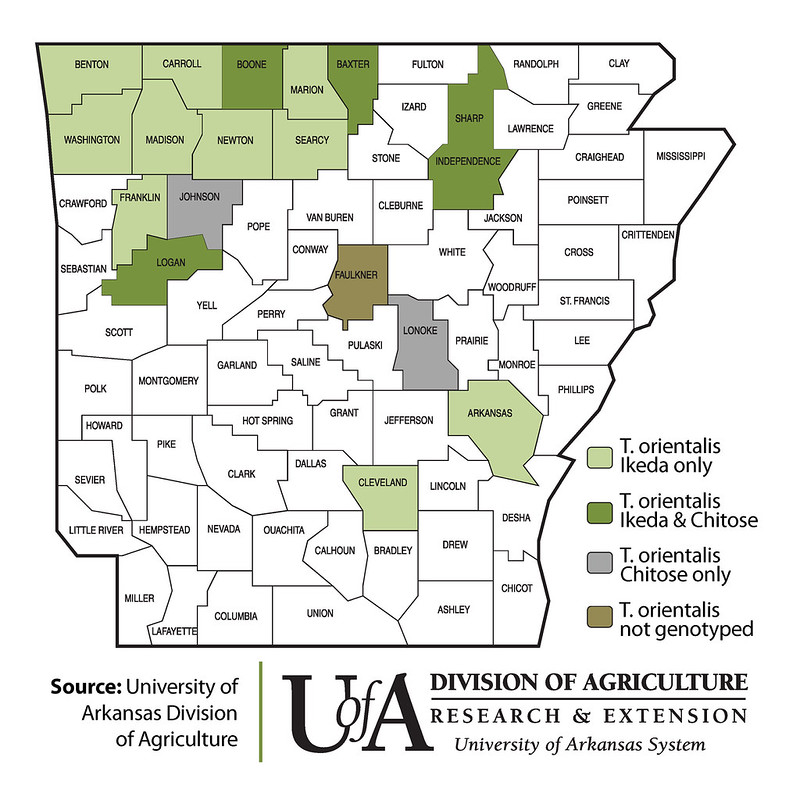
GRADUAL SPREAD — Two genotypes of Theileria orientalis, a vector-born disease affecting cattle and other animals, has been confirmed in 18 counties. | Division of Agriculture graphic
By RYAN McGEENEY | University of Arkansas System Division of Agriculture
For outdoor enthusiasts, the magic of spring is often tempered by the resurgence of chiggers, ticks and other nuisance insects. For researchers with the University of Arkansas System Division of Agriculture, the very pursuit of those creatures never really ends.
Kelly Loftin, extension entomologist for the Division of Agriculture, is part of a team including fellow Division of Agriculture researchers Emily McDermott, Elizabeth Smith and Jeremy Powell that has been tracking the spread of the Asian longhorned tick (Haemaphysalis longicornis) and two genotypes — genetic variants of a given organism — of the associated pathogen, Theileria orientalis, in cattle across Arkansas for several years. The study is funded by a U.S. Department of Agriculture National Institute of Food and Agriculture grant.
The Asian longhorned tick was first confirmed in the United States in 2017 before being found in Arkansas in 2018. As of September 2025, it has been confirmed in 23 states, mostly in the eastern portion of the country but as far west as Oklahoma and Kansas, according to USDA.
In May 2025, the tick was confirmed in Arkansas in Benton, Boone, Independence, Searcy and Washington counties. The Theileria orientalis Ikeda genotype was confirmed in Arkansas, Baxter, Boone, Carroll, Marion, Searcy and Washington counties. The Theileria orientalis Chitose genotype was also confirmed in Boone and Baxter counties.
Loftin and his team responded to calls from cattle producers and extension agents throughout the rest of the year, collecting ticks and testing for Theileria throughout the summer, fall and winter. Confirmation of both the Asian longhorned tick and the pathogen continued to spread to more counties.
In February, Loftin and his co-researchers published an update, identifying the tick in an additional five counties as of September 2025 — Baxter, Carroll, Madison, Marion and Newton counties — bringing the total to 10. One or both genotypes of Theileria orientalis have been confirmed in 17 counties as of February. In an eighteenth county, Faulkner, Theileria orientalis has been confirmed without a determined genotype.
“We first started doing those maps in 2024,” Loftin said. “We’ve seen a pretty steady increase in confirmed counties for both the tick and the pathogen.”
Loftin said severe winter weather events, such as those experienced in Arkansas and surrounding states in January, don’t diminish the Asian longhorned tick populations — they simply become less active.
“The ticks become somewhat less active, hunkering down in leaf litter or other protected areas,” Loftin said. “But as soon as warm weather returns, and animals are grazing again, the activity returns.”
Cows and other animals infected with Theileria display symptoms similar to those of Anaplasmosis, a common vector-borne disease in cattle. Those symptoms include weight loss, suppression of milk production, loss of appetite, lethargy, anemia, and more. Loftin said that in herds with higher infection rates, reproduction begins to become suppressed.
“Mortality is obviously an issue, but you also have to think about the fact that some of these cows aren’t producing calves,” Loftin said. “It’s a significant loss to consider — beyond cow mortality, losses from abortions and stillborn calves along with cows failing to rebreed, the impact is both a loss of life and a hit to our producer’s bottom line.”
There is currently no treatment for Theileria. Mortality rates in cattle typically range from 1 to 5 percent, although they have been recorded as high as 50 percent, according to USDA. The pathogen currently poses no health risks to humans.
If a farmer suspects theileriosis in one or more animals in their herd, they should draw blood from the animals and have it tested for Theileriosis orientalis, including both Ikeda and Chitose genotypes, Loftin said.
“The most reliable test is a PCR test that will identify the genotype,” he said, noting that the Division of Agriculture, the Arkansas Department of Agriculture Veterinary Diagnostics Lab and Kansas State University Veterinary Diagnostic Lab can all designate specific genotypes.
“It’s also important for producers to minimize animal stress and treat other conditions, such as bacterial diseases, promptly,” Loftin said. “Keep a close eye on cattle during calving and weaning, as these are known stressors. Finally, establish an effective tick control program for your herd.”
Recommendations for controlling tick populations in animals more generally through pesticides can be found in the Division of Agriculture publication MP144, “Insecticide Recommendations for Arkansas.”
This work is supported by the Tactical Sciences for Agricultural Biosecurity program, project award no. 2024-67016-42397, from the U.S. Department of Agriculture’s National Institute of Food and Agriculture.
Discover more from
Subscribe to get the latest posts sent to your email.