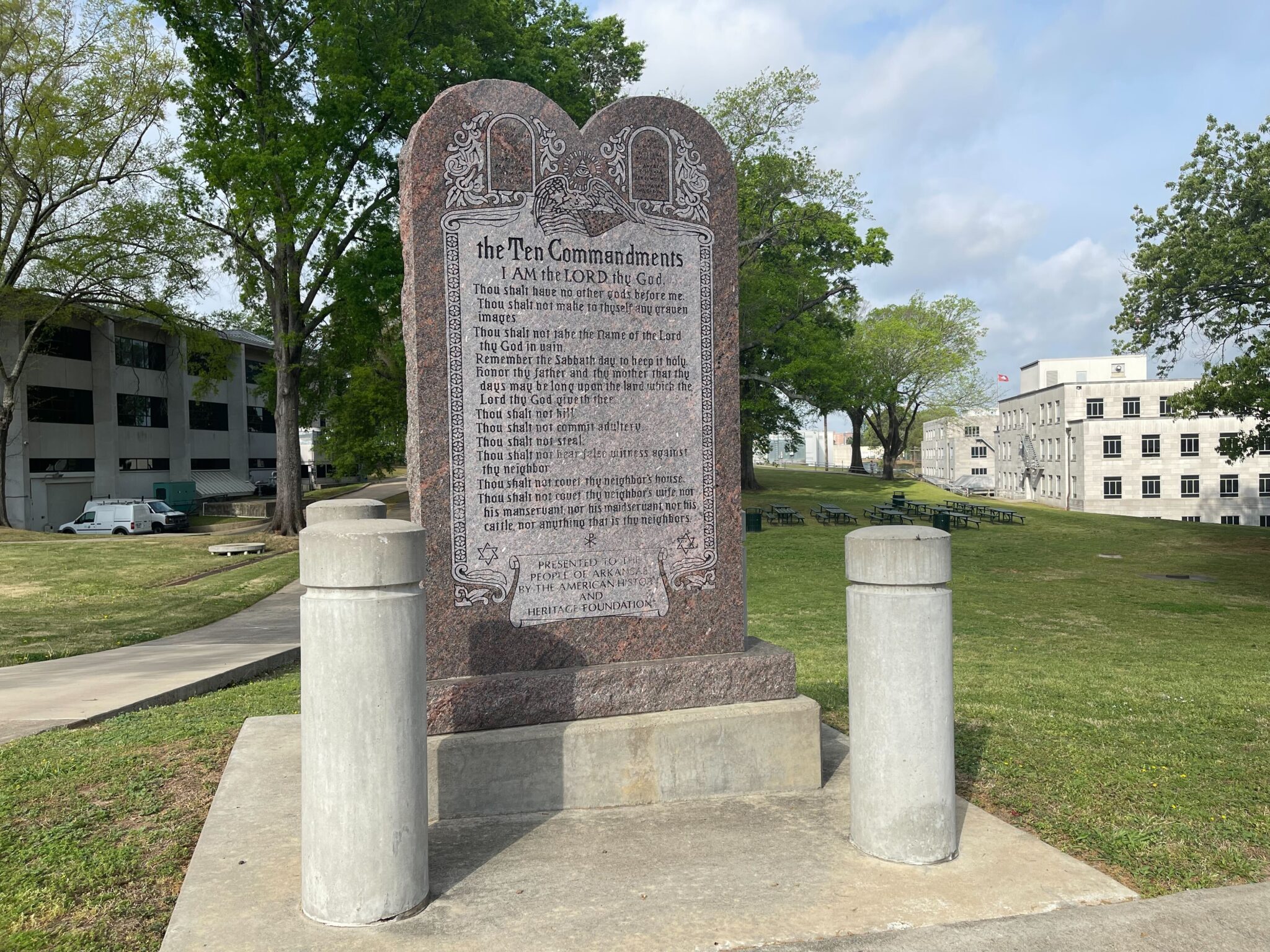
BLOCKED, FOR NOW — A Ten Commandments monument is on display outside the Arkansas State Capitol on April 1, 2026. | Andrew DeMillo/Arkansas Advocate
By ANDREW DeMILLO | Arkansas Advocate
A federal judge ruled Tuesday that Arkansas must remove a Ten Commandments monument from state Capitol grounds, but put her order on hold so officials can appeal the decision.
U.S. District Judge Kristine Baker blocked enforcement of the 2015 law requiring the privately-funded monument’s installation, ruling it violates the U. S. Constitution. Baker stayed her order giving the state time to appeal to the 8th U.S. Circuit Court of Appeals.
Jeff LeMaster, a spokesperson for Arkansas Attorney General Tim Griffin, said Wednesday morning that they are reviewing the decision and considering their options.
Opponents of the display who filed a lawsuit against the secretary of state in 2018, argue the Ten Commandments Monument Display Act violates the Establishment Clause of the First Amendment to the U.S. Constitution. The First Amendment prohibits Congress from creating any law “respecting an establishment of religion.”
Baker wrote in a 148-page order Tuesday that the law, “together with the other evidence in the record, conveys a message that the Christian religion is favored” and is coercive in violation of the Establishment Clause.
“The Ten Commandments are foundational to Western civilization and the history of law in Arkansas,” Secretary of State Cole Jester said in a statement. “We are working closely with the Attorney General’s Office to protect this critical part of the Capitol in the courts.”
Arkansas has 30 days to appeal Baker’s ruling.
Supporters of the law have argued the Ten Commandments are important to the foundation of the nation’s laws and legal system.
Baker said the law “has proven to be a divisive piece of legislation” that placed a monument funded by religious entities and bearing religious text in front of a population of varying religious and nonreligious beliefs.
“It did so for the purpose of ‘commemorating the Ten Commandments’ … not to commemorate the state’s religious heritage or the development of the law,” Baker wrote.
Plaintiffs in the case include an exercising group that said it must pass the monument regularly while walking or cycling; the Arkansas Society of Freethinkers; The Satanic Temple; and a rabbi.
The American Civil Liberties Union of Arkansas, which represented the plaintiffs, called Tuesday’s decision “a major victory for religious freedom and the constitutional principle of church-state separation.”
“This decision carefully walks through both history and precedent and reaches the right conclusion: the state cannot take sides in matters of religion,” ACLU of Arkansas Legal Director John Williams said in a statement. “The Constitution requires government neutrality — not favoritism, not endorsement, and not promotion of religious doctrine. That principle protects everyone, regardless of what they believe.”
The Satanic Temple’s request to install a statue of Baphomet, a goat-headed, angel-winged creature, in response to the Ten Commandments was blocked by a 2017 law that changed the process for approving any monument on Capitol grounds.
The Arkansas Legislature passed the law permitting the construction of the Ten Commandments monument in 2015, and the first monument was installed in 2017.
In less than 24 hours, a man with a history of mental illness intentionally smashed his car into the display. The man had also destroyed a Ten Commandments monument outside Oklahoma’s Capitol in 2014.
Oklahoma’s monument was replaced after its destruction but the state Supreme Court in 2015 ordered it removed from Capitol grounds. Voters in 2016 rejected a change to the state’s constitution that would have allowed the monument’s return.
A new Arkansas monument — protected by concrete bollards — was installed in 2018 between the Capitol building and the state Supreme Court building, where it remains today.
Several groups quickly filed federal lawsuits for the removal of the monument, and those efforts have been combined into one lawsuit, now in its eighth year.
Baker heard a full day of arguments on the suit in July 2023.
Arkansas’ monument is a replica of a display at the Texas Capitol that was upheld by the U.S. Supreme Court in 2005. Justices that year struck down Ten Commandments displays in two Kentucky courthouses.
Jason Rapert, the former Republican state senator who sponsored the bill, said in a social media post Wednesday that he would fight the decision.
“We are going to fight to ensure that this monument as well as monuments like it are going to be upheld and standing across the country,” he said.
Rapert said he was en route to the Alabama state Capitol where lawmakers are considering a law requiring Ten Commandments displays in public schools.
Arkansas passed a similar law last year. A federal judge blocked implementation of the law in six public school districts last month. Similar Ten Commandments laws have been challenged in other states, such as Texas and Louisiana.
Arkansas is also facing challenges with the installation of a “monument to the unborn” that’s required by a 2023 law, the first of its kind in the nation.
Fundraising has been slow for the project, which must be privately funded, and there have been issues selecting a design. The Capitol Arts and Grounds Commission sought new proposals for the monument after the artist selected for the project in 2023 sought to copyright her design for a “living wall” of plants.
The commission will consider another round of submissions at its April 7 meeting.
Discover more from
Subscribe to get the latest posts sent to your email.