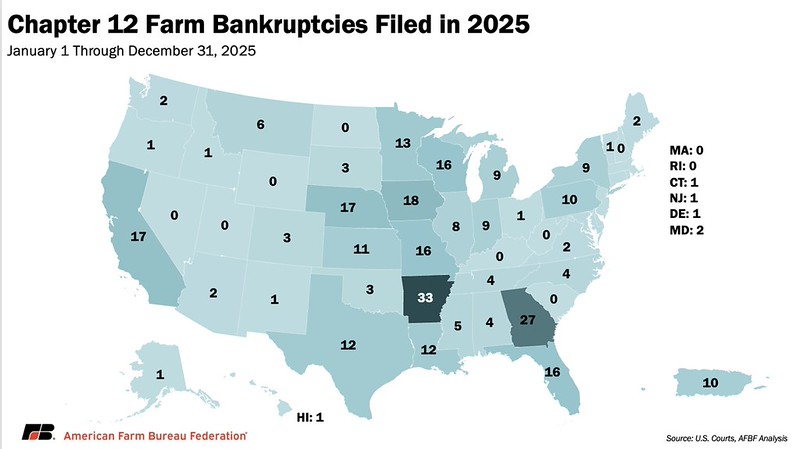
BUArkansas led the nation in Chapter 12 bankruptcies. | Image courtesy American Farm Bureau
By MARY HIGHTOWER | University of Arkansas System Division of Agriculture
WASHINGTON, D.C. — Arkansas led the nation in Chapter 12 bankruptcy filings in 2025 and had the largest year-over-year rise, according to the American Farm Bureau Federation.
Farm Bureau found that Arkansas had 33 Chapter 12 filings in 2025, more than double the number from the previous year. Georgia was second with 27 filings, which was 16 more than in 2024. Iowa was third with 18 filings, up 11 from the previous year.
It’s not just farmers. The Administrative Office of the U.S. Courts, or AOC, said that in 2025, 24,737 businesses and 549,577 non-businesses filed for bankruptcy, up 11% from the previous year.
“For more than a decade, total filings fell steadily, from a high of nearly 1.6 million in September 2010 to a low of 380,634 in June 2022,” the AOC said. “Total filings have increased each quarter since then, but they remain far lower than historical highs.”
Ryan Loy, extension agricultural economist for the University of Arkansas System Division of Agriculture, said farms are feeling pressure from several sides.
“Lagging commodity prices are a significant part of the problem, but it’s just one piece,” he said.
“Over several consecutive years, row crop farmers have been facing declining commodity prices and drastically increasing input costs,” Loy said. “This creates a perfect storm where farmers — especially those who rent their land — have burned through capital and reserves to try to ‘make it to next year,’ but that better year has not come. In this situation, farmers must restructure their debt through a bankruptcy filing.”
What the chapters mean
The federal Bankruptcy Code contains chapters that each describe a different process for allowing debtors to settle financial obligations. According to the National Agricultural Law Center, Chapter 11 enables a business or individual to reorganize and continue operating while paying creditors following a plan approved by a federal bankruptcy court.
Chapter 12 is available to family farmers with a regular income. Once the farmer-debtor files for Chapter 12, the proceeding automatically stops most collection agents. The court appoints an impartial trustee to evaluate the case and aid with disbursement.
Chapter 13 is specifically designed for individuals that are regular wage earners. Like Chapter 12, it allows the debtor to retain an asset that may have been lost under liquidation.
Chapter 7 is a process under court guidance where a bankruptcy trustee gathers the non-exempt assets of the debtor and distributes the property or proceeds from the property equitably to creditors following the rules in the Bankruptcy Code.
Under Chapter 7, the process begins when a bankruptcy petition is filed with the bankruptcy court. Similar to Chapter 12, the trustee holds a meeting of creditors where the debtor fields questions by creditors and the trustee regarding their financial situation.
Deciding on a chapter
Deciding what chapter to file under “deals with your intentions moving forward,” said Elizabeth Rumley, senior staff attorney for the National Agricultural Law Center.
“Someone farming as a sole proprietorship, general partnership, or single member LLC would file Chapter 7 after deciding that ‘I’m done being a farmer’,” she said. “That’s different from Chapter 11 or 12, which are for reorganization. Reorganization means you’ve decided that ‘I cannot handle the debt that I have, but I want to farm in the future and continue this business.”
The prevalence of Chapter 12 filings in Arkansas could be attributed to several factors, Rumley said. “With Chapter 12, there are limitations on the size of debt and the amount of income generated by the farm. There are large farms that can’t file Chapter 12 due to exceeding the debt limit and small farms that do not generate at least 50% of their income from the farming operation making them ineligible.”
Farmers who do not meet the requirements for Chapter 12 will be forced to use another bankruptcy chapter.
According to the National Agricultural Law Center, during the farm crisis of the 1980s, Congress enacted emergency legislation creating bankruptcy proceedings specifically tailored to farmers. Congress believed that Chapter 11 was too complicated, expensive and time-consuming for farmers, and Chapter 13 did not address the larger debt loads faced by family farmers. Chapter 7 liquidation was too harsh to be the only option for farmers tied to the land for generations. Therefore, Chapter 12 was created to give farmers a chance to reorganize their debts and keep their land.
Most of the total U.S. filings were Chapter 7, at 356,724; followed by Chapter 13, at 207,889. There were 9,201 Chapter 11 filings and 315 Chapter 12 filings.
Discover more from
Subscribe to get the latest posts sent to your email.