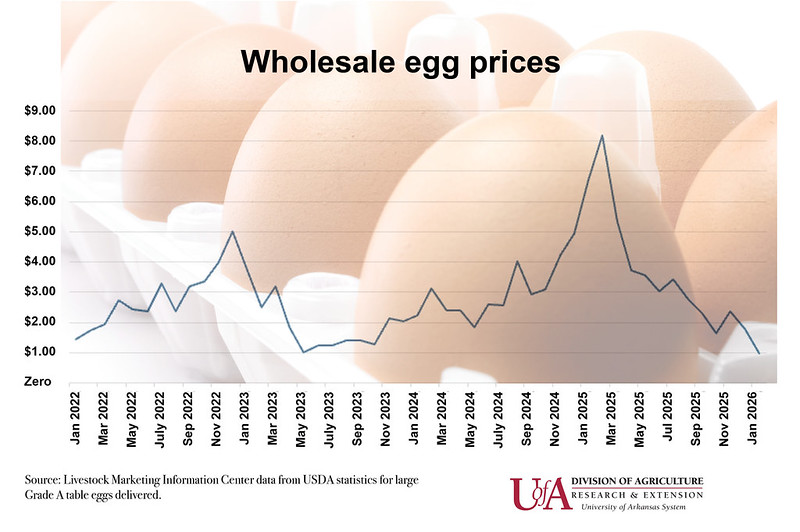
GRAPH: A look at the wholesale egg price rollercoaster since 2022. | UADA Image
By MARY HIGHTOWER | University of Arkansas System Division of Agriculture
Egg prices have fallen to levels not seen since 2023, but don’t expect that dip to last long, said Jada Thompson, associate professor and economist for the University of Arkansas System Division of Agriculture.
In a system where supply and demand dictate prices, “the lower prices are the result of an oversupply,” she said.
At a time when the poultry industry is facing unprecedented pressures from highly pathogenic avian influenza, or HPAI, the nation’s egg farms took something of a gamble.
“Growers, anticipating negative effects from avian influenza during the winter, increased the number of eggs they produced,” Thompson said. However, the highly pathogenic avian influenza that has hit other commercial and backyard flocks passed over the egg layers.
“That left growers with plenty of eggs, and consumers are the ones who get to benefit,” she said.
Egg prices made a slight recovery in May 2023, when HPAI cases were low and bird supplies ramped up. As cases increased, the prices rose again.
The current low price consumer windfall isn’t necessarily good for farmers.
“Growing eggs isn’t an industry with a large profit margin and lower prices make those margins even tighter,” Thompson said. “Farmers are reaching deeper into their pockets more at the moment.”
However, Thompson said the egg supply will likely drop from its current overabundant state.
“We are likely to see producers reduce egg sets, slowing the replenishment pipeline,” she said. “While the egg supply chain is highly dynamic and can change day to day, it is still constrained by biological timelines.
“Absent large-scale disruptions, overall supply could remain elevated for the next five to six months,” she said. “However, given ongoing HPAI risk, we may see new cases emerge sooner, which could tighten supplies earlier than expected.”
HPAI cycle
The current cycle of HPAI began when it was detected in a commercial flock in February 2022. According to the U.S. Department of Agriculture’s Animal and Plant Health Inspection Service, HPAI affected more than 4 million birds in the United States in January alone, affecting 44 backyard flocks and 18 commercial flocks. Backyard flocks have been hard hit, with 54 flocks in November and 56 flocks affected in December and 15 so far in February.
The number of commercial flocks affected by the disease has declined over the last four months. Forty-two flocks were affected in November 2025, 26 in December 2025, 18 in January and 17 so far in February.
To learn about extension programs in Arkansas, contact your local Cooperative Extension Service agent or visit uaex.uada.edu. Follow us on Facebook and Instagram. To learn more about the Division of Agriculture, visit uada.edu. To learn more about ag and food research in Arkansas, visit the Arkansas Agricultural Experiment Station at aaes.uada.edu.
Discover more from
Subscribe to get the latest posts sent to your email.