By COLE HANSON | States Newsroom
My dietitian colleagues and I were wrapping up our shifts at the hospital a few weeks ago when someone pulled up the new dietary guidelines on their phone. Within seconds, we’d abandoned our inboxes and crowded around their desk.
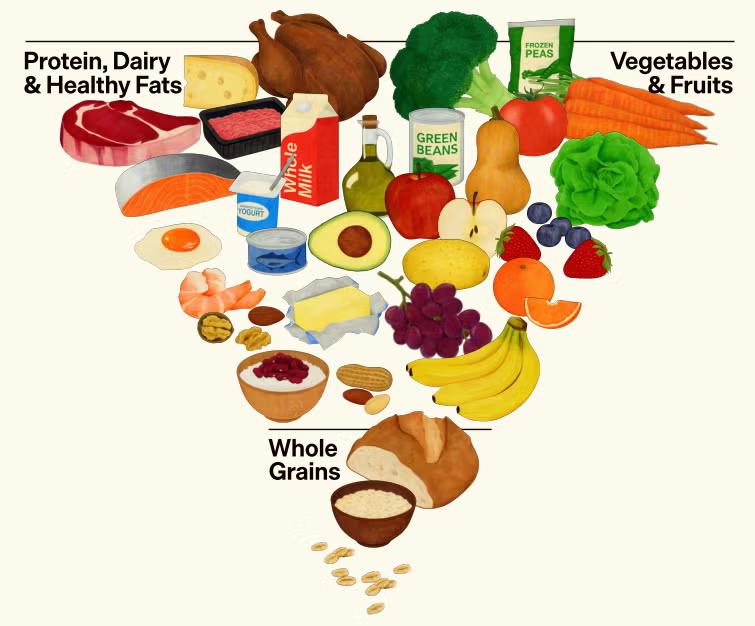
“Wait — they flipped the pyramid upside down?”
“Is that butter in the ‘healthy fats’ category?”
“Didn’t they just finish a report? Did they toss that out?”
We spent the next 20 minutes picking apart what the Trump administration is calling a “historic reset” of federal nutrition policy. Here’s what that reset actually means: a 421-page scientific report compiled by independent experts over three years was gutted — only 14 recommendations accepted fully, 12 partially accepted, and 30 discarded entirely. In its place, we got a 6-page document and an inverted food pyramid that nobody asked for. Fitting for our political moment of federal leaders disinterested in what others have to say.
This matters because these guidelines don’t just live on a government website. They determine what 30 million kids eat through the National School Lunch Program. They shape federal programs like Women, Infants, and Children benefits for low-income families. They guide nutrition counseling in every hospital in America — including mine, where I’ll now be expected to counsel cardiac patients using recommendations that contradict the evidence I see playing out in front of me every day.
The original 2025 Dietary Guidelines Advisory Committee recommended reducing red and processed meat consumption and emphasized plant-based protein sources. The Trump administration’s guidelines do the opposite, placing “protein, dairy and healthy fats” at the top of their new inverted food pyramid — or as I like to call it, MyTriangle, since apparently “MyPlate” wasn’t sufficiently triangular for the beef industry’s liking.
As a clinical dietitian working with cardiac patients, I see the downstream effects of our national diet every day. The evidence linking high consumption of red and processed meats to cardiovascular disease and certain cancers is robust. Yet these guidelines encourage Americans to prioritize animal protein at every meal while de-emphasizing whole grains and vegetable proteins like the almighty bean that provide both protein and fiber.
The administration claims it’s restoring “scientific integrity,” but their own Scientific Foundation documents tell a different story. Independent reviews commissioned for this process concluded that “causal evidence from RCTs does not demonstrate that reducing saturated fat to <10% of energy…lowers CHD or all-cause mortality” — yet the guidelines maintained the 10% limit anyway. When even your own evidence contradicts your recommendations, that’s not scientific integrity. That’s selective reading.
And let’s talk about where Americans actually get their saturated fat. According to USDA data, the top sources are sandwiches, desserts and sweet snacks — not whole foods. Yet, instead of addressing the ultra-processed foods driving chronic disease, we’re being told that beef tallow and full-fat dairy are “healthy fats” on par with olive oil. This isn’t evidence-based guidance; it’s agricultural policy masquerading as public health.
But it’s not just industry capture. It’s vibes-based policymaking. MyTriangle is the perfect example. The administration didn’t replace MyPlate because the evidence showed it was ineffective — they replaced it because it was an Obama-era initiative. And here’s the irony: Americans’ adherence to dietary guidelines, as measured by the Healthy Eating Index, reached its highest scores ever among older adults (63 out of 100) using MyPlate. My colleagues and I spent years teaching MyPlate to children and adults in SNAP-Ed programs. People understood it intuitively. A plate is something everyone uses every day. They could visualize their actual dinner and adjust portions accordingly.
An inverted pyramid? A “MyTriangle”? That’s a shape that exists nowhere in anyone’s kitchen, designed not for comprehension but for culture war points.
This is RFK Jr.’s approach in a nutshell: Reject the painstaking work of independent scientists, dismiss established communication tools that work, and substitute your own gut feeling about what sounds right. Never mind that the Dietary Guidelines Advisory Committee underwent rigorous conflict-of-interest screening and transparent public review. Never mind that their 421-page report represented three years of systematic evidence review.
And before anyone claims this was about cleaning up industry influence: The new committee also has conflicts of interest, with six of nine members reporting financial relationships and three of nine connected to the dairy industry. The difference is that the previous committee’s work was transparent, systematic, and accountable to established scientific processes — but it incorporated health equity considerations, so it must be corrupted by “ideology.”
From my hospital’s cardiac unit, I can tell you what happens when people follow the diet these guidelines promote — they come back. They come back with recurrent myocardial infarction, i.e., another heart attack. They come back with worsening heart failure. They come back needing more stents, more bypasses, more medication.
MyTriangle, with its inverted priorities and industry-friendly recommendations, isn’t the “common sense” reset the administration claims. It’s a step backward for public health, driven more by who created the previous guidance than by what actually works. And those of us who actually work with patients every day can see right through it.
This story was originally produced by Minnesota Reformer, which is part of States Newsroom, a nonprofit news network which includes Arkansas Advocate, and is supported by grants and a coalition of donors as a 501c(3) public charity.
Discover more from
Subscribe to get the latest posts sent to your email.