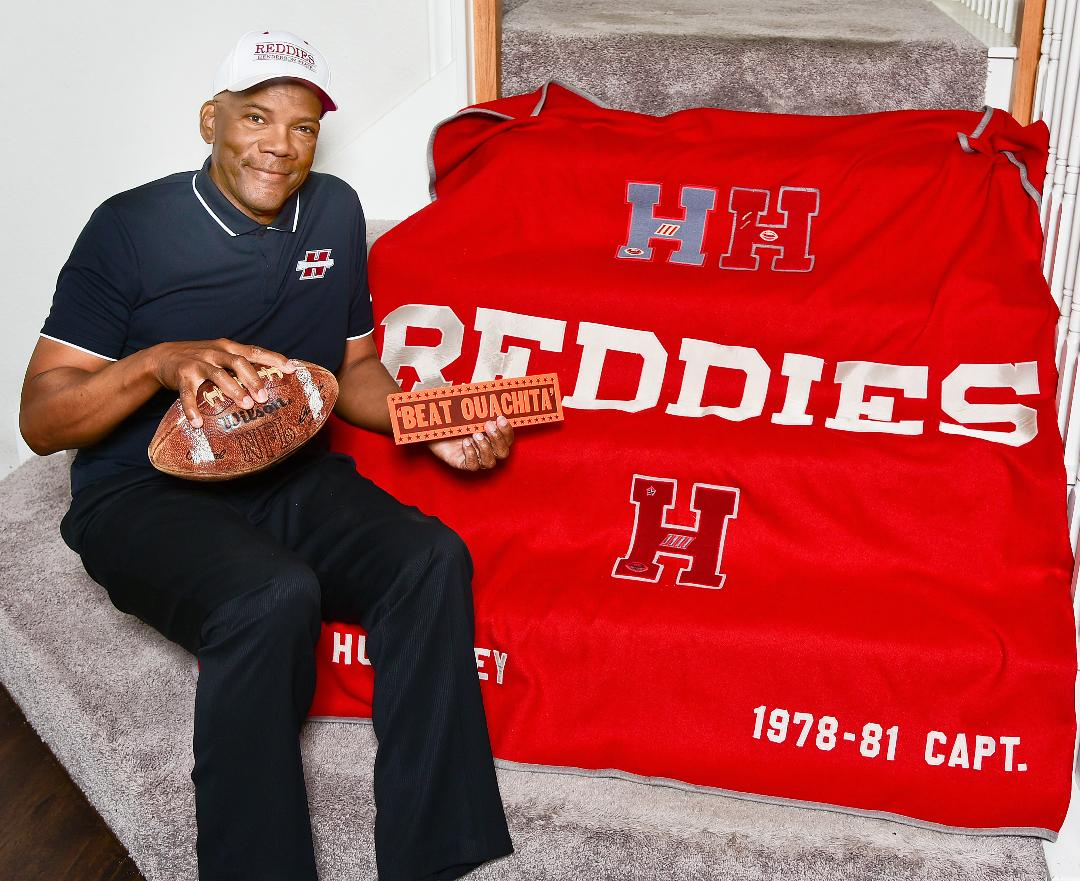
Former Henderson State University football player David Humphrey played in four Battle of the Ravine games. All four were decided by 7 points or less. | Courtesy photo
By DAVID HUMPHREY | Special to arkadelphian.com
The Battle of the Ravine. Henderson State University vs. Ouachita Baptist University. A football rivalry between collegiate neighbors.
It’s a walking-distance affair as the schools are a narrow highway apart in Arkadelphia, Arkansas, a city of approximately 10,500. It’s one of the most unpredictable and colorful games in sports history. All sports. This game has drawn national attention because of the proximity of the schools and its intensity.
The 98th meeting will be held Saturday, Nov. 15, 2025, at OBU. Next season is at HSU, and the milestone 100th meeting is in 2027 at OBU.
I played in four of these games from 1978 through 1981.
My record: 2-2. My path to 2-2 was as follows:
1978: Won 7-6
1979: Won 28-21
1980: Lost 28-21
1981: Lost 17-13
Historically, the games are close.
My freshmen season was an eye-opening experience simply because you never get a second chance to make a first impression. It was a home game at Carpenter-Haygood Stadium, which has a listed seating capacity of 9,500. It was built on a hillside. When all the seats are taken, fans sit on the grassy hills or stand around the track that encircle the field. The “overflow crowd” description is a catch-all term applied to many of these games. Reality shows the crowd can total 12,000 to 15,000-plus. Real numbers. No exaggeration. That means if you’re in town and breathing, you’re at the game.
The atmosphere and importance of the game came slowly, but clearly, to me as a freshman. The Battle of the Ravine was the final game of the regular season, normally on the second or third weekend in November. I was asked about this game more than any other. Even professors who had never acknowledged me as a football player all semester would ask if we were going to beat Ouachita.
During the week of the 1978 game, someone put purple dye in the HSU water fountain leading into the campus. That was new to me, but I found out later it was to be expected. There were other things that I didn’t see, such as some kind of marshmallow drop on the OBU campus. Henderson has the only four-year Bachelor of Science degree specifically in aviation in Arkansas. You can do the math on that one.
Most players attended the pep rally and the senior blanket ceremony. It was a nice ceremony, and one that I would participate in years later as a senior. My football blanket remains one of my most treasured sports awards. At practice, the veteran players who talked the most were quiet and the players who were outspoken didn’t say much. That was strange. Also, there were few, if any, new plays or trick plays installed. This game is played on effort, pride and a heavy dose of hostility.
In the 1970s, we had an athletic dorm, Goodloe Hall. The football players were on the second and third floors. My room, which I shared with fellow freshman Joe Flemons, was on the third floor. Goodloe Hall had fire escapes on each end for safety reasons, but they could be used for late-night runs in and out of the dorm. There are some interesting stories involving those fire escapes, but that’s for another day.
During the night before the game, some of the assistant coaches and managers walked the halls in the dorm. The assistant coaches had never walked the hallways before the previous home games. We would see some of the managers, but not the coaches. We had a curfew as most teams do. However, the campus security officers patrolled the parking lots and drove in circles around the dorm. There would be no sneaking out the night before the OBU game. We were safer than the President of the United States.
It rained early in the week, but the cloudy November gameday had a smattering of sunshine on the natural grass field.
Then came the game and the crowd.
I never gave any thought on how OBU got to the game. They simply walked across the street in uniform without their shoulder pads on, just as I would do the next season. Travel time? Maybe 5 minutes. Thus, it’s the shortest documented college football road trip on record.
Another unique facet of this rivalry was that both schools shared homecoming in the same game. Two queens and two courts. I had never heard of a double homecoming before that day or since those days.
With the added pomp and circumstance, the stadium was full during warm-ups.
After the HSU band lined the hilly entrance to the stadium and played the school fight song, marching to their spot in the stands. The pageantry faded and the game began.
We won 7-6. But nothing is easy in this rivalry.
It was a physical game because the hitting was personal. It was also a game full of talent. A total of 28 players on the rosters for the 1978 game received first-team, second-team or honorable mention on the coaches’ All-Arkansas Intercollegiate Conference team. It was basically an all-star game with only two schools represented.
The two most notable players were Henderson State defensive back/kick returner Roy Green and Ouachita running back William Miller. Both received All-America honors and would have successful pro football careers. In the spring, Green was drafted in the fourth round by the then-St. Louis Cardinals. He would become an NFL superstar as a two-time All-Pro and Pro Bowler. Miller signed with the Atlanta Falcons before heading to the Canadian Football League and earning rookie of the year and later All-Star honors with Winnipeg.
True to form, the game lived up to the hype. In the run-oriented ‘70s, plays were sent to the huddle by the players. No standing up and waiting on signals from the sideline as in today’s game. Tony Lewis, also a freshman, and I alternated at wide receiver unless we were in the game at the same time at flanker and wide receiver depending on the formation. That meant talking with head coach Ralph “Sporty” Carpenter or offensive coordinator George Baker on the sideline and delivering the play to quarterback Gary Lewis in the huddle.
Coach Carpenter was known for his tough, straight-talk language. He often used language that was for an adult-only audience. Coach Baker was also direct, but not with all the asterisks that coach Carpenter used. They both coached hard and thus the team played hard. It doesn’t take long to go from boys to men when you play football at HSU.
Anyway, back to the game.
After a scoreless first half, Paul Robinson’s touchdown run and Randy Hornbeck’s extra point gave us a 7-0 lead. We missed a field goal attempt with 1:25 left in the game that would have made it 10-0. OBU drove down the field and scored on a pass play in the final seconds. Indicative of the rivalry’s take-no-prisoners mindset, the Tigers chose to go for a two-point conversion and the win.
They failed. Linebacker Ned Parette knocked down a pass at the goal line. Game over.
We finished with a 7-2-1 overall record and 4-1-1 in conference play. No playoffs, but we beat OBU (8-2, 4-2).
That’s just a peep inside this rivalry from one player’s first-hand experience.
It’s a great game. A Super Bowl of sorts. One of the greatest sporting events on any level. Some observers say it’s the best small college football rivalry in America. Personally, I would drop the words small college football. It’s simply the best rivalry.
You have to see it to believe it. Or play in it.
David Humphrey is a 1982 graduate of Henderson State University and a retired trailblazing sports editor. He was a four-year letterman in football and track, a three-time All-AIC (1979, ‘80, ‘81) honorable mention wide receiver, and an Arkansas Democrat second team All-AIC (‘81) selection. He was one of the first black sports editors at a daily newspaper in Arkansas in 1982 at the Malvern Daily Record and gained national recognition in the 1990s when he was promoted to executive sports editor at the Austin (Texas) American-Statesman, one of six black sports editors at a major daily newspaper in the United States at the time. His distinguished 36-year career includes the Fort Worth Star-Telegram (NFL editor/Deputy sports editor) and The Orange Leader (assistant sports editor). A notable alumni, Humphrey is a member of the H-Club, the Reddie Club and recipient of the school’s 2024 Outstanding Black Alumni Award.
Discover more from
Subscribe to get the latest posts sent to your email.