By JOEL PHELPS | arkadelphian.com
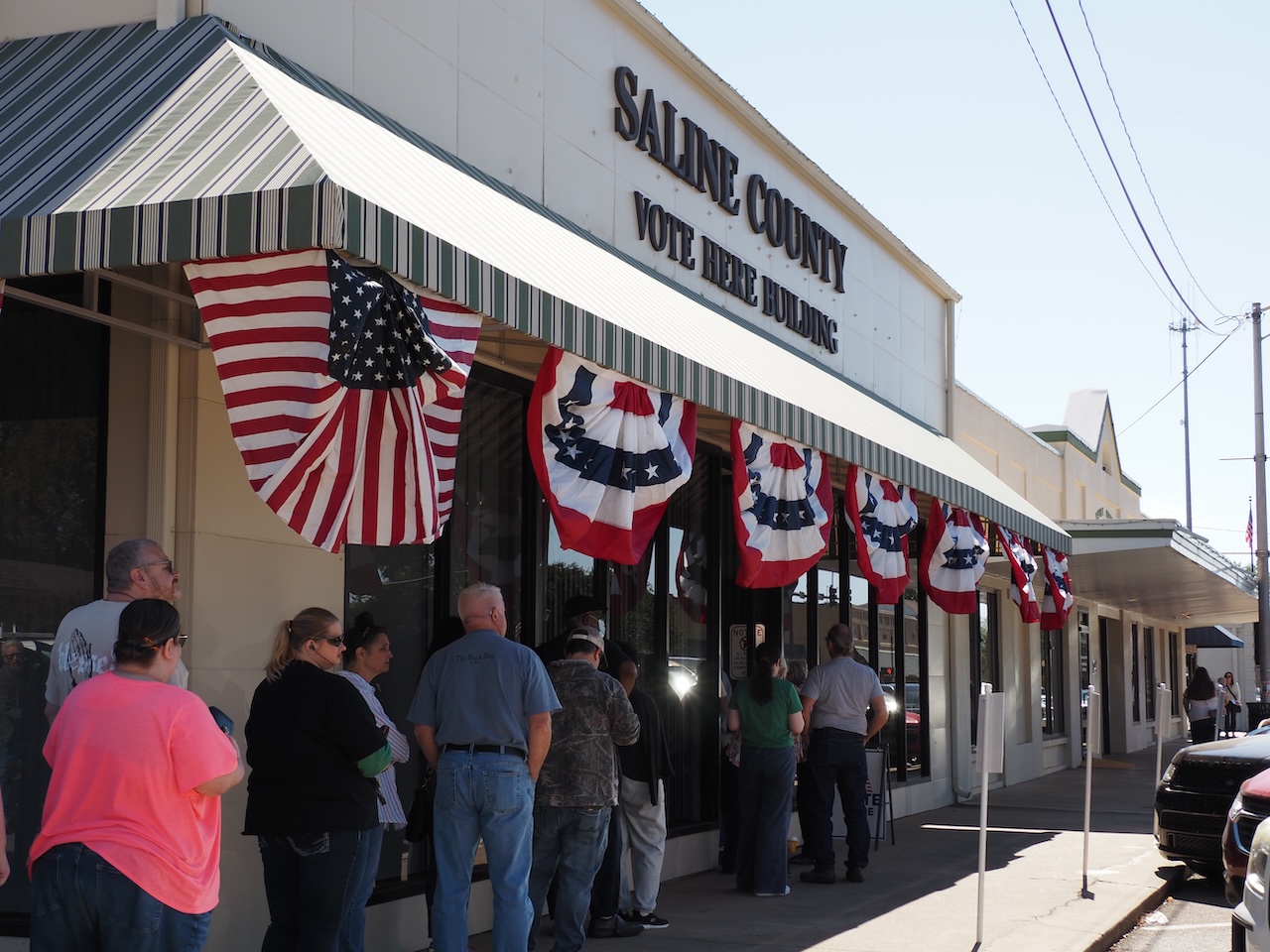
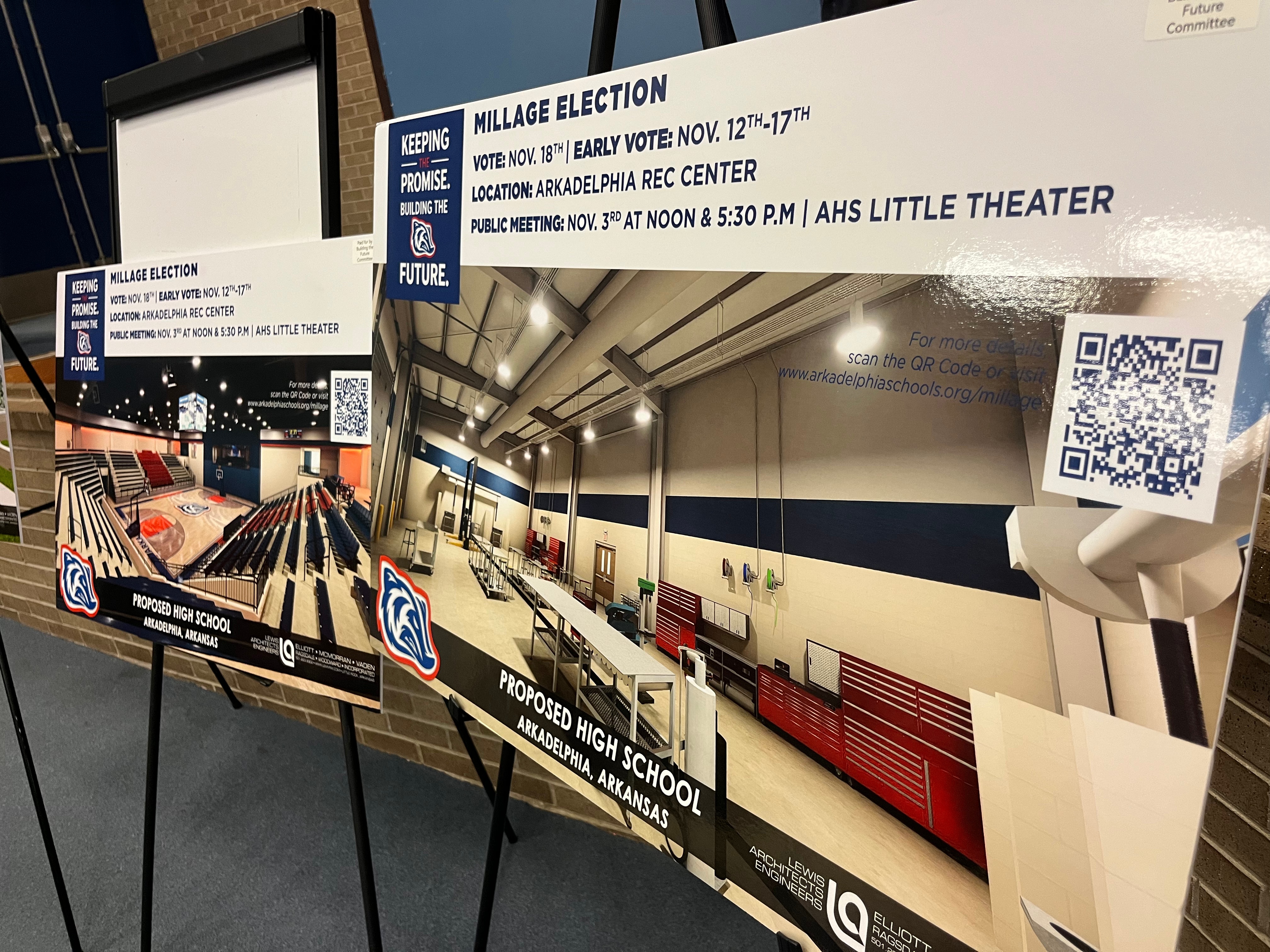
ARKADELPHIA, Arkansas — A decision about whether local voters support a millage increase to build a new high school will be finalized during a special election in mid-November. Ahead of that election, district administrators and school board members are getting their message across using social media and addressing civic club organizations. On Monday, Nov. 3, the school board held a pair of community informational meetings at Arkadelphia High School, coupling each session with a Q&A segment in which attending citizens could participate.
Using a PowerPoint presentation, Superintendent Nikki Thomas began each meeting highlighting the main arguments in favor of the proposed 3-mil increase — namely, the school’s failure to meet the state’s Warm, Safe & Dry requirements that include poor building conditions and the “safety nightmare” of entrances numbering in the teens and a maze of hallways that were likened to The Shining’sinfamous hedge maze. The building’s HVAC, plumbing and electrical systems are failing, and its flat roofs are constantly leaking and in need of repair, Thomas said. To make all the needed repairs would cost between $16-19 million, but still wouldn’t satisfy state requirements, she added.
State partnership funding to build a new school equates to $19 million, but it’s only available to the district if it can garner the public’s support for a millage increase that would cover another $37 million, or roughly 60% of the overall $62 million the district would use to build. The district would chip in $6 million from its own existing building funds.
What proponents say
The measure has gained momentum in recent weeks. The Arkadelphia Alliance and Chamber of Commerce announced publicly its endorsement for the millage proposal and subsequent new high school.
In a Monday news release, the Chamber of Commerce called the project a “significant investment” for the community’s future.
“Our schools are a cornerstone of our community and a key driver of local economic growth,” said Shelley Short, CEO of the Alliance and Chamber. “A new high school not only benefits our students, it strengthens our ability to attract new families, businesses, and workforce talent to Clark County.”
To that end, school board member Gina White said the old high school has acted as sort of a repellent in recruiting prospective manufacturers to the area, as economic development officials typically avoid showing prospects the local high school — a facility that prospects want to see more than most other attractions and facilities, White said.
Although not scientific, a reader poll suggests that the millage has voters’ support. A poll published last week by arkadelphian.com asking how district voters will decide in the election indicates that the measure would pass with about 63% in favor.
What opponents say
There is no known organized opposition to the issue, though vocal opponents have taken to social media to air concerns and raise questions. Some opponents spoke up during Monday’s Q&A session.
A fact sheet put together by the University of Arkansas Division of Agriculture Public Policy Center notes that opponents of the measure say they’re taxed enough already. Clark County was among 19 Arkansas counties that underwent a reappraisal process this year. Property owners in Clark County will see a 37.03% increase on their tax bill come 2026.
Opponents say the increase in property taxes comes too soon for yet another increase in their personal expenses.
Opponents also argue that the school district should rely on that reappraisal to secure funding rather than ask for a millage increase to pay for new facilities.
And, those against the measure say the district should dial back on some of the new school’s features — notably a covered practice field that’s included in the proposed blueprints and costing up to $4 million of the overall price tag.
Questions & Answers
Each of Monday’s meetings drew about 25 citizens, with a handful of them making inquiries or arguments during the Q&A segment.
Among the questions posed was whether the millage would have a sunset clause removing it from the tax charge once the debt has been repaid in 32 years. The millage would sunset once the debt is paid off, but whether it continues hinges upon the school board at the time the debt is paid, said Jason Holsclaw, a representative of Stephens Inc., the investments bank that would finance the project.
“A lot can happen in a 30-year period,” Holsclaw admitted. “If you did nothing [to extend the millage], it will sunset, it will go away.” One person said later that he worried the millage increase would be perpetual, as he had not seen any proposal to sunset the millage once the debt is paid.
One opponent took issue with the $19 million offer from a state that boasts a $1 billion surplus. Until the state is willing to foot half the bill, the resident said before he exited, he will oppose the millage.
One person voiced concern for higher property taxes — even without improvements to his homestead — to pay for high-end facilities. Another asked if the district has “to be so extravagant” in its facility plans.
Worried that locals will stop dining out, a restaurant owner chastised the board for asking for an increase in property taxes when residents are already strapped for cash. “It’s a bad time to be looking for extravagances. You need to scale it back,” said the restaurateur. He also complained that, in the eight years since he moved here from Tampa, Florida, repeated taxation has made him question whether his move to Clark County was in his best interest financially.
Proponents had their say, as well, arguing that it’s a good idea to add a covered pavilion — a $3-4 million add-on to the overall blueprint — in order to avoid costly litigation from heat-related sports injuries. Another said that building nicer facilities is what it takes to remain competitive as a district hoping to attract and retain stakeholders.
One proponent, a teacher, called on opponents to consider the modern student’s needs, calling the “bare-minimum mentality” “selfish”. Another urged voters in the district to “look beyond today” in making their decision, as while students constitute about 20% of the overall population, they’re “100% our future.”
New AHS features
In terms of safety measures, the new AHS campus would have modern access control, cutting off access to former staffers and having fewer entry points, Thomas said.
Classrooms would be stacked along each side of a single, two-story hallway.
Single-use restrooms would curb students from fighting or vaping, Thomas said.
A fine arts auditorium would seat up to 600 people — enough to fit AHS’s current student body (of about 575) and allow for student acts such as plays and band performances.
A Career Education Center would incorporate agriscience courses for students to learn trades like engine repair, electricity, welding and construction.
A covered practice pavilion with a 60-yard turfed field would give band, JROTC, cheer, dance and athletics to practice out of the weather.
An athletic arena would have seating for up to 1,800, allowing the district to host regional and state tournaments. The arena would also provide the district a place to hold graduation ceremonies (commencements are currently held at one of Arkadelphia’s two universities).
If the millage passes
Should voters favor the millage increase in the upcoming special election, Thomas said construction on the new AHS could start next summer, with an estimated completion target of 2028, ahead of that fall semester’s start.
If it fails
Without voter support of the millage increase, the district loses its state partnership funding, Thomas said, adding that the district would still be required to submit a facilities replacement plan.
School board president Blake Bell warned that AHS students “will not have a school to go to in Arkadelphia” if the state were to enforce its warm/safe/dry requirements and the district were unable to erect a new campus.
Asked if the school board has a backup plan should the millage fail, Bell said the board would “go back and completely regroup” and “do everything possible to get the next best thing.”
The district has until May 2026 to accept or decline the state partnership funding.
Discover more from
Subscribe to get the latest posts sent to your email.